

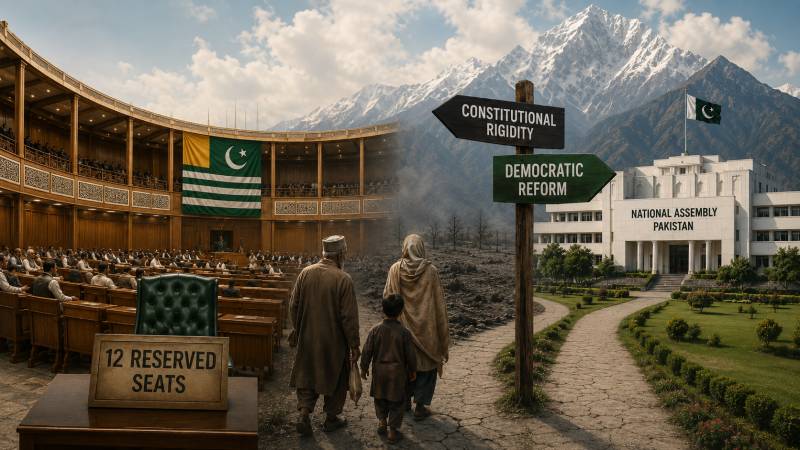
The debate over the twelve reserved seats for Jammu and Kashmir refugees in the Azad Jammu and Kashmir (AJK) Legislative Assembly has increasingly been presented as a choice between constitutional fidelity and political expediency. Supporters of the seats argue that they are rooted in history, equality, and the broader Kashmir cause, and that their abolition would undermine both refugee rights and Pakistan's longstanding position on Jammu and Kashmir.
This framing, however, obscures an important distinction. The real question is not whether displaced Kashmiris deserve political representation. It is whether the current arrangement of twelve reserved seats in the AJK Legislative Assembly is constitutionally immune from amendment.
It is not. Nor does reform require political exclusion.
The principal weakness in the argument for constitutional permanence lies in its conflation of rights with institutions.
Refugees recognised as state subjects enjoy the same fundamental rights as other citizens, including equality before the law, participation in public affairs, and protection against discrimination. Yet these rights do not create a perpetual entitlement to a particular electoral arrangement. Reserved seats are constitutional mechanisms established to advance specific political objectives. Like other constitutional institutions, they remain subject to constitutional amendment unless expressly protected from revision. The abolition of a reserved category of seats would alter a method of representation without affecting refugees' underlying rights as citizens and state subjects.
The AJK Interim Constitution itself recognises this distinction. Article 22 establishes the composition of the Legislative Assembly, while Article 33 provides the mechanism for constitutional amendment. Nothing in the Constitution expressly places the refugee seats beyond that process.
Indeed, the recent advisory opinion of the AJK Supreme Court appears to reinforce this principle. While rejecting attempts to alter the Assembly's composition through executive action, the Court nevertheless identified constitutional amendment under Article 33 as the proper legal avenue for any such change. Had the refugee seats been constitutionally immune from amendment, there would have been little reason to identify Article 33 as a viable route at all.
Neither history nor equality establishes constitutional permanence. Historical significance may strengthen the political case for preserving the seats, while equality guarantees equal citizenship rather than perpetual entitlement to a particular representative arrangement. Many constitutional institutions possess deep historical roots, yet remain subject to revision through the very constitutional processes that created them.
The strongest argument for retaining the seats is therefore not legal but symbolic. Supporters contend that refugee representation reflects the unity of the former State of Jammu and Kashmir and reinforces the political claim underlying the Kashmir dispute. This argument deserves serious consideration.
Yet symbolic significance alone does not transform a constitutional arrangement into an unamendable principle. A constitutional order may continue to affirm the unity of Jammu and Kashmir while adopting different mechanisms of representation. The Kashmir cause does not logically depend on the continued existence of twelve reserved seats in the AJK Legislative Assembly.
Nor does democratic theory necessarily favour the permanence of the current arrangement. Critics of reform often point out that AJK's constitutional framework reflects a continuing claim to the entirety of the former State of Jammu and Kashmir. That is true. Yet representative institutions must also operate within practical constitutional jurisdictions. The question is whether a symbolic commitment to territorial unity requires permanent legislative representation for populations residing outside AJK itself. Reasonable people may disagree, but it is clearly a matter of constitutional design rather than constitutional necessity.
The urgency of that question has increased in recent months. The continued controversy surrounding the twelve refugee seats has complicated efforts to achieve durable constitutional and electoral settlements within AJK, while also affecting public confidence in the Assembly's representative character. Whether one supports retaining or abolishing the seats, the issue has become too consequential to be treated as permanently beyond debate. It should instead be addressed through constitutional reform and democratic consensus.
If Pakistan believes that the political participation of displaced Kashmiris remains essential to sustaining its position on Kashmir, there is a compelling alternative. Rather than maintaining twelve reserved seats in a legislature whose primary responsibility is governance within AJK, refugee representation could be incorporated into Pakistan's parliamentary framework through representation in the National Assembly or another constitutionally established mechanism.
Such an arrangement would recognise an important constitutional reality. Pakistan, not AJK, bears primary responsibility for advancing the Kashmir case internationally. The case for locating refugee representation within Pakistan's national institutions is reinforced by the broader division of responsibilities reflected in the 1949 Karachi Agreement, under which external affairs relating to the Kashmir dispute were assumed by Pakistan.
This approach would preserve meaningful representation for displaced Kashmiris while addressing growing concerns about democratic representation within AJK. The Legislative Assembly would move closer to the principle of territorial representation, while refugee communities would continue to enjoy a recognised political voice at the national level.
Far from weakening Pakistan's position on Kashmir, such a reform could strengthen it. It would demonstrate that refugee representation is not being abolished but modernised and integrated into the institutions responsible for shaping and projecting Pakistan's policy on the dispute.
The choice is therefore not between permanent refugee seats and political exclusion. Constitutional democracies regularly adapt institutions to changing realities while preserving representation for affected communities. The real question is not whether displaced Kashmiris should remain politically represented, but whether the AJK Legislative Assembly remains the most appropriate constitutional forum through which that representation should be exercised.