

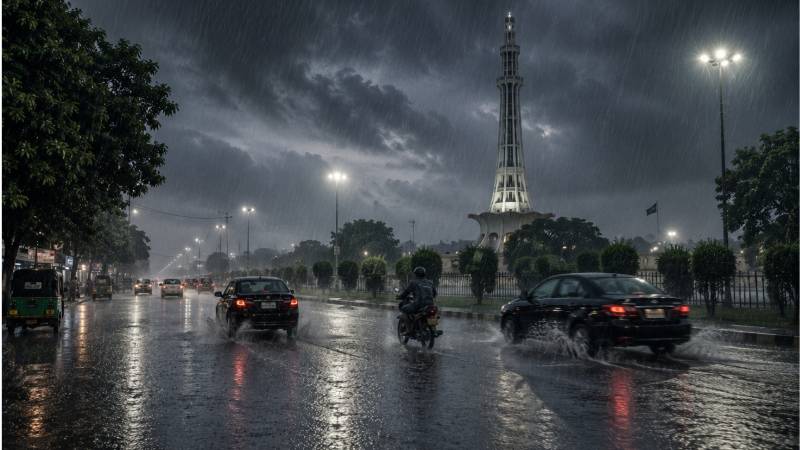
There is a rule you learn in the first month of a planning job, and it is not a clever one. You cannot order a thing on the day you need it. Between signing the purchase order and seeing the pallet on your floor sits the lead time, and the lead time does not negotiate. If a roll of imported material takes ninety days to reach Karachi, the decision about September was made in June, whether or not anyone in the room understood they were making it.
I plan raw materials for a factory in Karachi. The work is unglamorous. You take a forecast, subtract what is in the warehouse, add the lead time, and the arithmetic tells you when to buy. Get it wrong, and you pay twice. Once for the freight. Again, in the price a supplier quotes to a buyer who has no time left to argue.
I have been reading the NDMA advisories this month with that arithmetic running in my head. Since 6 July, there has been a steady run of them: flash flood warnings for hill torrents, landslide alerts across Gilgit-Baltistan and Azad Kashmir, urban flooding warnings for low-lying Punjab. The Met Office called the onset back in June for the first week of July. NDMA had already told tourists to stay out of the northern valleys between 25 June and 30 July. As of the first week of this month, the season had killed seventeen people and damaged eighty-eight houses, which is the number that always looks small in July.
Last year, it looked small in July too. By the time the 2025 season closed, more than a thousand people were dead, roughly 6.9 million were affected, and some 2.8 million were evacuated. Punjab had its worst riverine flooding in decades. Karachi received 163 millimeters of rain in a day on 19 August, the heaviest rainfall since 1979. The FAO costed the agricultural damage at around 1.23 billion dollars across Punjab, Sindh, and Khyber Pakhtunkhwa.
So we knew. We knew in May. We knew in 2025, 2022, 2010, and every year before that. The monsoon arrives in roughly the same eight-week period each year and has done so for as long as anyone has bothered to count in planning language that is not a demand shock. It is a seasonal peak inside a known window, and the correct response to a seasonal peak is to have the stock sitting in the warehouse before it opens. We do not do that. We buy in the middle of it.
There is a number from last September that should be pinned above every procurement desk in Islamabad. Between 28 August and 4 September 2025, at the height of the flooding, wheat flour prices rose by about 25 percent. One week. That is what an emergency does to prices, and it does the same thing to tents, tarpaulins, dewatering pumps, and trucking. The moment everybody in the market needs the same item on the same Tuesday, the buyer stops setting the terms.
The monsoon arrives in roughly the same eight-week period each year... It is a seasonal peak inside a known window, and the correct response... is to have the stock sitting in the warehouse before it opens.
Now look at what the Auditor General found. The AGP's 2023-24 report raised audit objections worth Rs28.62 billion against the NDMA. Buried in that figure is a line that deserves to be read slowly by anyone who has ever run a tender. The auditors flagged the mis-procurement of family tents on a pre-qualification basis rather than through open competitive bidding, which they costed at Rs4.829 billion. They found a further loss of Rs2.58 billion from tents bought without technical evaluation. The purchase of winterized and shelter tents, they held, breached PPRA rules.
Hold that Rs4.829 billion next to something from this year's budget. The climate change ministry secured Rs2.4 billion under the PSDP for the entire financial year that began on 1 July, to work on flood resilience, drought, urban flooding and ecological restoration. The loss the auditors attributed to a single badly timed tent purchase is roughly twice the annual development budget of the ministry whose job is to prevent the emergency in the first place. We are not short of money for preparedness. We are spending it, at the worst possible price, six weeks too late, and calling it relief.
Read the audit finding as a buyer rather than as an auditor, and it says something quite specific. Pre-qualification, rather than open bidding, is what you do when the calendar has run out on you. It is the reflex of somebody who needs stock this week and will take whatever the shortlist can physically deliver. Skipping technical evaluation is the same instinct wearing a different hat. At that point, you are not buying the right tent. You are buying the available tent and writing the justification afterward.
I have seen that call myself, on a much smaller scale, and it always costs money. The difference is that when a planner in private company do it, a production line runs late. When the state does it, a family in Rajanpur sleeps under a sheet that does not fit the frame.
The strange part is that the policy already exists and keeps being rewritten. The NDMA's National Disaster Management Logistics Stockpile Instructions of 2023 describe, more or less, the system a planner would design. Warehouses in tiers, from district up through provincial to national. Minimum stock scales for tents, tarpaulins, blankets, hygiene kits, and dewatering pumps, set against provincial population. Districts are expected to carry themselves before provincial stock moves. On paper, it is a safety-stock policy with reorder levels attached. This year, it has been joined by the National Disaster Response Plan 2026, which promises a scalable incident command system and an integrated resource mobilization strategy.
The 2022 season shows what follows when nobody does. By 25 August that year, with 33 million people affected, the NDMA and the provincial authorities had distributed 167,822 tents and 84,580 tarpaulins. Put those two numbers beside each other—one tarpaulin for every two tents. If you were provisioning against need, you would expect the tarpaulin figure to be the larger of the two, because tarpaulin is what you give the families you cannot give a tent to. That ratio does not describe a plan. It describes what the market was holding that month. None of the fixes require a new authority or a fourth strategy document. They require some ordinary purchasing habits.
Start with a rate contract signed in the dry season. A framework agreement fixes price and specification in February, when three suppliers still want your business, and lets you call off quantities later against that price. You are not buying a hundred thousand tents in February. You are buying the right to buy them at February's price, from a supplier who was technically evaluated while there was still time to evaluate anybody. Every serious private buyer in this country does this for seasonal items. There is nothing exotic about it.
Then reserve capacity, not only stock. A tent factory can produce so many units a month and no more. If the state has booked a share of that monthly output in advance, it takes priority in the queue rather than bidding against the UN agencies, NGOs, and four provinces for the same shift.
Then hold the district tier honestly. The 2023 instructions already say districts should carry stock. Whether they do is not published anywhere a citizen can check. The NDMA reports what it distributed after a disaster in daily situation reports, down to the level of livestock. It does not report, before the season, what is actually sitting in the Jamshoro or Muzaffargarh warehouse against the scale that its own policy demands. A single disclosure of that kind, published every May, would do more for preparedness than most of what gets announced in July.
And treat the lead time as the deadline it is. If a tarpaulin order takes ten weeks from award to warehouse, the last honest date to place it is the last week of April. Not the week the river rises. This year's budget documents tag allocations for climate and disaster for the first time in this form, which is a real improvement in transparency. But a tagged rupee is not a purchase order. Money identified in June for a hazard that peaks in August will go to the same supplier, on the same Tuesday, at the same price as everyone else.
Mohammad Ehsan Leghari argued in these pages this week that preparedness cannot wait for the storm, and he is right about the hydrology. I would only add the boring half of his case. Preparedness has a purchase order attached, with a date by which it must be signed. Readiness that is not on a calendar is a sentiment.
When the water came, what people needed in the first week was not a strategy. Instead, they needed a sheet of tarpaulin big enough to keep the rain off, delivered to the right village, on the right day. Whether it arrived at all depended on a decision taken by a buyer in an office in Islamabad, months earlier, during dry weather, when nothing felt urgent.