

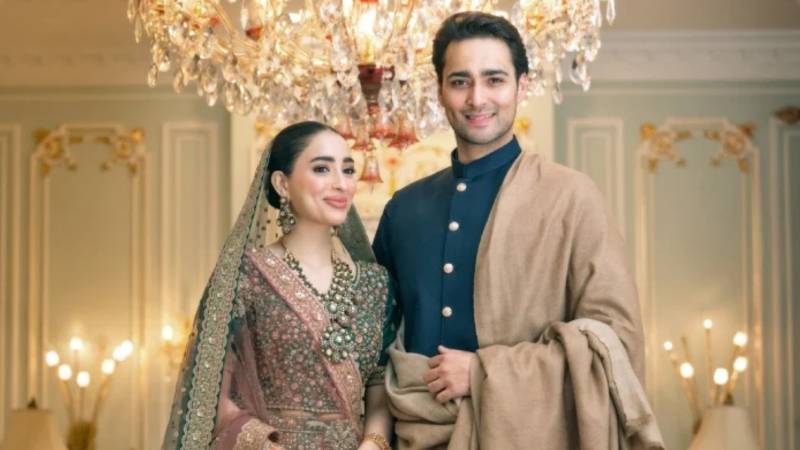
As the wedding of the season culminates and the scion of the Sharif family finds himself a new bride, social media is abuzz with glamorous photos of not just the bride and groom, but also the women in the groom's family, particularly his mother, the Chief Minister of Punjab, Maryam Nawaz Sharif.
Wearing an exquisite outfit at each function and sporting designer accessories, including a much-celebrated Valentino bag worth a combined 58 lac rupees according to wenews.pk, the Chief Minister was a sight to behold. The price of the bespoke jewellery is, of course, not included in this figure, and would undoubtedly be several multiples of that amount, as it seemed to be created exclusively to match the outfits. Gold, diamonds, and other gems were on display in abundance, as if the wedding were not that of a public servant's son, but of blue-blooded royalty.
Politically polarised as our country is, this led to two extreme reactions. Many from the PTI criticised not just the flagrant display of wealth, which is a legitimate critique, but also did not hold back from body-shaming or making derogatory comments about women's looks, which were in poor taste and completely unnecessary. On the other hand, there were PML-N supporters insisting that there is nothing wrong with this ostentatious exhibition, and that if their leaders are rich, they have every right to flaunt it.
What resonated most with me, however, was a tweet by Ihsanullah Tipu Mehsud, who wrote: “Pakistani masses and rulers live in two completely parallel worlds—one struggles for survival, the other for projecting status.”
I couldn't help but think of those words repeatedly. They were so true. Pakistan is a country where at least a quarter, if not a third, of the population is downright poor. Many lack access to basic amenities. The per capita income in Pakistan is around $1,500. And the rich definitely do not pay their fair share of taxes, thereby burdening those on a salary to shoulder the lion's share of the income tax burden, with the remainder collected by regressive indirect taxation, which affects rich and poor equally instead of proportionally.
In these circumstances, one would think that if the rich did spend in vain (and certainly the Sharifs aren't the only family guilty of this), then they would at least not show off about it. But in the age of social media, even PML-N's official accounts were tweeting wedding videos, without regard to how disconnected from the people this appears. After all, they are public representatives, not some random wealthy business house.
The rich have a right to live their best life, they say. I agree. But the tax authorities have an equal right to question them, and in the case of public representatives, so do average citizens
It was, in fact the Sharifs who had imposed on Punjab the rule of one dish at weddings, ostensibly to champion the cause of simplicity at marriage functions. Not only are their own weddings flamboyant, but they also broke the very law they have forced upon others. Copies of Junaid and Shanzeh's Mehndi dinner menu have been circulating online, and it appears guests were fed chicken and prawn tempura as a starter, followed by several other dishes and food stations to sample. This left the poor PML-N social media team flustered, as they first claimed there was only one dish served, but later argued that, as the function was at a farmhouse, the one-dish rule did not apply.
This law is yet another example of the parallel worlds of the rulers and the ruled. Why should those who live in large farmhouses big enough to host wedding celebrations be exempt from the one-dish rule while others have to adhere to it? What purpose does this law serve anyway? If simplicity is the goal, shouldn't there be a curb on overall expenditure at weddings, with no exemptions for anyone?
Or better still, shouldn't we just let everyone do as they please and enjoy their weddings as they deem fit, just like the PML-N supporters have been advocating over the last few days? Except perhaps we could impose extra taxes on wedding dresses that cost more than 5 lac rupees? Perhaps do the same for extravagant décor and lavish food? I mean, sure, rich people can spend their money, but maybe they should help the exchequer a bit too while fulfilling their whims. Speaking of taxes, maybe the FBR should be particularly vigilant when the rich splurge on weddings and when the fashion designers, jewellers, and event managers luck out.
To top it all off, what shall we do about the rich and famous for whom no Pakistani designer is good enough, and who must make a special shopping trip to Dubai to look for Indian outfits and jewellery? Should Tarun Tahiliani and Sabyasachi dresses be subject to import taxes? I would hope so, particularly when these outfits are paid for in foreign exchange. Shouldn't the consumers be questioned about the source of the foreign exchange? Are these Indian dresses being purchased from foreign exchange taken out of Pakistan or from bank accounts in Dubai? If from foreign accounts, are those accounts declared on Pakistani wealth statements/tax returns?
The rich have a right to live their best life, they say. I agree. But the tax authorities have an equal right to question them, and in the case of public representatives, so do average citizens.