

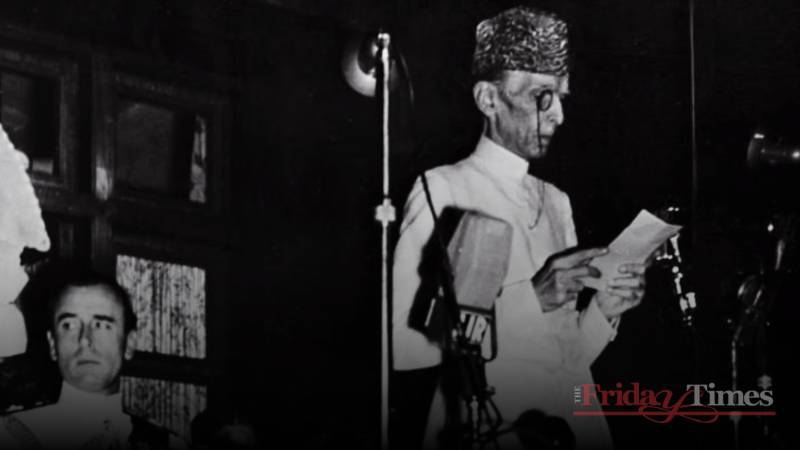
The people of Pakistan recently marked the nation’s 78th birthday, celebrating with their traditional love and devotion to the country. The elite, however, blended their claims of patriotism with a somewhat insincere commitment to the ideals of Muhammad Ali Jinnah and loyalty to the country founded by him. The ruling class has been reiterating these pledges and commitments rhetorically every year since August 1947. Being only two years younger than Pakistan, I have grown up with it. I served it to the best of my ability for over 30 years and will, hopefully, embrace its earth on my final farewell. This land gave me everything – shelter, education, career, dignity and a good life. Thank you, Muhammad Ali Jinnah.
Mr Jinnah spent his whole life fighting a pitched battle to secure the future of the Indian Muslims. He fought this battle on three fronts: with the British administration – to convince it of the truth of his political stance; with the All India Congress – to thwart its tough resistance to his demand for a constitutional system in which the Muslims felt politically and economically secure; and with the Indian Muslim nationalists – to silence their opposition to his political agenda. At the same time, he mobilised and rallied the despairing Muslims around his struggle for a separate country in Muslim-majority regions. This hard struggle had, indeed, consumed his life. He lived hardly a year in his dreamland for which he had staked his personal and family life, comfort, career, health, wealth and property.
A well-known theocrat and political leader once tauntingly stated that Mr Jinnah was making Pakistan with a bunch of sham leaders. I wonder how pathetically prophetic he was. Truth filters out of falsehood. Everything has now come out of the heap of lies and deception. It is agonising to recollect what his successors did with this country. The flowers on his grave were still fresh when the direction of the country was changed by adopting the Objectives Resolution as the preamble of the constitution yet to be framed – to the greatest peril of Jinnah’s ideals, as enunciated by him in his address to the Constituent Assembly on 11 August, to see his Pakistan joining the comity of nations as a secular, progressive and modern state. This was the beginning of the agony of Pakistan.
We have left no stone unturned to disappoint the people of Jinnah’s dreamland during all these 78 years of independence
Since my conscious age, I have been travelling along with my land from hope to disillusionment. This has been an agonising journey wading through stinking puddles of treachery, betrayal and deception. What we did with this country in all these years is shameful. We made all kinds of experiments – drifting from one system of governance to another – from federal to quasi-unitary, from parliamentary to presidential, and back again to parliamentary rule. Our presidents – both civilian and military – from 1977 to 2008 – were vested with executive powers and treated elected prime ministers and cabinets as subordinates, dismissing and sending them home at the drop of a hat. We have unsuccessfully tried all forms of governance – from nominations to semi-elected, authoritarian, dictatorial and martial law regimes. Our travel from August 1947 to this day has ended at Form 47 and hybrid governance.
We have left no stone unturned to disappoint the people of Jinnah’s dreamland during all these 78 years of independence. The constitution framed by a bureaucrat-turned-politician, Chaudhry Muhammad Ali, was adopted and enforced in 1956 by the Constituent Assembly. It was culled by a dictator in October 1958. We witnessed the abrogation of the successive 1962 constitution in March 1969. The first ever general elections on the basis of adult franchise were held in the country in December 1970. The newly elected National Assembly was not convened to allow the victorious party – the Awami League of Sheikh Mujibur Rahman – to frame the constitution and form the government. We did not trust the Bengalis in state matters. Instead, we plunged the country into civil strife.
Dear Quaid, the civil strife ended in the loss of the bigger half of your dreamland in 1971. The Bengali nationalism, stirred by your declaration of Urdu as the single national language of Pakistan, metastasised into Bangladesh, leaving us with a disgraced and truncated smaller part. We did not learn a lesson from this historic humiliation and disgrace, and continued with our political and economic blunders. We imposed martial law in July 1977. We hanged the elected prime minister in April 1979 after a mock judicial trial. He was the architect of the current parliamentary form and the unanimously adopted 1973 constitution, which has withstood two martial laws, two suspensions, and many mutilating amendments – holding the federation of Pakistan together despite strong political, economic and administrative fault lines.
Dear Jinnah, federations prosper within a constitutional political system marked by provincial autonomy, representative governance, and a just and fair division of political powers and economic and financial resources. We did not have any enduring political stability in the new Pakistan after the secession of Bengal. The outcome of the successive eleven general elections held in the country from 1970 to 2024 has not been accepted by the mainstream political parties, who blame each other for colluding with the establishment in rigging elections and acquiring power. The anomalous and lopsided political and bureaucratic systems that we have, by design, constitutionally invented place Punjab in a dominant position to ruthlessly exploit the resources of the smaller federal units. This has been at the heart of the political instability in the federation.
The performance of the ruling elite – both in government and in opposition – has never been above board or geared to the public good. They show no qualms in filling their coffers when in power. We have witnessed paupers turn into billionaires. State institutions, including the bureaucracy, have been politicised and reduced to a cesspool of inefficiency and corruption. The National Accountability Bureau could investigate cases of corruption involving over Rs 500 million. Some 70 percent of our people are deprived of their basic constitutional rights – to education, health, clean drinking water, and protection of life and honour – on the 78th birthday of Pakistan.