

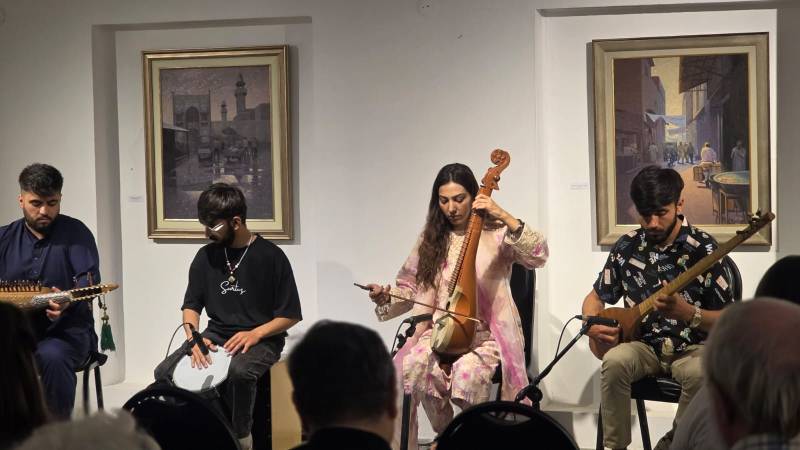
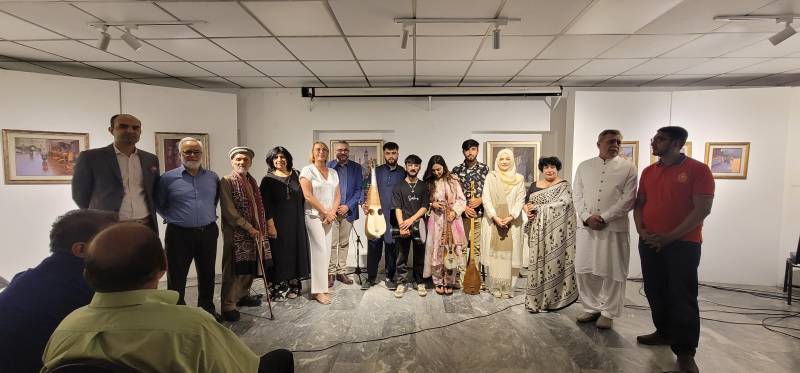
On Saturday, 19 April 2025, the Alliance Française de Lahore hosted a book launch for the recently published work of art historian Professor Dr Kanwal Khalid. The book, titled “Picture Wall of Lahore Fort: The Longest Mosaic Kashi Wall in the World,” provides a historical analysis of the Lahore Fort’s majestic Picture Wall, detailing its intricate frescoes, glazed tile mosaics, and filigree work. The event, organized in partnership with the Aga Khan Cultural Service – Pakistan (AKCS-P) and the Walled City of Lahore Authority (WCLA), concluded with an instrumental music performance by musicians from Hunza, aptly titled “Ishq-e-Lahore”—a celebration of history, art, and music synonymous with Lahore’s spirit.
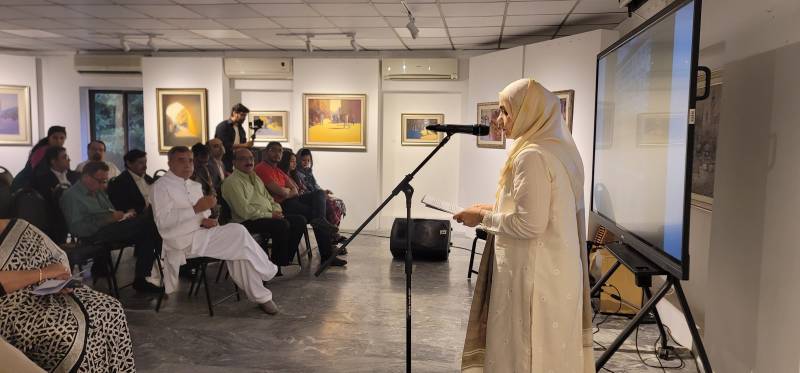
Fabrice Disdier, Director of Alliance Française Lahore, opened the event by emphasizing the wall’s historical significance. “This evening, we gather not just to launch a book but to reconnect with a 400-year-old masterpiece: the Picture Wall of Lahore Fort,” he said. “This monumental work of art, stretching 1,450 feet in length and standing 50 feet tall, is one of the largest and most intricate mosaics in the world. It is a treasure not only of Lahore but of humanity.”
Dr Kanwal Khalid then presented key highlights from her book, describing the Picture Wall as ‘one of a kind’ and the longest example of the mosaic Kashi technique, which she likened to assembling a jigsaw puzzle. She noted the lack of historical evidence on the wall’s structure despite its importance. “I mostly looked into traditional resources while researching this book since there was limited information shared by Mughal historians on the wall,” she explained.
Dr Khalid suggests that some patterns on the wall may represent musical notations. “These patterns that appear to be an embodiment of musical sounds are most likely to be the depiction of the audio of Mughal instruments,” she says. “Hence I say, let the wall sing!”
Her research uncovered the diverse influences in the wall’s designs, including European traditions, Iranian mythology, Judaism, Christianity, and Hindu mythology. She also highlighted depictions of animals and birds favored by the Mughals, sharing an intriguing detail: “There were tigers with blue spots visible on the wall, which one could perceive as an imaginary being. However, in one of the memoirs of Emperor Jehangir, it was narrated that a Monarch once presented Emperor Jehangir with a tiger whose fur had blue spots.”
Dr Khalid also suggested that some patterns may represent musical notations. “These patterns that appear to be an embodiment of musical sounds are most likely to be the depiction of the audio of Mughal instruments,” she said. “Hence I say, let the wall sing!”
Ms Aisha Khan, WCLA’s Deputy Director of Craft and Culture, praised the wall’s “exquisite depictions of flora, fauna, and geometric patterns, that are testament to the Mughal Dynasty’s unparalleled craftsmanship.”
Tausif Khawaja, CEO of AKCS-P, noted that the Picture Wall is a key reason for the Lahore Fort’s UNESCO World Heritage status. He described the conservation process as a collaborative effort involving engineers, architects, fine artists, archaeologists, drainage engineers, and project managers. “Each panel is designed after extensive meetings and discussions about what should be reconstructed and elements that should be left out,” he said.
Mr Khawaja announced that much of the wall has already been conserved, with completion expected by the end of 2025. “We plan to have a grand opening of the wall at the beginning of next year and will invite people from all over the world, as well as senior government officials, to mark the momentous occasion.”
The evening ended with a performance by musicians from Hunza’s Lief Larson Music Centre (LLMC), who played traditional instruments such as the Chitrali Sitar, Rubab, Xghini, and Dadang. Located within the Altit Fort, LLMC was established under the Aga Khan Music Initiative in partnership with the Royal Norwegian Embassy to preserve indigenous mountain music.
The event celebrated both Dr Khalid’s scholarly work and Lahore’s enduring cultural heritage, leaving attendees with a deeper appreciation for the Picture Wall’s historical and artistic legacy.