

Sindh’s e-challan system is a very good step taken by the provincial government to try and bring some order to Karachi’s chaotic and lawless traffic.
As expected, it has been roundly criticised, in particular by the ruling PPP’s political opponents, one of which, the Jamaat-e-Islami, has also gone to court over it. This was to be expected because, quite frankly, anything done by the PPP that is even remotely a good thing is often heavily criticised by many people, giving the impression that a lot of this criticism is merely for the sake of putting the party down.
Take the case of the newly introduced Traffic Regulation and Citation System, which is an automated AI-powered e-ticketing system launched in Karachi (and set to expand to the rest of the province) to detect traffic violations such as speeding, jumping traffic lights, and not wearing helmets, where violators will be issued fines digitally, along with proof of the fine.
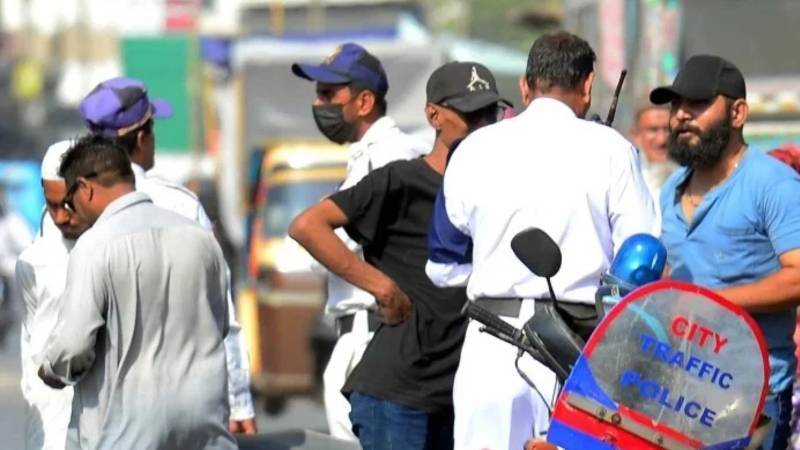
It has so far garnered heavy criticism, most of which has been unfair and not based on logic. But before we get into that, let’s take a look at Karachi’s traffic – anyone who lives in the city and uses its roads (as most citizens do) will attest that it has perhaps among the most chaotic and lawless traffic found anywhere in the world. The system is so bad that most motorists do not listen to the traffic police, and motorcyclists in particular are the most serious violators of traffic laws.
The situation is such that it is now downright dangerous for pedestrians to even walk on the sidewalks of roads, because in many instances, these are used by motorcyclists to cut through traffic jams. Furthermore, most of them jump red lights as if it were the norm, and they also, more often than not, go the wrong way in traffic. Unlike in Islamabad and Lahore, a majority of motorcyclists in Karachi do not wear helmets, and this is one of the main reasons why around 60–70% of traffic fatalities in the city involve motorcyclists who have not worn helmets.
The system is transparent, and in fact will reduce corruption at the level where motorists or motorcyclists felt that in the past they would have to pay bribes to traffic police to let them off
Checking the severe and rampant violations of traffic laws, as evidenced on Karachi’s roads, is common sense and would, in fact, be doing a public service to citizens, since it would reduce the danger to their lives when they travel on the city’s roads. So supporting the e-challan system should be a no-brainer.
Let us now examine the criticism against it, one by one. One argument cited in the petitions filed in the Sindh High Court against it uses suspect reasoning, in that it argues that the system should not be introduced unless Karachi’s road network is of a quality comparable with the rest of the world. The counter to that is simple: even if, for the sake of argument, this is accepted, by no means is it reason enough to not bring the city’s traffic under some semblance of order. And the truth is that, by and large, Karachi’s road network is pretty much similar to that of any major city in the developed world. Therefore, this is a very flimsy argument, and if the petitions have used this solely, then the court should throw them out.
Moving on, there is the criticism that the system is sending fines to people who do not even own the vehicles they are driving, but the Sindh police have said that this has to be sorted out by those who have sold their cars to others and did not transfer the ownership. Therefore, this is the responsibility of the car seller and buyer. Besides, all over the world, systems like these rely on identifying vehicles through their registration numbers, which is the universally accepted method, but it is just that in developed countries, the ownership is usually clear.
The system is transparent, and in fact will reduce corruption at the level where motorists or motorcyclists felt that in the past they would have to pay bribes to traffic police to let them off. This kind of e-ticketing system removes the layer where the traffic police even interact with potential violators, and hence, the question of whether or not one ends up paying a bribe does not arise.
There is also criticism that the fines are too high, whereas in the past, they may have been too low and did not serve as a strong deterrent; now it is the other extreme. On this account, one would have to agree somewhat – a fine of Rs 10,000 for not wearing a seatbelt is indeed steep, especially given the state of the economy and that Pakistan’s average monthly income is around Rs 43,000.
On this, the Sindh government has said that it may revise the fines downwards – even a fine of Rs 3,000 for not wearing a seatbelt should be a reasonable enough deterrent. Therefore, the fines need to be revised downward proportionally, so that people can pay them. It is no good having a system of high fines with an equally high non-payment rate.
Overall, the e-challan system is a positive step and should be supported. There is no other way around regulating and bringing Karachi’s traffic under control.