

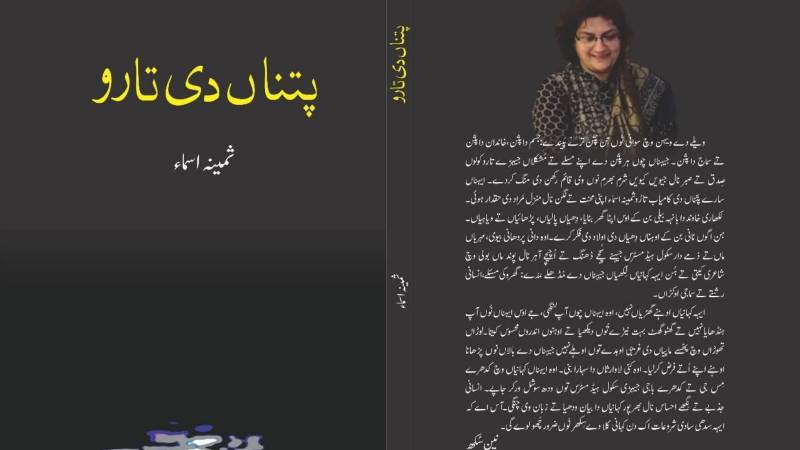
In the contemporary landscape of Punjabi literature, Samina Asma emerges as a compelling and multifaceted voice whose intellectual and creative pursuits intertwine with a lifelong commitment to education. A poetess of remarkable sensitivity and a seasoned educationist, she devoted over three decades to the Education Department, serving with distinction as a headmistress and shaping young minds with both discipline and vision. Her literary oeuvre reflects a profound engagement with language and culture, encompassing three volumes of poetry in Shahmukhi Punjabi:
Ataṇ Phēra pāh
Kōī Lāṭ Nimāṇī
Vēḷā Simaran Da
and one in Gurmukhi:
Dil Dē Nēṛē
thereby bridging scripts and audiences with quiet eloquence. Her recent foray into prose, marked by the publication of her Punjabi short story collection Pattaṇā Dī Tārū, further attests to her narrative versatility and deepening artistic maturity. Through her writings, Asma articulates the subtle textures of human experience, affirming her place as a significant contributor to modern Punjabi letters.
A short story collection by Asma unfolds through the delicate yet piercing lens of a profoundly sensitive observer. Within its narrative fabric emerges a haunting inquiry into the very essence of womanhood—an existence defined in relation to others, yet persistently denied recognition in its own right. The woman portrayed here is both creator and sustainer, a quiet architect of lives and meanings, yet she remains overlooked by a society that refuses to acknowledge her as a complete human being beyond the confines of gender.
Is she merely an object—a crafted form of clay, shaped and reshaped at will? Or is she the silent bearer of endless burdens, carrying the weight of responsibilities that are seldom her own? Perhaps she is a living paradox: enduring, striving, and sacrificing within a timeless struggle against a society that trivialises her worth. In this relentless cycle, she becomes estranged even from herself, uncertain of her purpose, questioning the very reason for her existence. In life, she is taken for granted; in death, even her grave offers no sanctuary.
This thematic anguish echoes the voices of many women writers across time. Virginia Woolf once wrote, “For most of history, Anonymous was a woman,” capturing the erasure of female identity.
In her writing, she seeks to lift the veil that women are compelled to wear—a veil woven from fear, silence, and societal judgement
Through its poignant exploration, taken together, the narratives of Samina Asma form not merely a collection of stories, but a profound literary cosmos where wounded lives, silenced voices, and resilient souls are rendered with uncompromising emotional truth. Her fiction traverses the fragile boundaries between home and exile, innocence and violation, despair and endurance, while transforming ordinary existence into extraordinary testimony. With rare narrative intensity and moral clarity, Asma compels the reader to confront both the beauty and brutality of human experience.
A woman, bound within the roles of mother, daughter, wife, and sister, carries the weight of these relationships with quiet endurance. Yet, paradoxically, in our society, she is often treated as a burden—a symbol of disgrace rather than dignity. To be a woman here is to undertake a long and demanding examination, one for which she is given no preparation, yet she perseveres and succeeds against all odds.
In her writing, she seeks to lift the veil that women are compelled to wear—a veil woven from fear, silence, and societal judgement. Women are conditioned to conceal their true selves, for exposure risks condemnation: they may be labelled as unstable, depressed, or morally compromised. Through her work, she reveals the emotional and psychological struggles that women endure as they strive to preserve relationships and uphold societal expectations that are often unjust and unfounded.
She challenges the notion that a woman is weak or irrational. Instead, she portrays her as resilient and selfless, tirelessly contributing both within the household and beyond, yet receiving little recognition or appreciation from a society steeped in superficial values. Asma brings to light the unacknowledged efforts of women and the depth of their sacrifices.
Her female characters confront adversity with courage, navigating their struggles with quiet strength. At the same time, she acknowledges that women are deeply emotional beings, yet questions why this humanity is met not with understanding, but with neglect and mistreatment by those closest to them.
“Rajjo! Swani bhanwin parhi likhi hoe ya anparh swani e hondi a, basi ya nawi nakor merd merd honda a sada da nakor”
Asma’s Waari offers a restrained yet powerful portrayal of a woman’s emotional struggle within a polygamous marriage. From a feminist literary perspective, Rajjo’s character reflects the psychological cost of patriarchal norms, where a wife is expected to endure betrayal and ultimately accept her husband’s second marriage. Rajjo’s pain is deeply rendered, while her “consent” to share her husband highlights the imbalance between male freedom and female sacrifice. Stylistically simple but emotionally charged, the story critiques a system where a woman’s loyalty is tested far more than her husband’s responsibility.
Samina Asma’s JHALLI constructs a psychologically layered portrait of apparent madness that, on closer reading, becomes a profound meditation on maternal love, social exclusion, and distorted perception. The central irony of the narrative lies in the disjunction between public interpretation and private reality: a woman deemed “insane” by society is, in fact, an intensely devoted mother whose emotional world is anchored in care for her children.
“Miss ji mere bacha pass ker dena”
Literarily, the story operates through unreliable social perception—madness is not an intrinsic state but a label imposed by observers. The protagonist’s homelessness and ragged existence intensify this misjudgement, allowing society to conflate poverty, nonconformity, and psychological disturbance. However, she subverts this reading by revealing emotional clarity within apparent chaos. Ultimately, JHALLI is a study in paradoxical humanity. It dismantles simplistic binaries of sanity and insanity, suggesting instead that extreme emotional depth. The story thus elevates maternal love into an almost tragic, misunderstood force—both socially rejected and spiritually profound.
In the fiction of Samina Asma, narrative becomes an act of intricate literary architecture, where plot is not merely arranged but deeply orchestrated to reflect the fractured and resilient contours of lived human experience
The main stream story, Pattaṇā Dī Tārū:
“Mera ji karda ke main purane ghise hue leere paa ke zameen utte sirhane ittan rakh ke so jawan”
There comes a moment of profound helplessness when life places every lost desire within one’s reach—not when the heart longs for them, but when it has grown weary of wanting. In that unbearable stillness, fulfilment itself becomes meaningless, and the soul remains suspended between emotional ruin and silent endurance.
Rukhsana (Taru)—an orphan estranged from both lineage and belonging—undertakes a haunting journey in search of her true home after discovering the fragility of the relationships she once trusted. Amid displacement, deprivation, and emotional ruin, she wanders through an indifferent world, carrying the silent grief of homelessness. Yet beneath her wounded existence resides an unyielding resilience, rendering her not merely a victim of fate, but a profound emblem of endurance and the eternal human longing for belonging.
In Shahni, Samina Asma crafts Shahni as a woman of mesmerising beauty, yet condemned beneath the cruelty of suspicion and social judgement. Against this storm of accusation stands her husband—unwavering in his devotion, loving her with a faith untouched by doubt. The story thus transforms loyalty into a sacred human virtue beyond gender, while silently asking whether such unconditional love can endure even in the shadow of mistrust.
In Mehrunisa, Samina Asma portrays a woman who refuses to surrender her individuality to the rigid expectations of society. Through three marriages, Mehrunisa encounters the varied temperaments, virtues, and failures of men, yet remains unwavering in her pursuit of dignity and emotional fulfilment. Rather than embracing helplessness, she asserts a woman’s right to seek a life unburdened by loveless companionship, transforming her character into a bold emblem of resilience, selfhood, and feminine autonomy.
In Bewasai, Samina Asma shatters the illusion of home as an inviolable sanctuary by exposing the silent horror of child abuse concealed within domestic walls. The story hauntingly reveals how relationships meant to embody protection and affection can instead become sources of fear and violation for an innocent child. Through this unflinching narrative, she undertakes a courageous literary intervention, compelling society to confront the hidden predators that dwell within.
In Sukne Pae Leera, she transforms an ordinary object into a living vessel of memory, grief, and maternal attachment, rendering the daughter–mother relationship profoundly intimate and emotionally resonant. Much like The Overcoat by Nikolai Gogol, she employs an experimental narrative technique through which lifeless fabric begins to breathe with human sorrow and affection.
The last story of the book, A koi kahni Naee, gives voice to a grief that transcends geography and language, turning the devastation of Gaza into a shared human lament. It is a narrative where every cry of a mother becomes universal, and every shattered childhood is felt as one’s own irreparable loss. With restrained yet devastating lyricism, she records not events but the trembling of the human soul under brutality, where silence itself seems to bleed. The story rises as an elegy of innocence destroyed and humanity wounded, affirming literature as both witness and wound—an unflinching echo of suffering that refuses to be forgotten.
In the diverse narratives of Asma, one encounters a finely woven literary tapestry where characters are not merely constructed but lived realities—figures who breathe, suffer, and persist within the moral and emotional landscapes of everyday life. From Nadia of Mobile Bhara to Murada of Chandere Dehare, from Masi Rashida’s muted sorrow in Chup to Kauser of Kamzat, each character emerges as a distinct emotional universe, shaped with psychological depth and social authenticity. Even in Taangh, where migration’s anguish is rendered through human displacement and the silent fidelity of a dog, she extends narrative empathy beyond the human condition itself.
Her craft is distinguished by a seamless fusion of plot and pathos, where emotional dialogue becomes a vessel of lived experience rather than mere expression. Nature, society, and domestic space are not passive settings but active participants in the emotional architecture of her stories. Through this intricate weaving of character and circumstance, she constructs a literary world marked by moral complexity, emotional intensity, and striking realism—affirming her as a storyteller of profound sensitivity and enduring narrative power.
In the fiction of Samina Asma, narrative becomes an act of intricate literary architecture, where plot is not merely arranged but deeply orchestrated to reflect the fractured and resilient contours of lived human experience. Her dialogue is marked by a rare philosophical undertone—thought-provoking, unadorned, yet resonant with ethical urgency—compelling the reader to engage beyond surface emotion into moral introspection.
Scenes unfold with a delicate interlacing of nature and human psyche, where external landscapes subtly mirror internal turbulence, creating an organic unity between environment and emotion. Through this refined craftsmanship of character, setting, and symbolic resonance, Asma elevates storytelling into a form of literary witnessing. Her work does not simply narrate life; it reimagines its pain, dignity, and silence with such evocative force that the reader is left not only moved, but irrevocably implicated in its truth.