

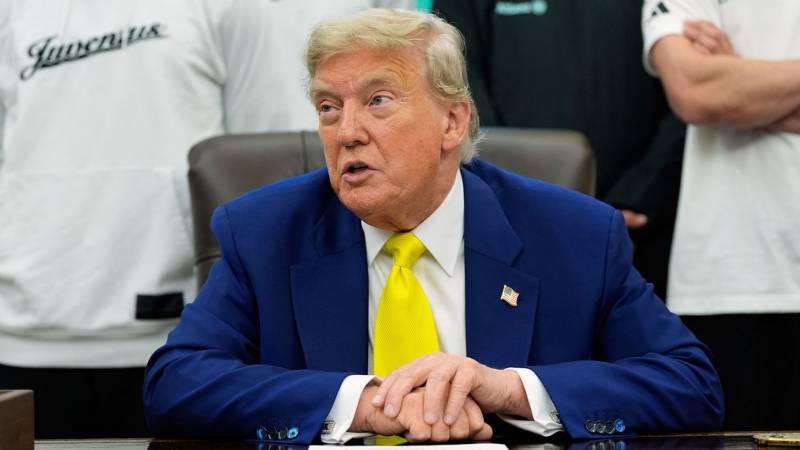
President Donald Trump approved attack plans on Iran late Tuesday, though he is delaying the final order in hopes that Tehran will abandon its nuclear programme, according to three sources cited by The Wall Street Journal. Trump gave private instructions in the Situation Room and confirmed publicly that an attack remains on the table. “We’ll decide at the last moment,” he told reporters.
On Wednesday, Trump hosted Pakistan’s Army Chief, Field Marshal Syed Asim Munir, at the White House for lunch. It was the first time a US president met a Pakistani military leader without civilian officials present. Trump called the meeting an “honour”. Islamabad sees it as a diplomatic win—especially as Indian media attempted to spotlight a recent Indian delegation’s visit with Vice President JD Vance. On the Iran–Israel conflict, Trump said, “They (Pakistan) know Iran very well, better than most, and they’re not happy about anything. It’s not that they’re bad with Israel. They know them both, actually, but they know Iran better.”
Vali Nasr, an Iranian-American academic and former US adviser, recently published a book, Iran’s Grand Strategy (May 2025). He argues that Iran’s foreign policy is not shaped by ideology alone, but by a long-term “strategy of resistance”—a bid to outlast and exhaust the United States.
Yet only weeks after the book’s release, Iran is teetering. Its leadership, under Supreme Leader Ayatollah Ali Khamenei, has made grave strategic miscalculations. Chief among them: overreaching in regional politics and underestimating the combined military force of Israel and the US. Israel has systematically dismantled Iran’s proxy forces in Syria and Lebanon. Now, its focus is Tehran.
This trajectory was foreseen. In 2007, former US National Security Adviser Zbigniew Brzezinski warned the Senate Foreign Relations Committee: “If the United States continues to be bogged down in Iraq, the final destination… is likely to be a head-on conflict with Iran.”
The 1996 “Clean Break” memo, written for Benjamin Netanyahu by US neoconservatives like Richard Perle, called for regime change in Iraq, Syria, Lebanon, and Iran. Its influence can still be felt. Today’s US–Israeli alignment mirrors that strategy, aiming to contain Iran through overwhelming force. But the implications for Pakistan are serious. Instability in Iran could spill directly across its border.
Adding to Tehran’s woes, Russian President Vladimir Putin—after Israeli strikes last Friday—made his first public remarks, maintaining a neutral stance. “We’re not forcing anything on anyone,” he said, while claiming to have offered proposals to all parties.
As bombs fall on Iranian cities, the spectre of regime change looms large. The campaign—marked by strikes on Natanz, Ahvaz, and Isfahan—has moved beyond nuclear containment. The target now is the regime itself. What began as containment is morphing into regime destruction, a long-standing goal of Netanyahu, and now, with Trump back in office, gaining renewed US support.
Unlike the early 2000s, the US no longer needs Pakistani bases, as it now maintains a substantial military presence in the Middle East with 40,000 to 50,000 troops
The 13 June Israeli airstrikes reportedly killed over 220 people and injured more than 1,200. Iran responded with missile attacks on Tel Aviv and Haifa. This is no longer a limited war. The goal is regime change. Sustained operations and official rhetoric from both Washington and Tel Aviv leave little doubt.
France and Britain have both issued stark warnings. Diplomats fear Iran could collapse into chaos, like post-2003 Iraq or post-2011 Syria. Netanyahu, who has long called for dismantling regimes hostile to Israel—from Saddam to Assad to the Ayatollahs—appears undeterred. But for Pakistan, a state with multiple fault lines and a long, porous border, this isn’t a theory. It’s an existential threat.
Scenario One: Limited Escalation and Ceasefire
In a moderate escalation scenario, Israel confines its attacks to nuclear enrichment sites and missile depots, while Iran responds proportionally and halts further offensives after some form of ceasefire is brokered. Casualties remain in the low thousands, and 10,000–20,000 refugees trickle into Balochistan. Brent crude settles at $70–80 per barrel, manageable through emergency Gulf credit lines and a modest draw on Pakistan’s foreign reserves.
Here, Islamabad’s playbook is straightforward:
- Deploy US‑provided drones under a clear civilian‑protection framework. Train Frontier Corps battalions to interdict smuggling without heavy troop concentrations that alienate local tribes.
- Activate pre‑positioned UNHCR camps at Chaman and Taftan. Use military logistics units to ferry supplies inland, ensuring equal distribution between locals and refugees.
- Publicly condemn Israeli aggression at the UN, while privately assuring Washington of continued intelligence and counterterrorism cooperation. Dispatch envoys to Tehran and Beijing to reaffirm Pakistan’s neutrality and commitment to regional stability.
- Finalise short‑term oil import contracts with Saudi Aramco and Qatar Petroleum to offset Iranian supply disruptions. Adjust fuel subsidies selectively to contain inflation without bankrupting the budget.
If executed with discipline, this approach allows Pakistan to weather the storm, burnish its reputation as a responsible actor, and preserve critical relationships with all major powers.
The Catastrophe Scenario: Regime Collapse and Regional Chaos
The “catastrophe scenario” now seems more likely. If airstrikes cripple Iran’s governance—hitting Tehran, Shiraz, Mashhad, and key energy centres—the state may implode. This would not be a surgical strike but a shockwave, potentially triggering an exodus of 500,000 to 2 million people, many into Balochistan.
This could shatter Iran’s command structures. Protest movements, ethnic minorities, and opposition factions could surge. In a vacuum, armed factions—not reformers—will take charge. As in Libya and Syria, fragmentation knows no borders. Baloch nationalism, dormant but not dead, could reignite separatism both in Iran and in Pakistan.
The economic fallout would be equally punishing. Brent crude could hit $100–$120 per barrel. For Pakistan, already struggling with weak growth, high taxes, low reserves, and sluggish exports, this would be devastating. Public anger would rise, fuelling instability.
Strategic Navigation: Between Washington and Beijing
The 18 June Trump–Munir meeting sparked talk of a “strategic reset”. Trump’s praise for Pakistan’s counterterror efforts and signals of renewed partnership may suggest a shift in Washington’s view. But Islamabad should temper its optimism.
Unlike the early 2000s, the US no longer needs Pakistani bases, as it now maintains a substantial military presence in the Middle East with 40,000 to 50,000 troops across at least 19 sites, including eight permanent bases in Bahrain, Qatar, Kuwait, Saudi Arabia, the UAE, Iraq, and Jordan.
If the Iranian regime falls, it will resemble Libya after Gaddafi’s downfall—fractured, violent, and vulnerable to foreign interference—rather than 1979
Today’s operations are remote, agile, and less dependent on geography. What Washington wants is influence: intelligence sharing, assistance in covert operations, overflight rights, evacuation corridors, and refugee containment.
This shift is both an opportunity and a risk. By leaning too far towards Washington, Pakistan could alienate Iran and China—two essential neighbours. Tehran has already warned regional states not to support “imperialist aggression”, and Beijing, wary of threats to the Belt and Road corridor, may rethink its commitments.
Pakistan must walk a tightrope. It cannot join the US–Israel push to redraw the Middle East. But neither can it afford to provoke Washington. The way forward lies in cautious diplomacy: assist with logistics and humanitarian relief, but avoid military entanglements. Stay neutral. Stay alert.
A Refugee Crisis?
If Iran collapses, the refugee crisis could dwarf the Afghan exodus. While Turkey and Iraq might absorb a portion, a substantial wave will surge toward Pakistan. Yet the border infrastructure at Taftan and Chaman remains dangerously inadequate. Without urgent planning, the influx could become a flashpoint—spreading disease, fuelling unrest, and opening the door to radicalisation. The risk of Shia–Sunni tensions flaring in an already fragile Balochistan would rise sharply.
Islamabad must act now. Designate refugee camp sites. Stockpile food and medicine. Involve NGOs and prepare multilingual messaging. More than tents and checkpoints, Pakistan must preserve social cohesion in Balochistan—already wounded by neglect. Frame refugees as victims, not sectarian threats.
The US must be asked to fund these efforts—not as aid, but as a strategic necessity. Washington must understand: without real support, Pakistan won’t be able to contain the fallout.
Internal Dissent in Iran: Revolutionary or Reactionary?
Since Mahsa Amini’s death in 2022, Iran has seen brave resistance: youth protests, worker strikes, and minority uprisings. Over 550 protesters were killed and 834 executed in 2023 alone.
But expecting democracy to rise from the ashes of regime collapse is naive. The opposition is fragmented. Monarchists in exile, controversial groups like the Mujahedin-e Khalq, and regional militias are unlikely to unite. The IRGC—or a breakaway faction—is the most probable inheritor of power. As in Iraq and Syria, regime destruction usually means disorder, not democracy.
Strategic Recommendations for Pakistan: Hope Is Not a Plan
As conflict threatens to spill across its borders, Pakistan faces a stark truth: hope is not a strategy. Swift, smart preparation is essential to navigate the storm.
The Balochistan border must be reinforced—but without heavy-handed militarisation. Surveillance tools, including US drones, can strengthen oversight. The Frontier Corps needs more than combat training; they must be ready to handle refugees, provide care, and defuse tensions.
Refugee camps should be mapped out now, supply chains for food and medicine secured, and partnerships with NGOs established. Public messaging campaigns must begin immediately to prevent panic and misinformation.
On the global stage, Pakistan must condemn civilian casualties and advocate for a ceasefire at the UN, while avoiding entangling alliances. Quiet coordination with China and Gulf states is essential, and diplomatic lines to Tehran must remain open.
Economic shocks are inevitable. With oil likely to top $100 a barrel, Pakistan should seek credit from Qatar and Saudi Arabia, trigger IMF emergency funding, and prepare citizens for possible rationing.
Finally, the battle for hearts and minds cannot be ignored. The government must lead the narrative—reminding people of shared history and humanity—to head off sectarian fallout.
A Collapse Uncharted
If the Iranian regime falls, it will resemble Libya after Gaddafi’s downfall—fractured, violent, and vulnerable to foreign interference, rather than 1979. But the comparison only goes so far. Libya, with a population of barely seven million and a long-standing tribal structure, was already fragmented before its collapse. Iran, by contrast, is a nation of over 92 million—a deeply rooted civilisation with a strong sense of national identity, a history of statehood, and remarkable social cohesion, even under duress.
Yet it is precisely this scale and cohesion that makes a potential collapse so dangerous. The disintegration of a country like Iran would not produce isolated chaos. It would radiate outward. For Pakistan, the danger isn’t just across the border. It’s within.
The lesson is simple: prepare without aligning, contain without provoking, and speak out before adventurism triggers disaster. Netanyahu’s vision of a broken Shia crescent might serve his interests. But it could set the region—and Pakistan—on fire.