

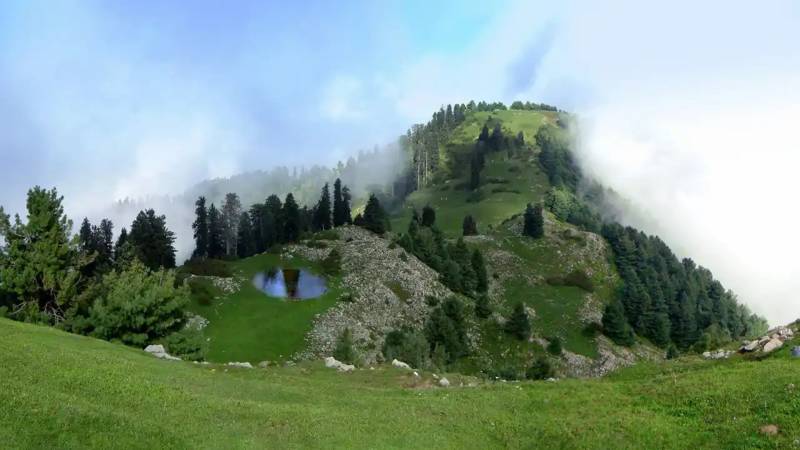
I have made several trips all over Pakistan’s beautiful North – and none more so than to Hazara’s Galyat region, which I have been visiting regularly since my late teens.
In that time, I have become reasonably familiar with several of the galis, particularly Dungagali, Khaira Gali and Nathiagali. All of them lie at altitudes between 7,500 and 8,500 feet and are major tourist attractions, especially for domestic tourism.
What these regular visits have, however, shown me – especially the more recent ones – is how the living environment in this very green part of Pakistan is being slowly but steadily degraded over the years. This is largely thanks to haphazard planning, municipal mismanagement and an unchecked explosion in concrete structures, particularly hotels and shops. All of this has come at the cost of a degraded quality of life for the local residents of this region.
At the outset, however, let’s be clear about one thing: no one is saying that tourists should be banned from the area. After all, given that it is mountainous and cannot be used for growing any major crops, tourism is one of the main economic drivers of the region. But it needs to be developed in a manner that ensures the very natural beauty which attracts visitors in the first place is not severely degraded – and that the quality of life for the local residents is not negatively impacted.
Let’s take the specific case of Nathiagali. In the past five years, I have visited it three times, each time staying for at least a week or more. I usually make it a point not to stay in the bazaar, which I realised from my most recent visit earlier this month is now virtually impassable by vehicle, even on a weekday evening. On the weekend, I didn’t even bother going down by car from where I was staying – you would simply get stuck in a massive traffic jam. And I’m not talking about Karachi!
It’s not just the Nathiagali bazaar area. Even the Upper Nathiagali Road – which leads to various other high-end hotels, resthouses, cottages, and includes the Khyber Pakhtunkhwa official resthouse, the Governor’s House and the famed St Matthew’s Church (built in 1914) – has become extremely crowded, even on weekdays. Walking along these stretches of road can now be hazardous to one’s safety, lest you be run over by a speeding car overtaking another on a blind turn.
Nathiagali is in Khyber Pakhtunkhwa, a province ruled by the PTI for the past 12 years – it shouldn’t be too hard to connect the dots
What was particularly shocking was how, on the beautiful walk that ends at the Governor’s House, and then continuing uphill towards the Church area, there was complete bumper-to-bumper traffic on both sides. It was only because I was already on foot that I managed to bypass the traffic mess and eventually reach my destination on time.
During this visit, I also came across what in my view is a concrete monstrosity, a complete eyesore, and something a town the size of Nathiagali can hardly afford to have.
It is a much-talked-about five-storey hotel built right on Upper Nathiagali Road. It is reportedly part of a well-known international hospitality and hotel chain, brought to town by a Pakistani based in the US, who is believed to be close to former Prime Minister Imran Khan. Given that Nathiagali is in Khyber Pakhtunkhwa, a province ruled by the PTI for the past 12 years, it shouldn’t be too hard to connect the dots.
The owner of this concrete monstrosity reportedly goes around telling residents, including those who have built summer homes and cottages on land approved by the local municipal agency, the Galyat Development Authority (GDA) – that the GDA has promised his hotel (slated to have over 100 rooms) an uninterrupted water supply. On the face of it, that doesn’t make sense. No municipal body would be in a position – legally speaking – to make such a commitment, especially when the area has limited water availability and most homes receive piped water for only a couple of hours a day. In such a situation, how can the GDA possibly guarantee an uninterrupted water supply to a large hotel? And if that is indeed the case, then it must be at the expense of the town’s residents.
This is just one example of how unplanned and haphazard construction is slowly but surely destroying the living environment of one of Pakistan’s most pristine forested regions – and bear in mind, a mere 4.7% of the country’s land area is covered by forests.
I feel bad for the people of the region, especially those who have permanent homes there. While tourism is certainly a key driver of the local economy, it must be developed and planned in a manner that does not endanger the very ecosystem and living environment that draws visitors from all parts of the country in the first place.
The million-dollar question, so to speak: who will take responsibility? The local municipal agency, like the GDA, or the government in power? Or will big money and developers simply march on with their plans to devour whatever forest cover remains in the country?