

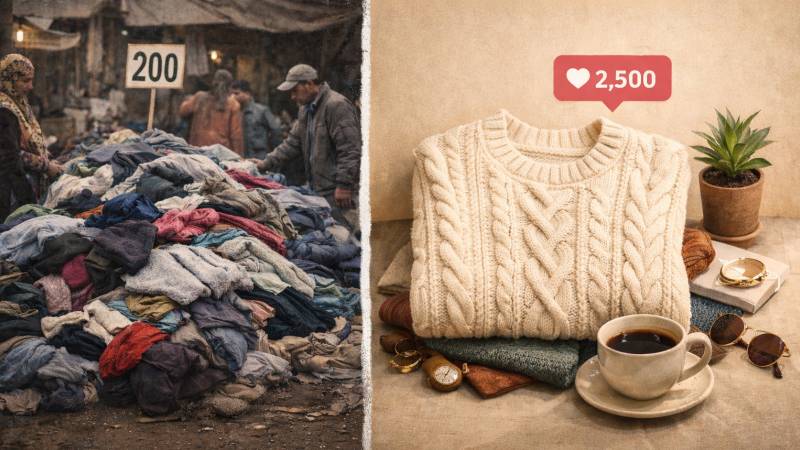
For decades, Landa bazaars were not about style or self-expression. They were about survival. People went there because they had to, not because it was trendy. On Railway Road or in the back lanes of major cities, clothes lay in piles, priced cheaply and sold quickly. A warm sweater for Rs. 200 could get you through the winter. No captions, no lighting, no hashtags. Just need.
Fast forward to today, and the same sweater appears on Instagram, neatly folded, shot against a beige wall, priced at Rs. 2,500. It is now described as “vintage,” “pre-loved,” or “a rare find.” The fabric hasn’t changed. The story has. And in that story lies a bigger question about class, choice, and who gets to look fashionable without being judged.
Instagram thrift stores have exploded among Gen Z, particularly in urban Pakistan. These pages sell secondhand clothes with careful curation. Every item is photographed with precision, sometimes styled on models, sometimes paired with coffee mugs or plants. Packaging is minimal and eco-friendly. Captions speak of sustainability, slow fashion, and conscious consumption. Buying from these pages is framed not just as shopping, but as making a statement.
This is where marketing comes in. What these stores are really selling is not clothing, but meaning. Through storytelling and visuals, they transform cheap items into desirable ones. A jacket that would have been ignored in a Landa pile becomes special once it is presented as unique or aesthetic. The price rises not because the product is better, but because the buyer is made to feel better about purchasing it.
There is nothing new about this in marketing. Brands have always used image to increase value. What is new is how clearly class plays into it. Wearing used clothes has long been associated with poverty in Pakistan. If you wear secondhand because you cannot afford new, it marks you as lower class. But if you wear secondhand because you “choose” to, it becomes cool, even elite. The same act conveys entirely different meanings depending on who is doing it.
The Landa has always been a reflection of economic reality in Pakistan. Turning it into a label without acknowledging that reality risks emptying it of meaning
This is the uncomfortable truth behind the thrift trend. Thrifting becomes fashionable only when it is optional—when it is framed as a lifestyle choice rather than an economic necessity. Paying extra for used clothes becomes a way of demonstrating taste, awareness, and the privilege of turning frugality into an aesthetic. In that sense, Instagram thrift is less about saving money and more about signalling identity.
The price hike is also part of a larger system. Many online sellers source clothes cheaply from traditional Landa markets or bulk suppliers. They clean them, photograph them, and resell them at a substantial markup. The original vendors, who rely on these markets for daily income, rarely benefit from this new demand. Value shifts upward, away from those who need it most, into the hands of those who understand branding and algorithms.
This is a form of gentrification—not of neighbourhoods, but of culture. A space that once served the working class is being repackaged for a more privileged audience. The Landa is no longer just a market; it becomes inspiration. But inspiration without credit or compensation can quickly turn into exploitation.
The sustainability angle complicates matters further. Thrift shopping is often defended as environmentally friendly, and in many ways it is. Reusing clothes does reduce waste. But when sustainability becomes a selling point rather than a practice, it loses meaning. Buying a Rs. 2,500 sweater and calling it ethical does not automatically make it so, especially if those at the bottom of the supply chain remain invisible.
None of this means that thrifting is inherently bad, or that young sellers are doing anything wrong by building businesses. The problem is not resale itself, but the lack of honesty surrounding it. If thrift is truly about conscious consumption, it should also entail fair pricing, transparency, and respect for the markets it draws from.
It also requires us to reflect on our own attitudes. Why do we celebrate secondhand fashion only when it looks curated and expensive? Why does poverty become stylish only when it is divorced from poverty itself?
The Landa has always been a reflection of economic reality in Pakistan. Turning it into a label without acknowledging that reality risks emptying it of meaning. Thrift does not need to be glamorous to be valuable. But if it is to be glamorous, it should at least be fair.