

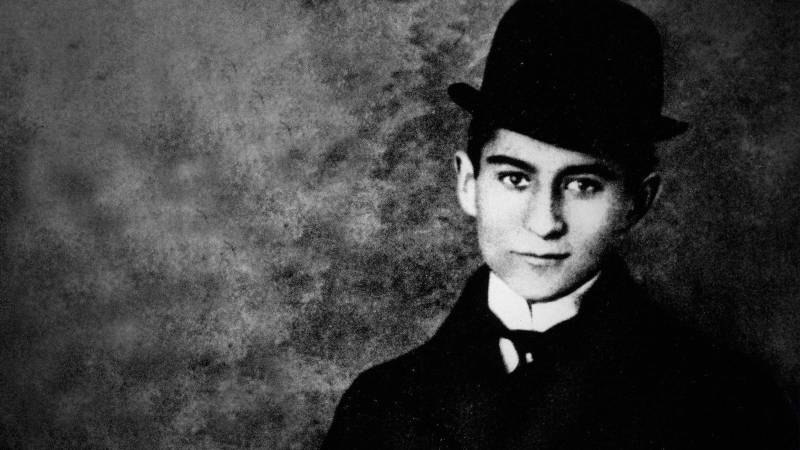
Franz Kafka was an Austrian Czech novelist and writer who wrote in German and died in 1924 of tuberculosis, at the age of 40. He is widely regarded as a major figure in 20th-century literature. His work typically features isolated central characters facing bizarre predicaments resulting from incomprehensible social forces and bureaucratic powers.
Perhaps only ‘Orwellian’ can stand ahead of ‘Kafkaesque’ as a twentieth-century literary term that describes the understanding of our twenty-first-century world. The term Kafkaesque has entered modern language to describe absurd situations like those depicted by Franz Kafka in his writings. The critic J. P. Stern attempted to define ‘Kafkaesque’ by using terms, ranging from ‘weird’ and ‘mysterious’ to ‘tortuously bureaucratic’ and even ‘nightmarish’ and ‘horrible’.
The term Kafkaesque generally refers to the bureaucratic nature of judicial and bureaucratic systems. The sort of complex, unclear processes in which no one individual ever really has a grasp on what is going on, and the system doesn't care. The crux of Kafka's style and work seems to be a confrontation with the absurd, a conflict in which the character's efforts, reasoning, and sense of the world are met with inescapable constraints of senselessness wherein success is both impossible and ultimately pointless.
In one of his most famous novels, ‘The Trial’, Joseph K is suddenly arrested at his home one day by officers who do not inform K why he is being arrested, and he is then forced through a long and absurd trial in which nothing is ever really explained or makes much sense. The trial is riddled with corruption and disorderliness, and by the end of the novel, after having endured the entire trial, K is never told why he was arrested, and yet he remains guilty. K. never discovered why he was arrested or what he was charged with, and he was never able to understand the principles governing the system of justice in which he found himself trapped. In the end, he did not resist his inevitable execution. K is faced with sudden, absurd circumstances for which there are no explanations, and, in the end, there is no real chance of overcoming them. This is a surreal story of a young man who finds himself caught up in the mindless and arbitrary bureaucracy and depicts an ordinary person’s struggle against an unreasoning and unreasonable authority.
If Kafka somehow returns from the house of Hades or the land of the dead in Greek mythology and has a chance to visit and study the workings of present-day Pakistan, he might be forced to extend the boundaries of the concept ‘Kafkaesque’ to limits he probably had thought inconceivable
The Castle is the last novel by Kafka, first published in 1926. In it, a protagonist, known only as "K" arrives in a village and struggles to gain access to the mysterious bureaucracy that governs it from a castle. The villagers hold the officials and the castle in high regard, even though they do not appear to know what the officials do. The actions of the officials are never explained. Everyone appears to have an explanation for the officials' actions, but they often contradict themselves, and there is no attempt to hide the ambiguity. The castle is the ultimate bureaucracy with copious paperwork that the bureaucracy maintains is "flawless". But the flawlessness is a lie; it is a flaw in the paperwork that has brought K. to the village. There are other failures of the system which, however, do not detract from its absolute authority.
Other works by Kafka also provide varying accounts of the senseless Kafkaesque world. It is believed that all societies and states, to a varying degree, exhibit complex, confusing, and seemingly endless administrative processes. The rules, regulations, and decisions of the authorities appear arbitrary, contradictory, and devoid of rational explanations. Authorities are opaque, unresponsive, and unaccountable, leaving individuals with no recourse or redress, making them feel disconnected, powerless, and trapped within the system.
However, if Kafka somehow returns from the house of Hades or the land of the dead in Greek mythology and has a chance to visit and study the workings of present-day Pakistan, he might be forced to extend the boundaries of the concept ‘Kafkaesque’ to limits he probably had thought inconceivable. He may end up being sorry for himself for failing to comprehend that the term ‘Kafkaesque’ falls far short of the senselessness possible and practiced in the land of the pure. Let us take just a few instances.
‘Kafkaesque’ fails to contemplate a government telling the people that they should invest in clean, renewable energy by installing equipment in their homes and businesses to generate electricity from solar energy. When the people respond to the call of the government by making significant investments, the same government informs them that they are a threat to the economic sovereignty of the nation and that all the incentives promised to them mean nothing. If Kafka could find a rare person acquainted with the history of the country, he would inform him that this episode is not unprecedented or unique. About two decades ago, the government learned that running motor vehicles on CNG was the best use of the natural gas the country was blessed with. It was made mandatory for government vehicles to install CNG kits, obviously at considerable cost. The roads were strewn with CNG stations, but suddenly the government realised that using natural gas as a vehicle fuel was not such a great idea; the CNG stations were closed, and their owners, as well as the vehicle owners who had switched to CNG, were left high and dry.
Kafka probably will realise that even his wildest visualisations about a senseless state machinery pale into insignificance in the face of a country exporting sugar on the basis that it is surplus by subsidising the exports, and then a few months later importing sugar at much higher prices
Having overcome his disbelief at the above episodes, Kafka will learn that there is much more in store that will test the limits of his imagination that he hitherto considered to be quite rich. His perplexity will know no bounds when he learns that the government is wooing foreign investors to invest in Pakistan when its investors are going abroad in droves and making offshore investments due to the treatment meted out to them by the government machinery. Despite being notorious for his disconnect with practical realities, Kafka would utterly fail to understand how, in such circumstances, any foreign investor, no matter how Kafkaesque, would be investing in Pakistan.
His confusion will know no bounds when he is told that a country that is facing an existential threat in terms of the money it owes to domestic and foreign debtors has plans to spend hundreds of billions of rupees on building motorways in a specific province by borrowing more. Even his Kafkaesque sensibilities will tell him that the priority of such a country should be to get itself free from the malignant debts that it owes, rather than trying to gain political mileage by financing the so-called mega projects through loans.
The shocks that Kafka must experience will not end there. He will be baffled when he learns that a provincial government is breaking all records of public service and development, and the people of the province are so insensitive to the twin tsunamis of development and service flooding them that they must be informed about it through costly government advertisements and supplements to the newspapers financed from the public kitty. He will also be bamboozled as to why posters showing the face of the Chief Minister have to adorn the roads of the province every 100 meters or so. No one will be there to provide him with an explanation as to why the public funds so expended couldn’t be used to provide more services and development for the people.
Kafka probably will realise that even his wildest visualisations about a senseless state machinery pale into insignificance in the face of a country exporting sugar on the basis that it is surplus by subsidising the exports, and then a few months later importing sugar at much higher prices. His writings will also feel deficient in explaining a country refusing to buy wheat from its farmers at market prices and then importing it at much higher prices from foreign markets. Speaking of agriculture, he will be highly impressed by plans to dig new canals to irrigate large desert tracts, but may be forced to rethink his definition of absurdity when someone tells him that the country is facing water scarcity and providing water to the existing cultivable areas is already a big challenge. What most likely may prove to be icing on the cake will be the revelation that the same state is undertaking a riverfront real estate development project, stretching over more than 100,000 acres of farmland, converting the most fertile land of the province into a concrete jungle.
Having become familiar with smartphones and the internet, Kafka will be impressed by the resolve of the government to develop the related IT sector. But when he tries to use YouTube to listen to what the succeeding thinkers have to say about his work, he will be left scratching his head when a 10-minute vlog takes two hours to run. On learning that this is the result of deliberate policies to slow down the internet, he will be as confused as to how the IT sector can flourish in such an environment as ordinary mortals get on reading his novels.
Confronting the rampant absurdities, he will have to cut his visit short but before returning to the house of Hades will send a written request to the major philosophical and literary associations in the world to replace the term “Kafkaesque” with “Pakistanesque”.