

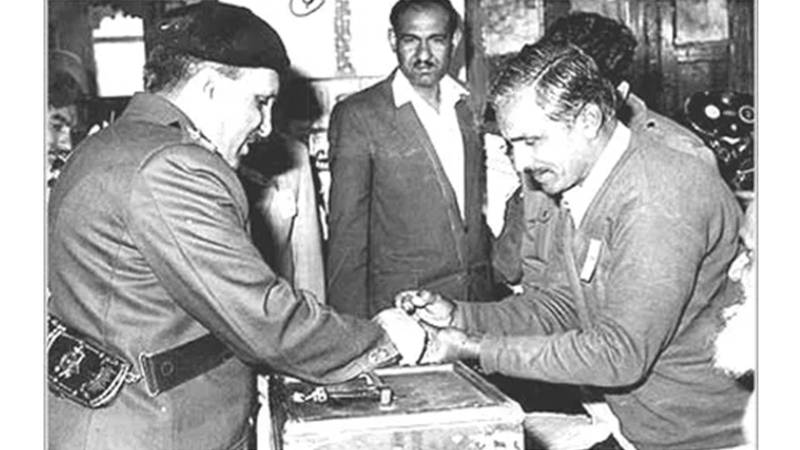
Why are autocrats so enamoured of referendums? Why do they so thoroughly distrust the people's mandate expressed through their elected representatives that they stage the farce of appealing directly to the masses? And what, in the end, do referendums bring to dictators?
The answer has been etched into history by the referendums of Zia-ul-Haq and Pervez Musharraf for generations to judge: a referendum brings nothing but eternal ignominy to the autocrat who resorts to it.
Then why do dictators love referendums so much?
Because referendums are easy to manage and even easier to manipulate. Do they reflect the will of the people? The outcomes of Zia's and Musharraf's referendums provide the answer. Habib Jalib immortalised that answer in his famous verse:
"Shahar mein hoo kaa aalam thaa, Jinn thaa yaa referendum thaa."
("The whole town lay desolate and abandoned. Was it a jinn, or was it a referendum, that had come to town?")
Fantasies of Immortality
Dictators, after exercising absolute power for some time, begin to see themselves as invincible. That is when they start harbouring fantasies of immortality. Having enjoyed unquestioned authority acquired through the power of the gun, they dream of etching their names into history through grand schemes conceived by obsequious courtiers. These lackeys are rarely concerned with the well-being of their master; they are interested only in securing their own share of the spoils if the scheme succeeds. If it fails, they lose nothing.
Pakistan's first establishment consisted largely of UP, CP, and Punjabi politicians and civil servants, along with a military establishment drawn from the same backgrounds. The One Unit scheme, though implemented by the Bengali Prime Minister Mohammad Ali Bogra and approved and promulgated under Governor-General Ghulam Muhammad, a Punjabi ICS officer, and later Governor-General Iskander Mirza, was in fact the brainchild of a Punjabi civil servant, Chaudhry Muhammad Ali, who was shortly thereafter elevated to the office of Prime Minister himself.
From the first establishment to the present one, there has been one constant: a mindset seeking absolute hegemony over power and resources at any cost. That, in my view, explains why the loudest calls for smaller provinces continue to emerge from Punjab.
Second Reset
While Chaudhry Muhammad Ali was the architect of the first re-set, the One Unit scheme designed to neutralise the Bengali majority through a manifestly unfair arrangement, this time too it is a handful of wealthy Punjabis of questionable background and motives who are pushing the agenda of a second re-set. The objective is not substantially different. They have forgotten the ultimate fate of the first experiment.
This new scheme, no less nefarious than the first, is two-pronged. First, decimate the major political parties and divide the people into smaller, more manageable fragments. Such fragmentation makes rule through naked authority much easier. Second, once that objective has been achieved, consolidate control over provincial resources for the gratification of centralised power, dominated by, well, the Punjabi.
Who are the loudest advocates of smaller provinces? Do you hear comparable demands from elsewhere? Even Mustafa Kamal can be found on YouTube speaking against the separation of Karachi from Sindh before he became a favourite of the establishment.
Why is it that only Punjabi universities are hosting seminars and discussions on the idea? Why is it that only Punjabi intellectuals are invariably invited to debate it?
The Punjab Assembly has passed two resolutions in favour of provincial division, while the Sindh Assembly has passed none. Why is it that whenever the division of Punjab is discussed, the response is invariably: "Divide Sindh first"? And why does that argument almost always originate from Punjab?
Will Punjab determine what is in the best interest of Sindh?
The Question of Sindh's Autonomy
Since 1948, the Sindh Assembly has passed seven resolutions opposing the division of Sindh. Listen to the speeches delivered in the Assembly, including those made by MQM members. Has even a single member spoken in favour of dividing Sindh? They have consistently and categorically denounced the idea. Why, then, is it only the Punjabi voice that remains interested in the division of the province?
When the Sindh Assembly passed its historic resolution in 1943 supporting the proposed federation of Pakistan as an autonomous state, Punjab was ruled by Malik Khizar Hayat Tiwana of the Unionist Party. Punjab did not fully embrace the idea of Pakistan until it became clear that Pakistan was indeed coming into existence and that Punjab would be part of it. Punjabis themselves were uncertain of their ultimate destination until the cry of "Hun hun khabar aayi hai, Khizar saada bhai hai" echoed through Punjab in March 1947.
Sindh joined the federation of its own free will as an autonomous state. Yet today Punjab seeks to dictate what the future of Sindh should be.
The desire to dominate Sindh is not new. Maharaja Ranjit Singh cast his eyes upon Sindh long before Pakistan came into being. Had the British not had designs of their own for the region, Sindh might well have fallen under Punjab's control much earlier. It is not concern for development, or the lack thereof, that makes Sindh so attractive. It is Karachi and its port that continue to draw the covetous gaze.
Resources and the Need for Equity
If the concern were truly for Karachi, the first priority would have been to connect it efficiently with the rest of the country through a motorway, just as an extensive network of motorways was built elsewhere, particularly in Punjab. Funds were readily found for major projects in Punjab. The Orange Line Metro, for example, was built in Lahore through the CPEC programme. Karachi is larger and more populous. Why, then, was a comparable project not pursued there with the same enthusiasm and federal support? Why are the federal highways in Sindh in such a dilapidated state? Why has Sindh not been provided the funding required for Karachi's much-needed water projects? Where does this professed concern disappear when it comes to allocating resources to Karachi and other neglected regions?
Sindhi-, Urdu-, Punjabi-, Pashto-, and Balochi-speaking Sindhis understand the game. They will not fall into the trap.
Sindh is not going to agree to any ill-conceived proposal to divide the province, referendum or no referendum.
The legacy of Zia and Musharraf has left a lasting lesson for autocrats seeking immortality in history: dictators come and go, but foolish ideas, especially referendums used to legitimise personal rule and foist preposterous schemes upon the people, earn nothing but eternal ignominy for those who impose them.