

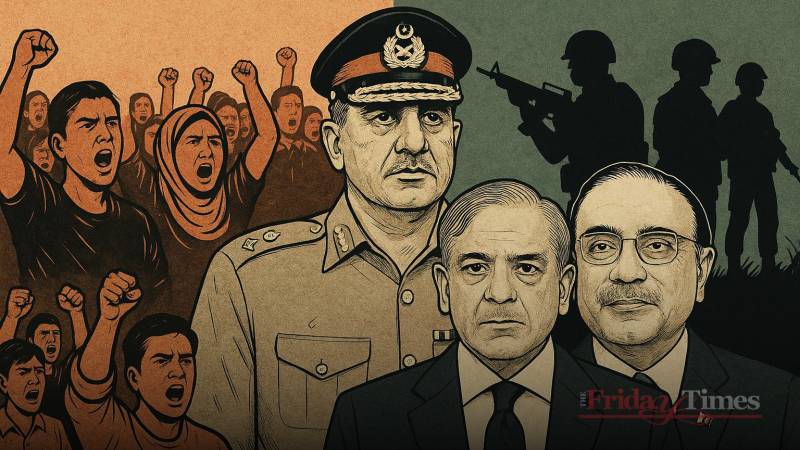
It was always going to come down to this — conflict across the border and calm at home. The kind of calm Gen Z and millennials, raised on hashtags and hybrid regimes, don’t remember ever really understanding. But I’ve known. I’ve been watching this game far too long for someone my age — long enough to guess the plot before it hits the stage, and still somehow be surprised when the credits roll the same page. The war kicks in, the country rallies, and somewhere in the shadows, the real decisions get made.
Once again, the boys are back in charge. Not that they ever truly left, but this latest flare-up with India has reminded everyone who really sits at the top of the food chain. There is something oddly dependable about it all — the choreography of crisis, the surge of patriotic programming, the warm, familiar embrace of institutional certainty. The man in the high castle doesn’t just manage the moment; he absorbs it, expands into it, and emerges on the other side stronger, quieter, more decisive.
What’s remarkable is the ease with which public anxiety is converted into political capital. The armed forces have long understood the power of narrative — the patriotic rally, the emphasis on unity, the clear demarcation of who stands inside the tent and who is left outside. It’s a calculus finely tuned over decades. This latest conventional exchange is no exception. The powers that be don’t just react; they pre-empt, steering the country’s focus and tempering civilian ambitions.
Meanwhile, Imran Khan — populist, prisoner, perennial problem — sits where the system has placed him, not so much silenced as sidelined. A few months ago, there was noise — talk of deals, backchannels, possible off-ramps. The usual murmurings from the usual places. But war, or even the scent of it, clears the table. And Khan’s name is lower on the agenda list.
In the cold logic of a security state on high alert, Khan is surplus. Still dangerous, yes. Still wildly popular, yes. But surplus. Popularity is a threat when it can’t be choreographed, and the only script now being followed is one where control trumps charisma. There is a cruel irony here. Khan’s rise was built on disrupting this very system — challenging the entrenched military-civilian nexus, promising a new Pakistan, one where all would be held accountable. Yet today, he is boxed in by the very forces he once sought to confront, his voice muffled beneath the roar of jets and the drumbeat of nationalism.
And the civilians still in the game? They have done what civilians here always do in such moments — adjusted. The Pakistan People’s Party has found its footing again by staying out of the way. Bilawal Bhutto Zardari, who once spoke confidently about constitutional supremacy and civilian space, now plays the long game — or maybe just plays along.
Nawaz Sharif, once the undisputed lion of Punjab and the nation’s heavyweight, has been quietly trumped by his own brother, Shahbaz. Where Nawaz once roared, Shahbaz governs now — less thunderous but far more attuned to the realities of the moment. The veteran finds himself overshadowed, sidelined by the very family that once carried his banner. Nawaz’s influence has waned; his defiance tempered by Shahbaz’s steadier, more establishment-friendly posture. The old guard bows, perhaps reluctantly, to a new balance of power within their own ranks.
The Sharif family’s shifting dynamic mirrors a broader recalibration among Pakistan’s political elites. Shahbaz Sharif’s approach — measured, pragmatic, less confrontational — is the product of lessons learned navigating the country’s volatile political landscape. His acceptance of the man in the high castle’s primacy, whether voluntary or born of necessity, signals a departure from Nawaz’s more defiant brand of politics.
Neither Nawaz nor Bilawal has reason to disrupt the order. With Khan behind bars, the noise is muted, the threat contained. The centre may not hold, but the silence around it is useful. They are, whether they admit it or not, beneficiaries of this vacuum. Beneficiaries rarely rush to fill it with the wrong kind of noise.
Yet beneath this uneasy peace, frustrations simmer. For many within PPP and PML-N ranks, the military’s ascendance is both an inconvenient reality and a source of private grievance. Bilawal’s posturing no longer hints at undercurrent of impatience among his supporters — a yearning for genuine civilian space that continues to shrink in the shadows of the uniform. Similarly, Nawaz’s loyalists chafe at the loss of influence even as their leader fades from public view.
But the calculation remains clear: better to survive and adapt than risk outright confrontation, especially while national unity under the military’s banner is near unanimous. This is the reality of Pakistani politics when guns roar and banners fly — civilian leaders who could challenge the powers that be risk being branded unpatriotic or worse, sidelined indefinitely.
So the system grinds on — predictable, measured, perfectly suited to the moment. Courts go through their motions. Cases drag. Press conferences churn out soundbites and silences in equal measure. But the outcome is already pencilled in, awaiting only ink.
Khan, for his part, remains where he is. His party tweets, his lawyers file petitions, his supporters chant slogans in side streets and comment sections. But it’s not the same. The movement runs on muscle memory now. The punch has faded. The machine sputters. The man who once seemed like the future now feels like the hangover of a movement that lacks impetus. He was once the storm. Now he’s the forecast — unpredictable, yes, but no longer urgent.
Of course, this is still Pakistan. Things change. Fault lines crack. A fallout here, a miscalculation there — suddenly, the script flips. But not today. Not while the war drums beat, jets roar across news tickers, and the man in the high castle wears the quiet confidence of a country exactly where he wants it.
For now, Imran Khan waits behind bars. Nawaz stays in the back seat, not quite centre stage but close enough. Shahbaz, steady and unshaken, holds the reins. Bilawal circles, careful not to fly too close. And if Khan ever walks out again, it won’t be to cheers echoing through a nation at fever pitch. It will be to the quiet sound of doors opening — not because he’s won, but because those who locked them have decided he’s no longer worth fearing.
And the rest of us? We watch as Curtain Falls on Civilians.