

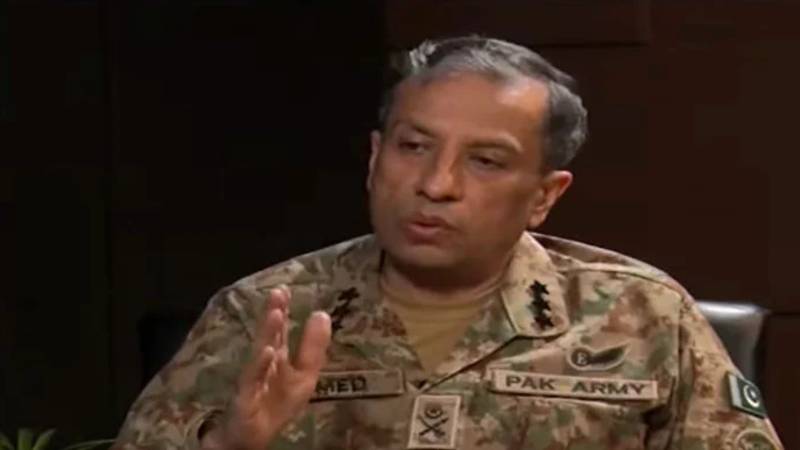
Director General Inter-Services Public Relations Lt Gen Ahmed Sharif Chaudhry has said that Pakistan’s ongoing military campaign, including Operation Ghazab Lil Haq, is part of a broader war against terrorism imposed on the country, alleging that militants are operating from Afghan soil with external backing.
In an interview on Capital Talk hosted by senior journalist Hamid Mir, the military spokesperson stated that Afghanistan had become a hub for multiple terrorist organisations and that Pakistan’s actions were aimed at dismantling infrastructure used for attacks in the country.
“Afghanistan has become the centre for terrorists across the world; it’s a can of worms which Pakistan has pushed to close,” Lt Gen Chaudhry said, adding that Pakistan was fighting not only for its own security but for regional and global stability.
He said Pakistan had carried out precision airstrikes on 81 locations based on intelligence, targeting what he described as terrorist hideouts, ammunition depots, and drone facilities. He rejected claims that civilian or rehabilitation centres were targeted, calling such allegations misinformation spread by hostile social media networks.
“We used precision-guided munitions in all strikes. We do not use general-purpose bombs because of the risk of collateral damage,” he said.
The DG ISPR maintained that Operation Ghazab Lil Haq was not a standalone campaign but part of Pakistan’s long-running counterterrorism efforts. He described the conflict as one imposed on Pakistan, asserting that thousands of Pakistani civilians and security personnel had been killed over decades.
He alleged that Afghan territory was being used as a base for attacks inside Pakistan, citing incidents in Wana, Bannu, and Tarlai, where he said attackers were trained and dispatched from across the border.
“In every terrorism-related incident in Pakistan, Afghanistan is used as the base of operations,” he said.
Lt Gen Chaudhry further claimed that militants involved in attacks in Pakistan were Afghan nationals and that groups such as the Tehrik-i-Taliban Pakistan were being sheltered in Afghanistan.
He also accused India of supporting militant activity by supplying rudimentary drones to actors operating from Afghan territory, alleging a nexus between Indian intelligence agencies and the Afghan Taliban.
“They are providing rudimentary drones so that their signatures cannot be traced back to them,” he said.
Addressing recent drone incidents in Islamabad and Rawalpindi, he questioned whether Afghanistan possessed the capability to manufacture such technology independently, suggesting external involvement.
The DG ISPR said Pakistan’s air defence systems, operated jointly by the army and air force, were effectively countering drone threats through both kinetic and electronic means.
On cross-border escalation, he said Pakistani forces had initially targeted militant positions near the border, after which Afghan Taliban forces allegedly attacked 53 Pakistani posts.
“They started it by attacking Pakistan along the border at regular posts. This is our response,” he said, adding that Pakistan would “take them to task.”
He reiterated that Pakistan had no conflict with the Afghan people, describing them as “brothers and sisters” who were themselves victims of oppression under the Afghan Taliban.
“We have no issue with the people of Afghanistan. They are themselves suffering under these warlords who have imposed this war and have no connection with Islam,” he said.
The military spokesperson also alleged that the Afghan Taliban were using drug addicts as suicide bombers and that terrorism and narcotics were part of a broader “war economy” sustaining the regime.
Responding to international criticism over civilian casualties, Lt Gen Chaudhry said attackers often operated in plain clothes, making it difficult to distinguish them from non-combatants.
“When our posts are attacked, the attackers are not in uniform. They are terrorists in plain clothes; we cannot call them civilians simply because of that,” he said.
He cited a United Nations report claiming that over 20 terrorist organisations were operating from Afghanistan, reinforcing Pakistan’s concerns about cross-border militancy.
On diplomacy, the DG ISPR said Pakistan remained open to dialogue and had proposed third-party investigations into terrorist incidents, but accused the Afghan Taliban of failing to act against militant groups.
“You cannot talk about dialogue and at the same time send terrorists into our country. These two things cannot go together,” he said.
Outlining Pakistan’s end goal, Lt Gen Chaudhry said the objective was clear: to ensure that Afghan territory is not used for terrorism against Pakistan.
“The choice has to be made by the Afghan Taliban regime — what is more important to them: TTP or Pakistan; terrorism or peace,” he said.