

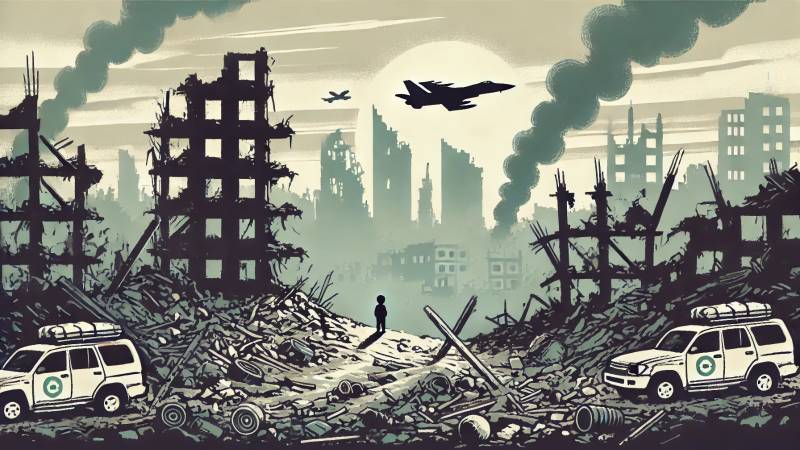
“Mum, I’m hungry. Are you listening?”
“Dad, you’re here! Look at me. I’m really hungry.”
A tiny voice, barely four years old, echoed among the ruins. Dust clung to the child’s face and his belly growled in protest. But his mother could only stare blankly at the devastation surrounding them. Her eyes, dry from too many tears, fixated on the emptiness where homes once stood. She looked at her son, then quickly dropped her gaze, choking back her sobs. Her shoulders trembled but she refused to let the sound escape.
“Mum, look! Sister’s still sleeping. I think she’s hungry too,” the boy continued innocently. “She’s been asleep so long. Can you wake her up now? I’m tired of playing this game.”
The mother’s hands clenched. She couldn’t respond. Her daughter, his sister, lay just a few steps away, unmoving. Lifeless. A child, no older than four, her tiny frame scarred by the war that had stormed into their home uninvited.
She collapsed beside her daughter’s body, to saw her. The father stood a few feet away, his jaw tight, fists clenched, tears fighting for space in his bloodshot eyes. He was a man at the edge of grief’s cliff, one step away from freefall. His daughter had been found after a violent assault during a bombing raid, left for dead by the very hands that claimed to be protectors of peace.
The little boy ran towards his father, tugging at his clothes.
“Dad, what’s wrong with my sister? Why isn’t she waking up?”
His father wiped his face, trying to summon strength he no longer had.
“Your sister… has gone to Allah,” he said quietly.
The boy blinked innocently. “But how will she live there without us?”
The boy looked around at the broken streets and said, “Our house is gone, my friends are gone too, did they go to Allah as well?”
His father knelt, placed his hands on the boy’s trembling shoulders, and replied, “Allah loved her very much. That’s why He called her home. She will be safe there. He’ll take care of her.”
The boy’s face lit up slightly. “Will she get lots of food? And nice clothes too?”
The mother, now curled over her daughter’s body, let out a wail that could have cracked stone.
“Yes,” the father whispered. “Everything. She’ll have everything she ever wanted.”
“Will she come visit us?” the boy asked.
“One day,” his father said, voice faltering. “One day, we’ll go to her. But not yet.”
The boy nodded, as if accepting this sacred truth. “Then I want to go too, Dad. I want to be with her.”
“No, my son. Not now,” his father said, his voice suddenly firm. “You must stay here. You must live for her.”
The boy looked around at the broken streets and said, “Our house is gone, my friends are gone too, did they go to Allah as well?”
His father said nothing. He only nodded, lips pressed shut, silently praying for mercy—for his son, for his people in Gaza. For the world to remember them not just as numbers in a death toll, but as families torn apart, as souls that once dreamed.
And then—another siren.
Another strike.
A blinding flash.
A moment of silence.
When the boy opened his eyes, everything was different. The dust was gone. The rubble, the smoke—all disappeared. He looked down at himself. He wore white, brilliant, glowing white. Confused, he called out, “Mama? Baba?”
And then he saw them; his mother, his father, and his sister—walking towards him, dressed in the purest light. Their faces were calm. Smiling.
“We’ve come to take you with us,” they said, reaching out.
He ran into their arms and together, they walked into the light. Away from the sound of sirens. Away from war. Towards peace that this world could never give.