

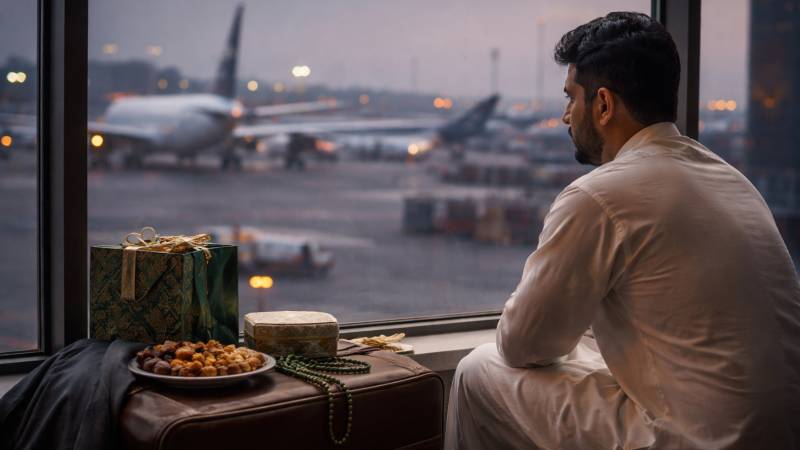
Eid is one of the most joyous occasions in the Muslim world. After thirty days of fasting, of waking before dawn, the Eid morning arrives as a breath of fresh air.
Chaand Raat is spent in last-minute shopping, making sure the dress is ready for Eid prayer and dessert is in the fridge to devour first thing in the morning.
For us, it is one occasion when relatives living across continents unite, as Eid asks of you: to come home, to share food, to sit at the same table with people, and to talk not through a screen but by sitting across the table in your living room.
For the Pakistani diaspora, this occasion is more than a yearly visit, and for their families living in Pakistan, this is the cure to their longing for a full house, like old times.
This year, however, Eid will be different for many, and the reason lies far beyond Pakistan's borders. Pakistani expats find themselves entangled in a war that was never theirs.
The ongoing Iran–Israel war is not only impacting oil prices, stock markets, and global trade; it has also resulted in disrupted airspace across the Middle East, the corridor through which almost every flight connecting Pakistan to Europe, the Gulf, and North America passes.
Return fares that were $760–$890 only a few months ago are now at $1,520–$1,900, with no sign of easing before Eid. But the flights are not the whole story.
They reveal the limits of distance and the deeper question that every diaspora family faces: who will care for our parents when we cannot be there in person?
Pakistani expats did not start this conflict, nor do they have the power to end it.
The thought of asking a maid, a relative, or a neighbour to be there in their absence on this joyous occasion is more heart-wrenching for those abroad than the thought of finding a cheaper flight.
Eid asks you to come home. When you cannot, the least you can do is ensure that the home is looked after, not by goodwill and hope, but by someone who actually shows up
On normal days, a cousin might help Ammi with grocery runs, or a neighbour might take Abbu to the hospital, but do they guarantee that they will be there with your parents on Eid too?
They might still look after them out of cultural or religious obligation, but with an increasingly individualistic culture, people are drifting away from those obligations. Goodwill, it turns out, has its own limits.
Moments like this reveal how fragile these arrangements are.
A group call cannot substitute for real care, and relying indefinitely on relatives is never a plan.
When a parent is discharged from the hospital and needs daily supervision, or when an elderly mother living alone begins forgetting where she last placed her favourite tasbeeh, distance becomes painfully real.
Some try to manage a father’s blood pressure from thousands of miles away through instructions over the phone.
But when flights are suddenly disrupted, and families realise they may not make it home for Eid, the panic exposes a deeper truth: elder care cannot be managed from afar through a video call, a maid, or occasional help from relatives.
Informal arrangements may have long carried this responsibility, but they were never designed to sustain the scale of today’s diaspora.
In Pakistan, an eldercare service like Mohsyn exists because of this recognition.
In many ways, Mohsyn is less a company than a surrogate sibling, someone who looked at the borrowed goodwill holding these arrangements together and decided to build a professional infrastructure around it instead.
One with dedicated support, consistent oversight of ageing parents, and real accountability, including on the days when the absence is felt most.
The Iran–Israel conflict may eventually change shape or fade away. Airspace will reopen, fares will fall, and people will find a way to be with their families.
A diaspora that sends home more than $30 billion in remittances every year keeps families afloat and local economies running across decades.
Yet the infrastructure of care has not kept pace.
These arrangements still matter, but they cannot guarantee that Abu, recovering from surgery, will have someone there when he needs it most, whether on an ordinary afternoon or on Eid morning when the house feels the absence most sharply.
Eid asks you to come home. When you cannot, the least you can do is ensure that the home is looked after, not by goodwill and hope, but by someone who actually shows up.