

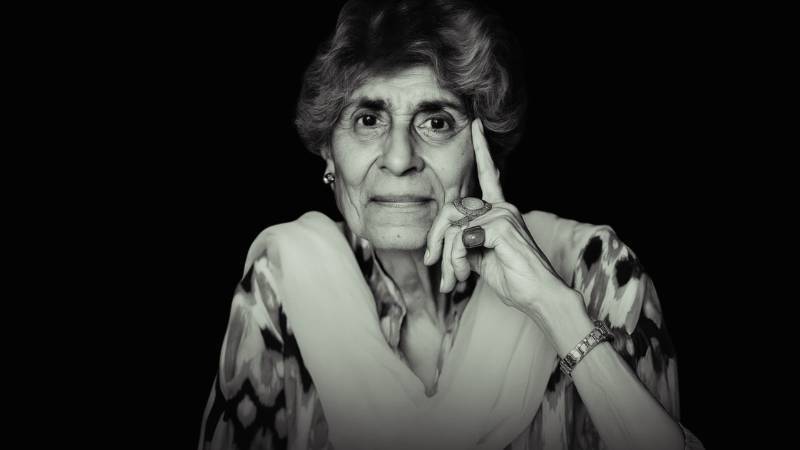
Sonu Rehman, the legendary educationist, teacher and phenomenal debater, has left for her heavenly abode. A renowned legend in the true sense of the word, she touched the lives of many generations of students, and anyone with the slightest interest in history, the English language or parliamentary debate knew her by name or by fame.
I had the good fortune to meet and interact with her in my capacity as in charge of the Headstart School debating society and as the debates coach. This beloved teacher, historian and the one who laid the foundations of parliamentary debates in Pakistan, and a mentor to thousands of young students, passed away in her favourite city, Lahore, and was buried in her family graveyard in Mardan.
She was the daughter of the renowned educationist Professor Sondhi and the wife of the late Abdul Rehman Khan of Mardan. Born into a Hindu family, she converted to Islam after marrying her Muslim husband. She had a passionate interest in debates and loved to work with youngsters, always encouraging her students to become debaters.
After marriage she remained a homemaker and started teaching after the death of her husband, almost at the age of 60. So in fact, it was a fairly late start to her brilliant career in education and debates. Her father was a very liberal and highly educated person who encouraged her to take up a career, but she did not do so during the lifetime of her husband.
She was very vocal and assertive, believed passionately in the freedom of speech, and encouraged debate and discussion by giving her students challenging and controversial topics to debate upon. She encouraged boys and girls equally.
She once wrote in Ravi (Government College’s magazine):
“I was amongst those lucky ones whose college years were spent in pre-partition Lahore. For us students, Lahore was where students came first. It was a city where cultural activities were central to its existence, especially those in which students took part. Debates, plays, musical concerts, competitions and athletics filled our lives. But above all was the love and respect we had for our great teachers which made learning and the love of books an ingrained part of our lives.”
She was of the view that she had achieved the status of being called a liberal:
“I help open minds and the fact that I’m worth listening to. The fact that I’m respected is a great achievement. Without even aspiring for it, I ended up being a highly respected person, with children and my old students coming up to me. I love it.”
If she felt you were in the right, she would protect your interests like a fierce lioness
Sonu Rehman was a confirmed believer in the secular system of governance and always dreamed of a secular Pakistan. She loved the secular atmosphere of Lahore during the early years of independence. She started her teaching career with the Bloomfield School in Lahore just a year after her husband’s death.
Very soon she blossomed into an excellent teacher, a devoted debater and a wonderfully warm human being. Ms Sonu Rehman was the founder and the matriarch of parliamentary debate in Pakistan and will be remembered forever as the founding president of the Debating Society of Pakistan. She can never be forgotten as one who inspired confidence and eloquence in all who had the good fortune to be taught or coached by her.
After completing her matriculation, she enrolled in Kinnaird College Lahore and remained there for the next four years until graduation. Her father was appointed Principal of Government College Lahore in 1939, so he shifted both his daughters to the Government College. In those days, very few girls went to college, so Sonu Rehman was the only girl in her Government College class, with about thirty boys in the same class.
During a recent interview she narrated:
“The only person I knew was Krishan Khanna, a childhood friend. By the way, he was to become a world-famous artist, but at the time was my only defence in a world of staring males. Gradually my fears abated and I became friendly with others in my class. Lahore had a rich variety of different religions and cultures.
Amongst those I came to know were Hindus, Sikhs and Muslims. After partition I only met a few occasionally when I would go to India to meet my parents. By now several have passed away, but thanks to the many re-union events encouraged by Dr Khalid Aftab, I was able to meet one of my classmates last year; Sardar Pushpinder Singh, who sought me out and came over with his wife to meet my family.
We were meeting after 60 years! We could not stop talking ‘about those days’ and I had tears in my eyes when they left. It was as if once again the old Lahore was disappearing.”
Lahore Grammar School, where she taught for many years, expressed its pain and sorrow in the following words:
“It is with deep sorrow that we announce the passing of Mrs Sonnu Rahman, who was a faculty member of A-level World History for many years at Lahore Grammar School, Senior Boys, JT. However, she was not only a beloved teacher and colleague, but also an excellent travel companion on numerous international school trips to China, Spain, Morocco and Russia, to name a few.
Mrs Rahman was a champion of every person’s right to free speech and encouraged her students to entertain another’s point of view, even if they did not agree with it. She did wonders in inculcating the ability to think critically and was a die-hard optimist. Those students who knew her never forgot her indomitable spirit. She defied age and had a young soul, hungry to learn and to disseminate knowledge.”
The contributions which Mrs Sonnu Rahman made to the cause of debate in general, and to the Debating Society of Pakistan in particular, are ground-breaking and far-reaching. She is truly a founder of the institution of debate and her contributions are rightfully celebrated in a debate contest held in her name.
Another quality of Mrs Sonnu Rahman was her ability to offer ‘tough love’. If she felt you were in the right, she would protect your interests like a fierce lioness. However, if she felt a critique was in order, she would not shy away from telling it like she saw it. In this regard, she could be relied upon for absolute integrity.
We offer sincere condolences to her family, her children and grandchildren, and to everyone else who knew her as a friend, mentor, guide or teacher.
Mrs Sonnu Rahman, you will be missed indeed, but the angels in heaven must all be rejoicing.
Inna lillahe wa inna alaihe rajeoon.