

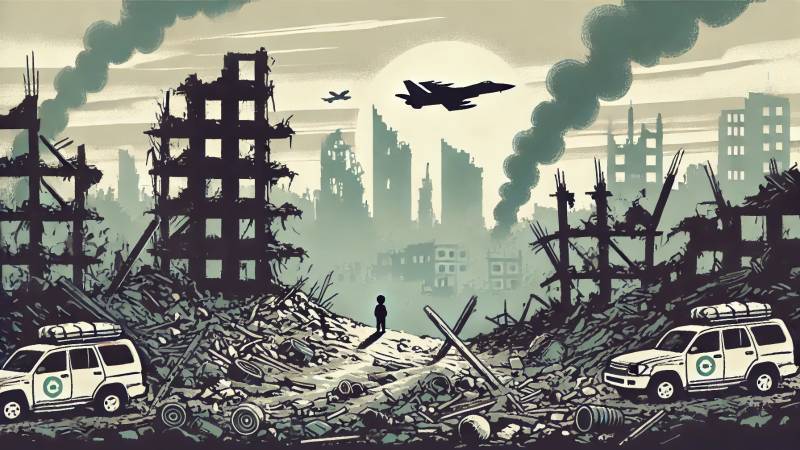
“War is a massacre of people who don’t know each other for the profit of people who know each other but don’t massacre each other”—Paul Valery
Conflicts, disputes, and disagreements are common among human beings. There is nothing unique or surprising to learn that two or more people are not getting along with each other. Likes and dislikes vary on innumerable subjects that prevent humans from an absolutely tranquil existence. Thus, agreeing to disagree becomes the only humanistic way out, where all are allowed to exercise their choices without infringing upon others’ freedom or space. This also means that respect is shown for different opinions while retaining one’s own.
On a one-to-one relationship this is fairly easy to handle where for example, an atheist husband can be on excellent terms with his orthodox wife without hurting one another’s sentiments or a Zoroastrian boss may be hundred percent dependent for his profits on his Muslim engineer or the only source of knowledge for an enthusiastic Palestinian student of history is an Israeli professor. In all these cases, the pursuit of humanistic objectives rises above all kinds of ideological or nationalistic differences, bringing everyone under one umbrella of peace and prosperity. However, on the world’s political stage, this dream is nothing more than living in a fool’s paradise, as apparent from the recent events in South Asia when two nuclear states came to the brink of annihilating themselves.
The twentieth century has gone down in history as becoming notorious for its deadly wars and realignment of nation states chalking out new boundaries to limit people within specified territorial jurisdictions to the extent of creating separations between relatives and close allies. Despite being confined, these entities could not stop themselves from craving for natural resources across their own borders, now appearing inaccessible. Signing various international agreements became a huge obstacle in the path of direct intervention, necessitating the creation of bogies to frighten nations into blocs poised against one another. Now it was easy for big bullies to take over weaker nations in a subtle manner by dragging them into proxy wars with their neighbours, creating pockets of perpetual regional disturbances.
Since the chief proponents of wars are the hostile leaders of states, they should go for an open duel rather than subjecting innocent members of their public to losing lives when they are never involved in the first place in fights of which they are clueless or have no say
As we advance into the twenty-first century and with the emergence of a new generation of world citizens who are breaking territorial boundaries and connecting to each other across an invisible web (thanks to modern technology), false myths of these old school giants are fast declining. The dawn of the internet, together with fast circulating information, is making it more difficult for propagandists to convince people to believe whatever these bigwigs cunningly want them to imagine. Pangs of separation are gradually alleviating, allowing space to virtually link up with those who were out of reach because of politically imposed divisions.
There are multiple ways for the resolution of conflicts, but over the centuries, the most favourite one is where weapons are used as a license to kill and establish supremacy of physical power to force a surrender. The stronger, of course, emerges victorious, thrusting its decisions on the vanquished. Till today, most peace accords are only signed between those who are equally placed as far as their military strength is concerned.
The question is, who decides to go to war? The people? No. Armies? No. Neither of these is interested in losing lives or their valuable assets, although they seem prepared for the ultimate. The signal comes from those who are secure within their palatial confines and who will never venture out without adequate protection. When gripped with war hysteria, everyone seeks to safeguard personal interests, letting professional mercenaries go ahead with their job. In such circumstances, the most vulnerable are ordinary civilians and soldiers. One does not need to show any proof, as these are well-recorded in historical annals.
Considering H.G. Well’s famous quote: “If we don’t end war, war will end us” and Albert Einstein’s prediction: “I know not with what weapons World War III will be fought, but World War IV will be fought with sticks and stones,” one can say with confidence that other than peaceful negotiations there is no right way to end conflicts.
The only hurdle that seems to be in the way is how to bring two belligerent parties face to face to a table. There is someone or something that keeps eternal enemies from talking to one another. Anyhow, there is a solution that is already available, and which was resorted to until the nineteenth century. DUEL.
Based on a code of honour, duels were fought to settle long-running disputes on one basis. Without causing unsolicited suffering to bystanders, a fight ensued between individuals with swords and later pistols. The idea was not to kill but to risk one’s life for the restoration of pride and honour. Interestingly, public opinion and not legislation brought an end to this exercise.
Since the chief proponents of wars are the hostile leaders of states, they should go for an open duel rather than subjecting innocent members of their public to losing lives when they are never involved in the first place in fights of which they are clueless or have no say. Engaged in battling day-to-day problems of their own existence, they are made to become targets of artillery for which no sanction was sought from them. Only on account of the bloated egos of their leaders, they become food for the ravenous forces of destruction, just like the way helpless humans of the cave ages were, at the hands of wild beasts,
A hand-to-hand duel between antagonists who are blind to the benefits of peace and peaceful co-existence seems the only solution to end global destruction. Thus, Zelenski and Putin, Netanyahu and Hamas representative, Modi and Shehbaz, et al, should think about the prospect of appearing on the stage of the United Nations to face one another in a bid to end public sacrifice.
Ending on this note, echoing William Tecumseh Sherman’s words: “I am tired and sick of war. Its glory is all moonshine. It is only those who have neither fired a shot nor heard the shrieks and groans of the wounded who cry aloud for blood, for vengeance, for desolation. War is hell.” Let us bring an end to this madness.