

The BNU work presented for the Masters Thesis this year took my breath away. Each student had a distinct voice and presence, which was amply evident in the work on display, as well as in their connectivity to their work. As a whole too, the exhibition was not overly curated, which I found made the work more accessible. It was evident that each student whom I spoke to, was deeply involved in their practice. They were cognizant of the materials they had worked with, they had in-depth knowledge of where and how their investigations into their areas of interest had started. Each journey undertaken whether it was the first idea or the first exploration of material, I felt, was made apparent in the final outcome. The traces of the first marks, stitches, scratches and daubs of colour are important to leave visible, but this takes a certain kind of courage. It was also heartening to see how well matched the ideas were to the mediums chosen.
Memory, perception, loss of control, empowerment through self-realisation, awareness of the environment, loss and death, time, a hankering to return to childhood and a time of innocence were the themes within whose oeuvre, this year’s 15 artists posited their work.
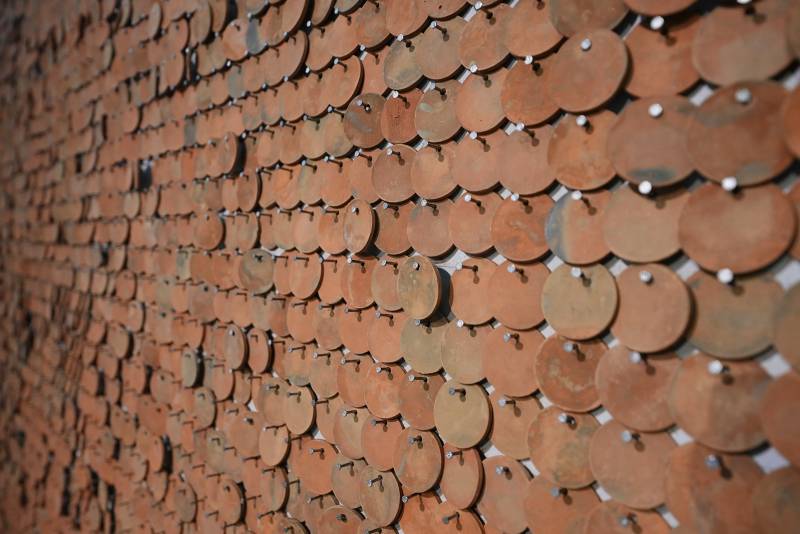
Memory of touch and sensation were explored very differently from each other in the sculptural work of Kulsoom Mehmood and Mahnoor Naveed. There is an underlying current of almost palpable anxiety and fear. The strong visual vocabulary employed by both artists focused on the sense of touch and proximity. Mehmood’s wall of clay scales that trembled and shook reminded me of armour. It’s ironic and telling that malleable clay is used to shield and protect when it is itself breakable. The elements of danger, of fear which unwelcome and threatening proximity can bring, are sensitively and beautifully expressed in her work. While there is a deep-rooted distress in Mehmood’s sculptures which resonate and reverberate with sound, Naveed’s video made for distress in another way. Here the overt sensuality of silk and skin and other textures was underscored by a sense of unwilling possession. Both artists speak from the feminine perspective. Shazma Arshad contributes another view through the lens of the feminine. The female body is celebrated, through the colour green associated with shrines and with tinsel, also seen at shrines. Set against the backdrop of references to religious places of worship, there is a primal element in the way the paintings are resolved which point to the underlying fragility and brittleness of the ordinary woman.
This year’s fifteen artists anchored their work in profound themes ranging from memory, environmental decay, and surveillance, to empowerment and the longing for lost innocence
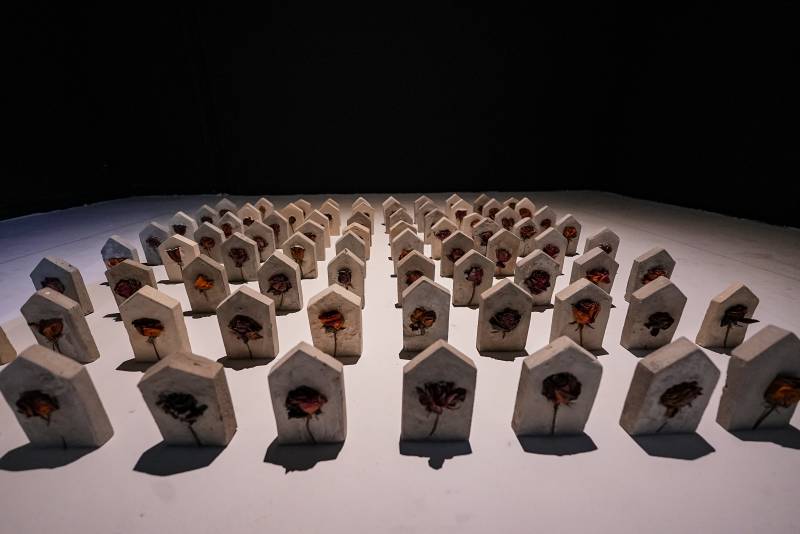
This aspect of proximity, fear and un-safety is viscerally experienced in Gulsoom Musa’s installation of tombstones and roses. The unquiet history of Balochistan is the reference point for the images of a graveyard, which has now become a meeting place, for both the dead and the living community of survivors in that locality. The sheer resilience of a battered, targeted peoples who continue to play, work and live amongst the ruins, is a testament to will power and to overcoming the odds. The video runs on a loop showing the scuffed shoes of children playing in a wasteland. Muhammad Zaman too explores hierarchies of power, the unseen ropes that keep us tethered to our designated places. Surveillance in its crudest form is now always part of our daily lives. The recording of unimportant details in the course of a given day, day after day, hour after hour, speaks to the levels of mistrust, untruth and lack of privacy in our world today. The monotonous reiteration of the commonplace, un-threatening daily round of activities that make up our lives are monitored and examined. One wonders as to what the collective outcome of such dedication to suspicion will be.
Escapism and a longing for a safer world is seen in the work of Muzamil Chandio. His enjoyment of drawings which are deliberately childlike remind one of Picasso famous quote, ”It took me four years to paint like Raphael, but a lifetime to paint like a child.” In the context of the frightening present that we live in, we all may want to escape into the realms of a secure and happy childhood. The value of time, past and present is at the root of the matter in this work. It is however scored and bloodied with the experience of living.
Responsibility and awareness are two dirty words today – how the waste and disregard of decades, in truth centuries is now coming home to roost. All around us in our daily routines we contribute unthinkingly to the pile up of dangerous waste. Sadaqat Ali and Amjad Tunio have broached these weighty themes in their distinctive ways. Ali’s sensitively rendered and quiet paintings speak to lands ravaged by waste, by erosion, by unconsidered disposal of poisons. Nature and man made structures vie against each other. The juxtaposition of damage against sensitivity is a testament to the painterly skill of the artist. This is a world where chaos rules. These images speak too to the yards of woven plastic made by Tunio. Here, too, there is a silence, but this is weighted down by the toxic nylon. By overlaying natural materials on those garish printed colours on the flex has created an altogether subtler pattern
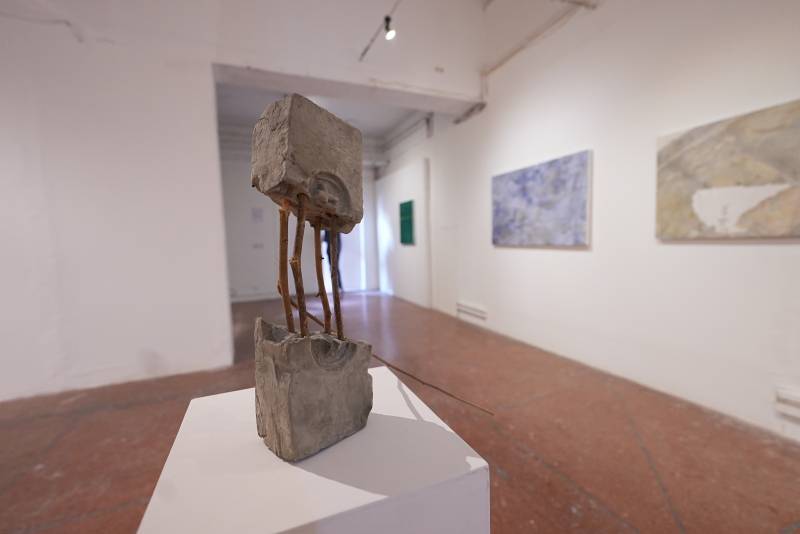
In Humd Shaikh’s work Nature is explored with reference to textile waste and consumerism. This work speaks to our societal mechanisms that propel us to keep acquiring and buying more and more, almost in a kind of frenzy. This manic mind set is seen in her Pollock-like sculpture created from off cuts and strikes a despairing note in her image of green fields and brown earth, where the destroyed fields are encroaching upon the good earth. The textile and fashion industry worldwide is a huge contributor to the carbon footprint. The world spins unstoppably on its way to destruction, while Nature is disregarded.
The labour that goes into something creative and in something destructive is also not ignored. Maqbool Jatoi’s iconography of workers tools speaks to their utterly miserable living and working conditions. The word ‘safe’ doesn’t apply to their working conditions. But it is the lack of expectation perhaps that is even more heartbreaking. This is their eternal grim reality and their spirit is so bowed that they cannot question fate any longer. The broken implements of their trade say it all, worn through, rusted and torn.
Shifting into the medium of film, Hafsa Nawaz and Jawad Hussain both explore simple themes of growth, replanting, and of the wonderful eco systems within nature. The eternal cycle of life, growth, decay and death are explored here. Nature’s systems heal and promote life. The span of life is unimportant if it’s living out its existence within the laws of Nature. It is no coincidence that in a group of graduates so much stress has been laid on our dying planet. Not only is it the question of the moment, but as the atmosphere of doom pervades all our lives, we can expect such work as a response to it.
Seemingly divorced from the organic, Fawad Hassan Jafri’s geometric shapes, in solid colours offer an escape from the madness of our present day. Their undemanding presence creates areas of calm reflection. Relying on proportion, geometry and colour, Jafri executes his sculptures with simplicity and precision. In their undemanding space, perhaps the unrelenting mills of God slow down.
In her resonating study of the importance of sunlight Arooba Rauf brings to the fore a fact that we may intuitively have known but to see it interpreted through a structured experiment affirms the fact. Not only school children, but all of us inhabitants of this earth need to see the sun. Without it, life will be extinguished. On a darker level of course her work speaks to the pressures of our lives; where we seek to fill in every hour with activity. This results not in huge arcs of learning and achievement - quite the opposite. To have no time to play, to read a book and to take part in a conversation, one conducted face to face and not on a mobile phone, brings us closer in touch with what we need in order to re-centre ourselves. For all the ‘connectivity’ today, we are growing ever more separate from each other.
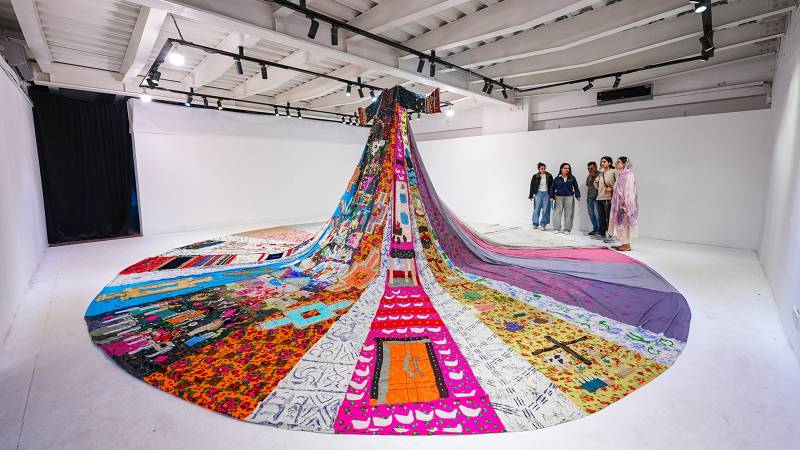
I want to end on a note of hope. I want to speak of resistance and courage in the face of manmade, ecological disasters. I found positive energy in the acts of re- claiming and enlivening traditions and histories in the iconic dress by Salva Umer. This monumental dress form stood like a cruciform beacon, almost like the figure of Christ blessing the city of Rio de Janiero. Despite the references to sacrifice, encroaching urban sprawls and destruction of the rural landscape in it, the reclamation and acknowledgment of old embroidery patterns, rooted in traditions of community, support, of joining families, seemed to weave the past into our present. This was a positive and energising portrayal where a bridge to something good was created.
When a work of art is able to communicate the thoughts of the artist to a viewer, I consider that successful. Successful in the sense that the marriage of initial concept, working and resolving an idea into ultimate form have resulted in work that needs no further explaining. The concept is understood and makes for revisits or allows work to be remembered with clarity, each time bringing other latent nuances into view.
The fifteen artists in this year’s Masters Degree exhibition were indeed successful.