

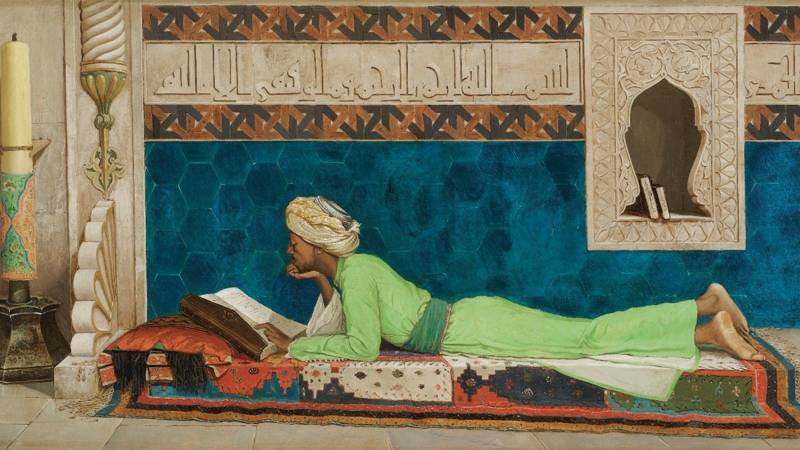
It has been over seven decades since the Union Jack came down. Yet walk into any elite university in Lahore or Karachi, and you will find students who can speak with fluency about Foucault's concept of the episteme or about the Frankfurt School's critique of instrumental reason. These are not unworthy things to know. But ask those same students about Shah Waliullah's theory of social organisation, or Al-Biruni's philosophy of comparative civilisations, or even the basic contours of the intellectual tradition that shaped the world their grandparents inhabited, and you will encounter, more often than not, a polite and slightly embarrassed blankness.
This is what colonial education accomplished at its deepest level. Not merely the imposition of a foreign language or a foreign administrative system, those are visible, and the visible can be contested, but the slow replacement of a civilisation's instinct for its own knowledge with a borrowed set of references, a borrowed set of questions, and most fatally, a borrowed sense of what counts as serious thought.
Macaulay was at least honest about the project. His 1835 Minute on Indian Education is an extraordinary document, less because of its arrogance than because of its clarity of purpose. The goal was not to educate Indians in any expansive sense, but to produce administrators: people literate enough to be useful, and oriented enough toward English taste and English judgment that the machinery of empire could run with minimal friction. That the descendants of those administrators would one day run sovereign states was not, presumably, part of the calculation. But the machinery remained. We inherited it. And in many respects, we have maintained it faithfully.
Geographically and culturally, Pakistan sits at a vibrant intersection of the Persianate, Arabic, South Asian, and Central Asian worlds—a natural, overlapping zone of scholarly exchange
The university curriculum in Pakistan today is not identical to what it was under the British. There have been adjustments, but the underlying architecture, the assumption that rigorous knowledge is Western in origin, that the proper scholarly conversation is conducted primarily in English and oriented primarily toward Euro-American academic concerns, that our own intellectual traditions are at best supplementary and at worst pre-modern curiosities, has proved remarkably durable.
For a long time, a certain kind of Pakistani liberal intellectual made a reasonable-sounding argument that went something like this: the Western intellectual tradition, whatever its origins in colonial power, had nonetheless generated the most rigorous and universal frameworks available for understanding the modern world. The smart thing, the modern thing, was to master the dominant frameworks and operate within them. It was not an entirely foolish argument. But it rested on a faith in Western institutional integrity that has, in recent years, been tested in ways difficult to ignore.
The events of the past two years, the destruction visited upon Gaza and the response of Western governments and institutions to that destruction, have produced a reckoning whose implications extend well beyond the immediate horror of the violence. What became visible, with unusual clarity, was the distance between the declared values of the Western liberal order and its actual operating logic. None of this was entirely new. Students of colonialism and Cold War history could have pointed to earlier instances in which the universalism of Western liberalism proved to have significant geographical exceptions. But there is something clarifying about watching it happen in real time.
The point is not to descend into simple anti-Western resentment, which is both intellectually lazy and practically useless. The point is that a particular ideological claim, that Western liberal institutions represent not one tradition among others but the universal destination of human progress, has been weakened in ways that create genuine intellectual space. Space that Pakistan, if it were willing to be serious about it, is unusually well-positioned to occupy.
Consider what Pakistan actually is, geographically and civilisationally. We sit at the intersection of the Persianate world, the Arabic-speaking Islamic world, the South Asian subcontinent, and the Central Asian steppe. For most of recorded history, these were not separate civilisations sealed off from one another but overlapping zones of exchange. There is a natural scholarly community here that shares enough in religious tradition, in Persianate literary inheritance, in the experience of colonial interruption and post-colonial confusion, to constitute a genuine conversation.
What would it mean, practically, to begin taking this seriously? It would mean that our universities treated the Arabic and Persian intellectual traditions not as heritage objects but as living resources. It would mean that the HEC oriented a meaningful portion of its international partnership energy toward universities in Central Asia, Turkey, Iran, and North Africa, not instead of Western partnerships, but alongside them. And it would mean that the Pakistani intellectual class overcame its own internalised hierarchy of prestige, in which a degree from a British or American university confers a status that a degree from the University of the Punjab simply cannot match, regardless of the actual quality of the work. That hierarchy is not natural. It was constructed. And it can, with sufficient collective will, be reconstructed.
Iqbal wrote, in the Reconstruction of Religious Thought in Islam, that the task before Muslim civilisation was not to reject modernity but to subject it to critical engagement from within a living tradition, to think with and against the modern world simultaneously, neither retreating into nostalgia nor dissolving into imitation. It remains the most honest formulation of the challenge. It was written nearly a century ago. We have not yet risen to it.
Pakistan is a country that sometimes struggles to believe in itself. But consider what we actually are: the inheritors of the Indus Valley, the Gandharan crossroads, the Mughal synthesis, the reform movements of Shah Waliullah and Sir Syed, the revolutionary poetry of Faiz and Iqbal. We are not a peripheral country. The West's moral credibility is at a historic low. The moment is uncomfortable. But for those willing to do the intellectual work, it is also, quietly, an opening.
It is time to remember what we know.