

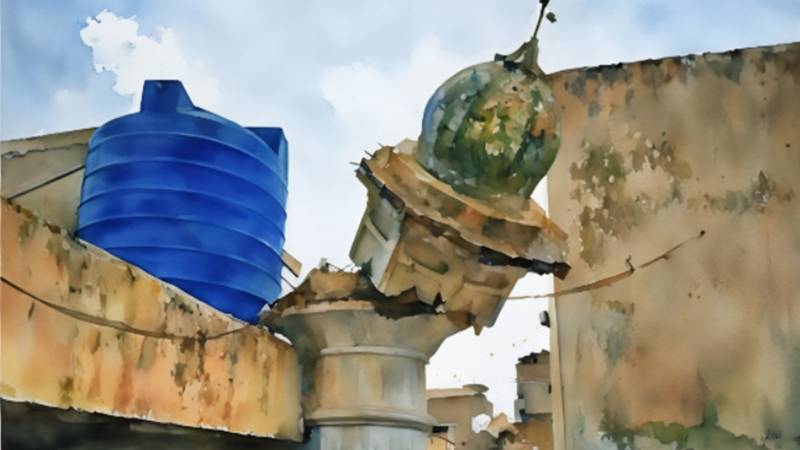
Ramadan can be a particularly dangerous time for Ahmadis in Pakistan. In 2024 ahead of Eid-ul-Azha, Ahmadis were placed in preventive custody so that they could not engage in qurbani because of its association with Islam, with Ahmadis constitutionally declared non-Muslims and legally prevented from posing as Muslims. Just before Ramadan this year, at least 28 Ahmadis were arrested in Punjab when they gathered for prayers, under pressure from members of the Tehreek-i-Labbaik Pakistan (TLP). A few days later, 25 Ahmadis were placed in “protective custody” after a similar incident unfolded.
The community’s properties are also at risk. An Ahmadi place of worship built by Sir Zafarullah Khan before Partition in Daska was demolished by local administration on 16 January, allegedly because the building’s extension encroached upon a public road. But this is not the first time that it has been under attack. Back in September 2023, members of the TLP had threatened to destroy the minarets of the very same place of worship for violating sections 298-B and 298-C of the Pakistan Penal Code. Members of the TLP are often shown to be responsible for, or at least party to, acts of violence against people and property for alleged transgressions of these sections and the penal code’s wider offences relating to religion.
I argued in my doctoral thesis that Jinnah refused to be drawn in by the anti-Ahmadi movement spearheaded by groups like the Majlis-i-Ahrar-i Islam
This case is slightly different, in the sense that offences relating to religion have not been cited as the justification for the demolition of the place of worship. The Lahore High Court had ruled in April 2023 that Ahmadi places of worship built prior to the adoption of sections 298-B and 298-C in 1984 would not be demolished, though this did not ensure the protection of a place of worship in Kot Karambakhsh demolished in November last year. It should also be noted that sometimes there is no evidence that places of worship targeted by groups like the TLP and local administration contravene sections 298-B and 298-C, especially if they are not labelled as a masjid and the caretakers do not use the azaan. Rather, these sections are more loosely interpreted to ensure action is taken against the Ahmadiyyah community by making the claim that Ahmadis are posing as or claiming to be Muslims. For example, there is no explicit reference against using minarets on places of worship, but the minaret is perceived to be specifically an Islamic architectural motif, though even this is disputed when looking at its historical origins.
The destruction of such places of worship is not just about religious freedom, although this is a very important matter. Since the revisions to the Mubarak Sani case last year, the space in which Ahmadis can express their faith is shrinking. But it is also about existential and historical violence, insofar as the commonality of such destruction, whether by members of the general public or by the authorities, is dismantling the very existence and history of the Ahmadiyyah community within Pakistan.
As noted, the place of worship in Daska was built by Zafarullah Khan, the first Pakistani foreign minister (1947-1954). He was also a key figure in the All-India Muslim League and Pakistan Movement alongside Muhammad Ali Jinnah prior to independence. The significance of Jinnah in this context is that Pakistanis often mention Jinnah to justify their vision for Pakistan or certain ideological positions. I argued in my doctoral thesis that Jinnah refused to be drawn in by the anti-Ahmadi movement spearheaded by groups like the Majlis-i-Ahrar-i Islam. One letter from a member of the Ahmadiyyah community in 1944 shows that he was asked to comment on whether Ahmadis were allowed to be members of the Muslim League, given that membership to the primary branches was conditional on being a Muslim. Though Jinnah did not explicitly state in his response whether or not Ahmadis were Muslims, the fact that he did not expel Zafarullah from the Muslim League and supported his role as the foreign minister suggests that he considered Ahmadis as legitimate members of the party, and he faced a backlash for this stance.
After Jinnah’s death, the desire to have Ahmadis declared non-Muslims in Pakistan would later lead to widespread violence in both 1953 and 1974, with Zulfiqar Ali Bhutto’s government eventually caving to such pressure to have Ahmadis constitutionally declared non-Muslims through the Second Amendment in 1974.
The destruction of Zafarullah’s place of worship is further evidence of the marginalisation of the Ahmadiyyah community in Pakistan, despite the service that they have extended to the country since its inception. Another example is the violence shown towards the legacy of Abdus Salam, the Nobel Prize-winning physicist. The word “Muslim” was removed from his grave from a line that read: “the first Muslim Nobel laureate.” Many other Ahmadi graves and graveyards have been desecrated for use of the kalima, which is an act any person should be horrified by. In 2017, a member of the National Assembly also publicly criticised the renaming of Quaid-i-Azam University’s physics centre after Salam because of his Ahmadi faith. By contrast, Imperial College London, where Salam worked, named its new library after him for his contributions to physics in 2024 and unveiled it on his birthday. Therefore, the exclusion of Ahmadis from the Pakistani conception of Muslimness extends to their exclusion from national acclaim, too.
A significant factor to consider is the growing popularity of groups responsible for violence against religious minorities, particularly the TLP. A Gallup survey conducted in June 2023 found that the TLP was the third most liked political party after Pakistan Tehreek-e-Insaf (PTI) and the Pakistan People’s Party (PPP), and that the TLP’s chief was the second most popular leader after Imran Khan. So, the TLP does have popular support which may one day translate into greater representation within the national and provincial assemblies. Not to mention how they have been able to exert influence over successive governments through pressure politics.
Violence against religious minorities in Pakistan is one of the most pressing challenges the country faces because it threatens the very fabric of society. As with young people increasingly turning to opportunities overseas, contributing to the so-called “brain drain,” persecuted religious minorities will also feel like they have no option but to move abroad. The journalist, Zia-ur-Rehman, recently conducted a fact-finding study published by the Human Rights Commission of Pakistan (HRCP) investigating the reasons why Hindus are said to be leaving Sindh for India and other countries. These include the destruction of the Babri Masjid in India in 1992 and the consequent anti-Hindu violence in Pakistan, fears for safety in light of the deterioration in law and order in Sindh, forced conversions, accusations of and misuse of offences relating to religion and the search for economic opportunity in light of discrimination. Therefore, it is not only Ahmadis who have turned to migration.
The result of the use and misuse of offences relating to religion is a sense of fear and insecurity within the Ahmadiyyah community, as Ahmadis could be accused at any time for reasons not explicitly mentioned in the offences. There is also the physical and symbolic erasure of their place within Pakistan historically that should be connected to wider attempts since 1947 to rewrite the country’s history and identity in a way that excludes certain communities or ideas.