

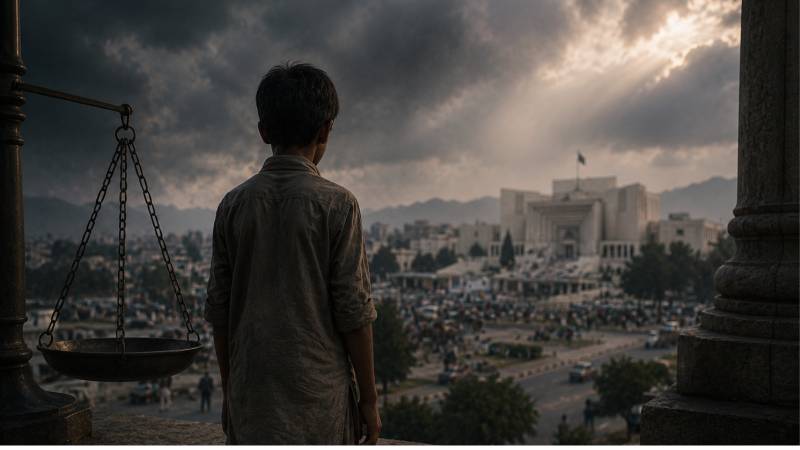
There’s an old joke President Reagan used to tell about the Cold War, and I’ve never quite been able to forget it, partly because, in my own quieter way, I once lived a version of it.
An American intelligence chief and his Soviet counterpart are out for a drive, each with a friend along. They pass a waterfall. On a dare, the Soviet chief tells the American’s friend to jump in. The American laughs it off; he has a wife and three kids, he says. So the Soviet chief turns to his own man. No hesitation. The man jumps. Fished out downstream, he is asked why he did it, and gives the exact same answer. Wife. Three kids.
Same words. Completely different reasons. One man could refuse because nothing would happen to his family if he did. The other jumped because something would have happened to his if he hadn’t. That is the whole difference between a free country and a frightened one. The question is simple: can you say no, or just say something, anything, without first running the numbers on what it costs the people you love?
I keep coming back to that joke because we’ve become a country that answers to the second kind of fear far more often than the first. Somewhere along the way, I couldn’t tell you exactly when, we built ourselves a system where there are only two certificates worth having. You’re a good Muslim if the self-appointed guardians of religion decide you are. You’re a good patriot if the establishment of the day signs off on it. Everything else, what you actually believe, what loving your own country looks like in your own words, counts for nothing until someone with the power to hurt you approves it. It isn’t really a nation. It’s more like probation, and we’re all serving it.
It isn’t just a problem at home, either. I’ve lost count of the Pakistanis I’ve met abroad who’ll tell you exactly what they think over dinner and then go quiet the moment you suggest they say any of it publicly. Not because they’ve run out of opinions. Because everyone still has someone, or something, back here within reach, and they know it. They left the country. They didn’t leave the fear; it just got a longer commute. And usually it doesn’t even land on the person who spoke. It lands on whoever they left behind.
I want to be upfront about something. I was hard on the last government for refusing to sit down with its own political opponents while it was perfectly happy to talk to the Taliban. I find myself making almost the same complaint today about the government we have now, except the silencing feels more practiced, and there’s less room left to disagree in. I’d rather be wrong and have things actually improve.
A country running on paralysed brains, no new thought, no development, whatever is left of the mind spent on working around the fear instead of putting the glass down.
What I really can’t get my head around, though, is this. I could understand, not agree with, just understand, this sort of fear coming from a far-right movement, the kind that treats disagreement as something close to heresy. What I cannot make sense of is finding it here, on either side of a border that cost what it cost. Pakistan and India were both born out of real sacrifice, by people who agreed on almost nothing except this one thing: that whoever came after them shouldn’t have to perform loyalty just to survive. Somewhere along the way, we both seem to have misplaced it.
So what would actually change anything?
Here’s an idea, for what it’s worth. Put every political leader, their loyal lieutenants, every senior establishment figure, civil bureaucracy included, and every member of the superior judiciary, on national television. One at a time, under oath, in front of the whole country, have each of them make three statements: that neither they nor their families built their wealth illegally; that they never used their office for unlawful benefit; and that they never knowingly committed intellectual dishonesty, under pressure or otherwise. Let that sit. Then pass a Truth and Reconciliation Act, the way South Africa did after Mandela walked free. Not to punish anyone, but because it’s about the only mechanism any country has ever found for closing a chapter instead of leaving it open and bleeding.
That is what starting over would look like. Not another commission whose report gathers dust, but people saying things out loud, under oath, on a record the whole country can watch, and then agreeing to put the ledger down and begin again.
None of this is really about one government or one general. It’s about whether the next generation of Pakistanis gets to follow a thought all the way to the end without first checking who might be listening in. We talk endlessly about investing in our youth while quietly building a country where the riskiest thing a young person can do is have an original idea. You can’t have it both ways. A mind that’s busy calculating risk isn’t a mind that’s busy making anything.
This isn’t just a lawyer’s hunch; the numbers tell the same story. We sit near the bottom of every index that measures the freedom to speak, 158th out of 180 on press freedom. Our standing on global innovation slips further every year. Seven lakh of our people, many of our best qualified, leave every year, and two out of three tell surveyors they would go tomorrow if they could. A country that punishes thinking should not be surprised when the thinkers stop, or leave.
A professor once held up a glass of water and asked his class how heavy it was. Wrong question, he said. The weight does not matter; how long you hold it does. A minute, nothing. An hour, the arm aches. A day, and the arm is paralysed. Fear works the same way, except what it paralyses is the brain. Carry it long enough and the thinking simply stops. That, I suspect, is where we already are. A country running on paralysed brains, no new thought, no development, whatever is left of the mind spent on working around the fear instead of putting the glass down.
Here is the connection we keep missing. Minds grow the way muscles do, by being used, and a mind is only used when it’s free to follow its own reasoning wherever that leads, including into error. Nobody arrives at a good idea except through a graveyard of bad ones, and a society that makes the bad ones dangerous never gets to the good ones at all. When every thought has to clear a loyalty inspection, people don’t just stop speaking. They stop thinking, because there is no point manufacturing a product you’ll never be allowed to sell. That is our real deficit: no genuine mental growth, and what little there is never reaching the quarters where it could matter. Other nations compound their ideas like capital. We are not standing still. We are moving backwards.
Nor is this poverty of thought something the powerful inflict on the rest of us. They drink from the same well. Sit through our talk shows, where nothing is said that anyone could repeat the next morning. Read the summaries our bureaucracy writes to protect their authors rather than inform anyone. The ruling class, the political dynasties, establishment, the civil bureaucracy, the television intelligentsia, is not hoarding intellect. It has none left to hoard. A system that permits only safe thoughts cannot produce thinkers even for its own service; the censor’s children turn out no brighter than the censored. The standard on display at the top has sunk so low that watching it no longer makes one angry. It makes one sorry. Sorry at how far down we have come, and at how little anyone up there notices.
The instinct of every ruling elite, ours included, is to watch a citizen start thinking freely and reach for something to put in his way. That instinct is the actual problem. Not the economy, not the institutions. Until we’re willing to let people say the inconvenient thing without flinching for their families, we aren’t really building a country. We’re just teaching one more generation to jump into waterfalls for reasons they’ll have to make up on the way down.