

There was a ferment of ideas originating from South Asia that influenced popular music in the West in the late 1960s and 1970s. Perhaps the most notable example was the Beatles' embrace, from George Harrison’s inspiration, of Maharishi Mahesh Yogi at his ashram in Rishikesh in northern India in February 1968. By accounts from all four Beatles and their biographers, this short period resulted in one of their most productive periods of songwriting, including nineteen songs from the White Album (1968), two songs from Abbey Road (1969), and ten songs from their respective and subsequent solo albums. The impact of their engagement with South Asian musical traditions in all these songs is perhaps unnoticeable to those unfamiliar with those musical traditions, but for those of us who know it, you can hear it.
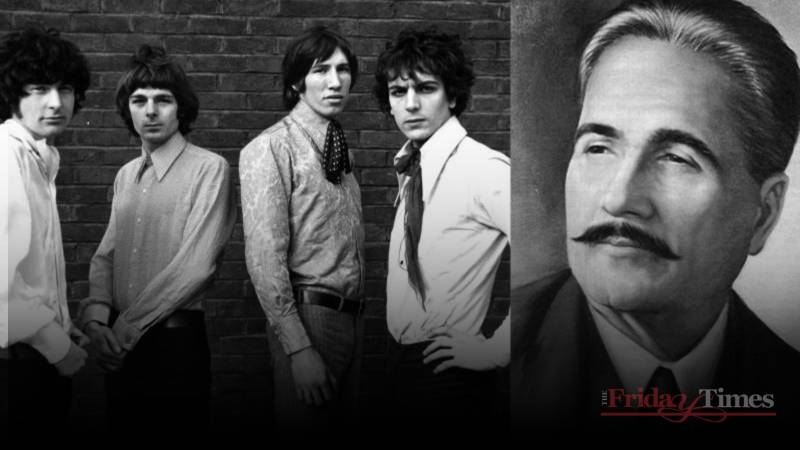
The Beatles were unique, but not alone among Western musicians who drew on South Asian ideas. Pink Floyd, or more specifically the four members of Pink Floyd, were people who read widely and deeply, and their reading inspired their musical compositions.
Roger Waters, the band’s main lyricist, had read Muhammad Iqbal’s poetry. Pink Floyd had been characterised as a ‘space rock’ band, somewhat justified as their post-Syd Barrett albums did lean into this genre, such as Saucerful of Secrets (1968) and their live performance on television during the Apollo 11 Moon landing (1969) that lasted for many hours given the complexity of humans landing on the Moon.
It is a lovely discovery to make how Iqbal’s words found their way into a song by a band whose music is globally renowned
The first draft, as it were, of the seminal Pink Floyd track Echoes from their album Meddle (1971) directly used the poetry of Muhammad Iqbal’s poem Two Planets (Payam-i-Masriq,) Message from the East), 1923):
Two planets meeting face to face,
One to the other cried, ‘How sweet
If endlessly we might embrace,
And here for ever stay! how sweet
If Heaven a little might relent,
And leave our light in one light blent!’
But through that longing to dissolve
In one, the parting summons sounded.
Immutably the stars revolve,
By changeless orbits each is bounded;
Eternal union is a dream,
And severance the world’s law supreme.
Some recordings of these early drafts of the song are available online, but in bootleg form, as they are not officially sanctioned by Pink Floyd.
Yet Waters’ dislike of the ‘space rock’ label the band had been given in the musical press led him to build on, and revise, the lyrics from Iqbal’s poem. Waters connected Iqbal’s planetary poetry to what he later referred Echoes to as an ‘epic sound poem’ towards a more earth-based sense of disconnection. Waters’ characterisation of the track as a poem is a reference to Iqbal.
‘One window in the apartment [Waters and his girlfriend Judy Trim’s apartment in Shepherd’s Bush, West London] down which the couple would observe an ant-like procession of commuters head off for a day’s toil and returning in the evening. The lyrics referring to strangers passing in the street, were, he [Waters] explained, all about making connections with other people. About the potential that human beings have for recognising each other’s humanity’ (Mark Blake, Pink Floyd, Pigs Might Fly, 2013 revised edition).
Iqbal’s poetry is of course wonderful. And while the lyrics of Echoes were revised, the metre of the lyrics remains the same as Two Planets. It is a lovely discovery to make how Iqbal’s words found their way into a song by a band whose music is globally renowned.