

In this era of technological marvels, from ground-breaking discoveries in femtotechnology to space exploration and quantum computing, humanity continues to push the boundaries of what was once thought impossible. Let’s pause and reflect on some milestones reached in just the past few years, like the Mars Perseverance Rover landing, Clustered Regularly Interspaced Short Palindromic Repeats (CRISPR) gene editing, and quantum supremacy illustrate how far human ingenuity has come. I don’t expect everyone to grasp the intricate details, but surely, we can all agree that these achievements are unusual. These advancements remind us that the extraordinary is no longer a distant dream but a tangible reality; making the impossible possible and opening new trajectories for progress.
Amid these modern triumphs, it's worth considering that what we now take for granted. Comforts and conveniences available even to those with modest means would have been unimaginable luxuries for rulers of bygone eras. Many primordial amenities—and their enhanced modern counterparts—are now widely accessible and affordable.
Take transportation as an example. From different types of vehicles to various models of the same vehicle, most people today have experienced traveling in one form or another. This availability highlights how far we’ve come in making luxuries of the past into everyday conveniences. Yet, if told that one amenity remains reserved for the elite or middle class, they might find it hard to fathom. This amenity, the possibility of air travel, remains inaccessible to many, owing to prohibitive costs, lack of awareness, and limited familiarity with the field. Therefore, air travel, even today, is largely reserved for those with the means to afford it. Imagine explaining to someone from centuries ago that despite the wonders of modernity, the ability to fly is still a privilege enjoyed by few. And as for the idea of a person flying independently? Well, that’s still considered utterly fantastical.
Hence, how astonishing the revelation would be that the concept of human flight predates these modern advances by over a millennium. Yes! Imagine being told that the first human flight didn’t happen 120 years ago in 1903 with the Wright brothers, but rather 1,124 years ago. And what if I told you that this flight didn’t involve a machine but an actual person, aided by wings?
Let that sink in. A man from the 9th century, living in a world far removed from the modern marvels we know, achieved what seems unfathomable even today. How did he, without the resources or technological advantages we have, manage to make history and leave a legacy of innovation?
So, the true pioneer of aviation, contrary to popular belief, was not Orville or Wilbur Wright but a Muslim polymath in his 50s or 60s. The notion of human flight, inconceivable even in today’s advanced world, was made possible by a man who transformed the delusional into the documented: Abbas ibn Firnas.
Nearly a millennium after Abbas Ibn Firnas's daring leap into history, humanity—with all its scientific advancements, cutting-edge machinery and sophisticated technology—still grapples with failure in the realm of flight
Abu al-Qasim Abbas ibn Firnas ibn Wirdas al-Takurini, better known as Abbas ibn Firnas, deserves more recognition. His name, often overlooked on bridges and airports, graces significant landmarks, such as the Abbas Ibn Firnas Bridge over the Guadalquivir River in Córdoba, Spain, and a statue near Baghdad Airport.
This pioneering aviator was Abbas Ibn Firnas, a polymath from the 9th century who lived in Córdoba, a major intellectual hub during the Islamic Golden Age. Alongside Baghdad and Cairo, Córdoba was a major centre for science, philosophy, medicine, arts and education. Much like the Silicon Valley of its day, ideas flourished, explorations were made, it was a place where scholars thrived under the patronage of the authorities. This period, spanning the 8th to the 13th centuries, was thus marked by extraordinary achievements in multiple fields. This period is a precursor to renaissance and scientific exploration in Europe in later centuries.
Abbas Ibn Firnas embodied the spirit of this era. A scholar of many disciplines—horology, physics, medicine, engineering, poetry, and astronomy—his contributions were both diverse and profound. His work ranged from designing a mechanized planetarium to developing methods for working with quartz crystals, which laid the groundwork for Andalusian glassmaking. He also made early advancements in optics, with inventions like the "reading stone," a precursor to modern corrective lenses.
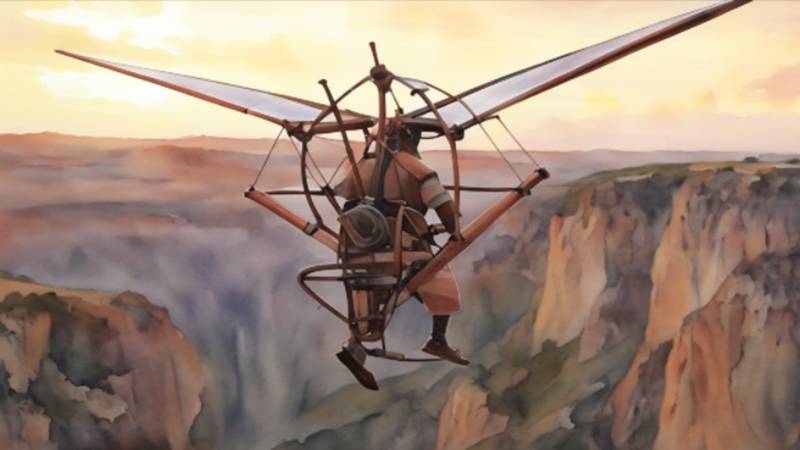
But perhaps his most audacious endeavour was his attempt to achieve human flight. After studying the nature of flight for 23 years, Ibn Firnas constructed a glider made of wood, feathers and silk. To test his invention, he leapt from a cliff at Jabal Al-Arus in Yemen. Incredibly, he managed to glide through the air for approximately ten minutes, demonstrating an understanding of aerodynamics that was centuries ahead of its time. Yes, you read that right: in air for ten whole minutes. These 600 seconds of flight were to forever mark him as the first person to be airborne much like Neil Armstrong’s first foot on moon. Of course, this endeavour, as much as it was historic, non-conventional and monumental, wasn’t a fairy tale with perfect ending.
However, it is also vital to point out that nearly a millennium after Abbas Ibn Firnas's daring leap into history, humanity—with all its scientific advancements, cutting-edge machinery, and sophisticated technology—still grapples with failure in the realm of flight. Rocket launches, despite meticulous planning and groundbreaking engineering, are far from foolproof. In 2022 alone, there were 186 launches globally, yet eight of them ended in failure—a 4% failure rate despite the rigor of modern space science. And for newer launch vehicles, the risks are even higher, with up to 30% of first or second flights failing.
Consider this: SpaceX's Starship, regarded as one of the most advanced rockets of our time, cleared its launchpad in 2023 only to explode mere minutes into its maiden flight. Failures like these underscore the inherent challenges of venturing into the skies, even with our unparalleled technological expertise.
Now, imagine the courage and brilliance of a 9th-century polymath like Abbas Ibn Firnas, who, with no sophisticated machinery or prior precedent, not only conceived but also executed the first recorded human flight. True, his landing was not flawless—a shortfall he himself acknowledged but, when juxtaposed with the frequent setbacks of today’s rocket science, his achievement is nothing short of extraordinary.
Therefore, Abbas’ problem in descent shouldn’t overshadow what he was able to achieve. His failure to land properly was acknowledged by him and worked for next so many years to identify the flaw and come up with solution. The landing, an aspect he had overlooked, ended in a crash that left him injured. Reflecting on the experience, he realized the importance of incorporating a tail into the design to aid in controlled landings—a conclusion reached through meticulous observation of bird flight.
Ibn Firnas's bold attempt was not only a testament to his ingenuity but also a foundational moment in the history of aviation, he was in the air for 1/6th of an hour! Ibn Firnas lived for another 12 years, continuing his studies and leaving behind a legacy that shaped the future of aviation. His pioneering work laid the groundwork for future innovations, influencing figures like Leonardo da Vinci and, eventually, the Wright brothers.
While his name might not be as widely recognized as it deserves, his legacy endures. Commemorating his contributions, even the moon honours him, with a crater named in his memory.
So, the next time someone mentions the marvels of modern aviation, remember Abbas Ibn Firnas, the man who defied the odds and flew into history over a thousand years ago.