


Sindhi tombs have their own beauty and appeal. In the plains and deserts, the beauty of a Sindhi tomb of Kalhora (1700-1783) and the Talpur (1783-1843) periods attracts the passerby from a distance. Massive structures with glittering glazed tiles or a white lime-plastered dome juxtaposed with the green patches of the field break the monotony of the plains. At some places, a solitary tomb stands with all its majesty, while at other places, a cluster of tombs seems to be rising from a mirage. In the parched plains of Kachho in Dadu and Kamber-Shahdadkot districts, the only visual appeal for the footloose photographer is the painted tombs. Even in the narrow valleys of the hill country in the Khirthar Mountain Range, tombs break the skyline. In every district of Sindh, the Kalhoras and Talpurs commissioned funerary monuments not only for themselves but also for their nobility. Like the Kalhora nobility, the Talpur nobility (1783-1843) also built impressive tombs reflecting the power they wielded in the governments of both dynasties.
The chiefs of many tribes who served the Kalhoras and Talpurs were bestowed with jagirs in return for their service. In order to attest their political authority, the chiefs of a certain tribe erected fortresses, mosques, and tombs, the potent symbols of their power. The tomb-building activity, in fact, was prevalent during the Kalhora and Talpur periods, creating the public identity of some tribal chiefs whose tombs dominated village landscapes. The more the loftier domes of the tombs, the more powerful, influential, and affluent the tribal chiefs were. If the tomb was commissioned by a ruler for his officer, it truly heralded his prestigious position, which he enjoyed in the Kalhora or Talpur governments. In the majority of cases, the nobles erected their tombs during their lifetimes, but in a few cases, their sons commissioned tombs to commemorate their fathers' heroic lives. Thus, the lavishly decorated tombs denoted the power and opulence of the builders.
The tombs of nobility or people who served them were also built, and are located across Sindh. Most of these tombs are built in a square plan. The distinctive feature of those tombs is the painting that decorates their interiors. Among the various themes painted on the interior walls of the tombs were folk romances, a theme that is an identity of Kalhora and Talpur period monuments. This theme frequently appeared in the tombs of nobles who served both the Kalhoras and the Talpurs.
At some places, a solitary tomb stands with all its majesty, while at other places, a cluster of tombs seems to be rising from a mirage
The most commonly depicted romances were of Sasui-Punhun, Suhni-Mehar, Lila-Chanesar, Moomal Rano, and others. However, the Sindhi painters also adopted non-local romances, notably Laila-Majnun. This romantic tale became the most favourite of Sindh's painters, who painted the walls of tombs built in Dadu, Larkana, Sanghar, and other districts. However, this romantic tale was chosen as a ready reference for painting in the tombs of the Kachho region, in the Dadu and Kamber-Shahdadkot districts. The painted Sindhi tombs reflect the material culture of the eighteenth and nineteenth centuries. This culture, evident in the interiors of the tombs, represents the identity of their builders and owners. People recognise these tombs by their diverse themes and the specific regions where they were constructed. The entire Kachho area, which encompasses the two districts of Dadu and Kamber-Shahdadkot in Sindh, is dotted with such tombs, celebrated for their romantic tales and rich material culture.
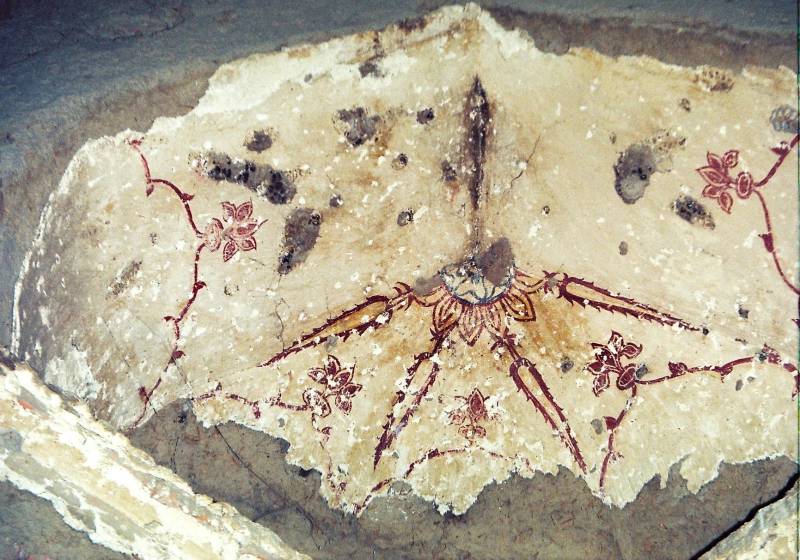
In addition to figural representations, painters also used various floral and geometric designs for the tombs. In Larkana and Kamber Shahdadkot, several historic graveyards feature painted tombs. Unfortunately, some of the paintings in these tombs have deteriorated over time.
Over the course of two decades of fieldwork in Sindh, I came across hundreds of tombs noted for their beautiful architecture. One such tomb is located in Rato Deo taluka's Khairo Dero village. Rato Dero is a taluka in the Larkana district. Khairo Dero is named after Khairo Faqir Gachal. It is located 3 km west of Bangul Dero in Larkana’s Rato Dero taluka. I first visited the village in 1998 and returned in 2000, 2002, 2004, 2008, and 2015. During these visits, I documented the tomb of Khairo Faqir Gachal and other monuments in the village. It is believed that Khairo Gachal served Mian Noor Muhammad Kalhoro (d. 1753). He also took part in the battle of Sanni, which was between the Kalhoras and the Brohis of Kalat.
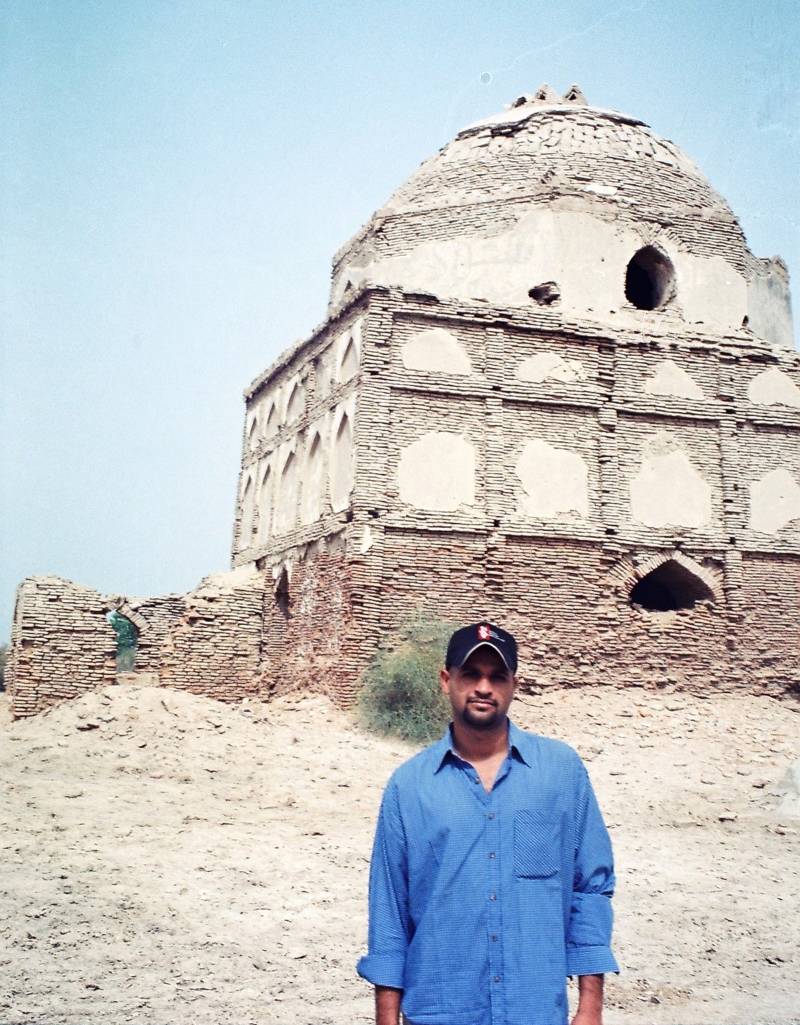
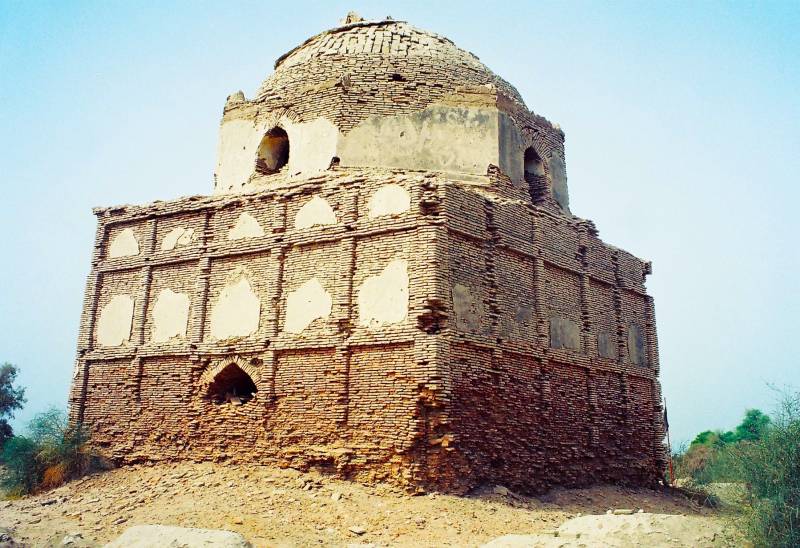
The tomb bears no inscription to fix its chronology. Traditionally, it is believed to have been built during the Kalhora period, most likely during the reign of Mian Noor Muhammad Kalhoro (1719-1753) or, possibly, later in the third quarter of the eighteenth century, during the reign of Mian Ghulam Shah Kalhoro.
The tomb is built in a square plan. The tomb's façade is marked with sunken panels. The same pattern repeats on all three sides of the structure. The monotony of the interior walls is also relieved by sunken panels. The main archway of the tomb faces east. Close to the main archway and attached to the southern wall are two small structures added later. The low dome rests on an octagonal drum with four ventilators to provide light to the interior. The drum's perimeter was marked with finials. Both the drum and the dome finials are broken. The tomb's parapet was decorated with merlons, which have now all collapsed.
The interior of the tomb is square in plan. Squinches transform this square interior into an octagonal form, which serves as the base for a dome that covers the tomb.
Additionally, the interior is decorated with floral paintings, a style commonly found in several tombs built during the Kalhora period.