

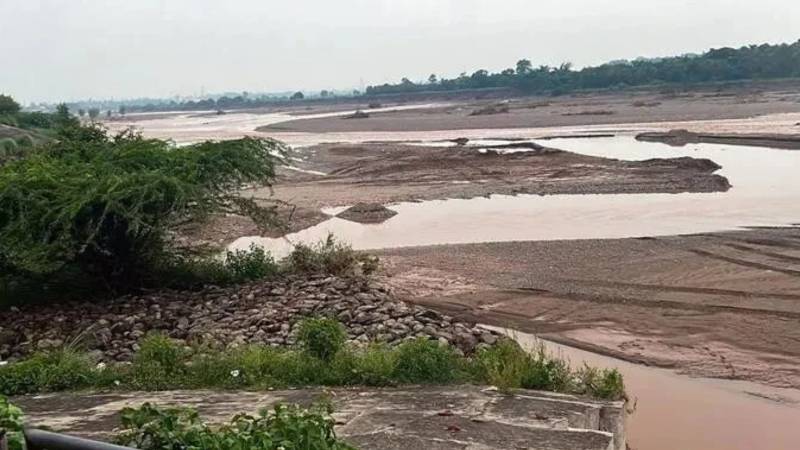
Long before it was called the Ghaggar or the Hakra, this river watered one of the world’s earliest urban civilisations. The seasonal floods of this elusive stream once fed the settlements of the Indus Valley, sustained long-distance trade across the Thar Desert, and recharged an ecosystem uniquely adapted to scarcity.
Though not mighty in volume, the river’s rhythm synchronised with centuries of pastoral mobility, dryland farming, and rain-fed subsistence. It stitched together what we now call Rajasthan, Sindh, Cholistan, and Tharparkar into a single ecological and cultural geography.
Over 400 archaeological sites have been identified along the dry Ghaggar-Hakra course, including significant Harappan settlements like Kalibangan in India and Ganweriwala in Pakistan, suggesting that the river—now seasonal or dry—once sustained a thriving civilisation. Several researchers argue this was the fabled Sarasvati River mentioned in Vedic texts.
That lifeline was severed in 1897 when British engineers constructed the Ottu Weir in present-day Haryana. Built to irrigate the princely state of Bikaner, the weir intercepted the Ghaggar before it could wander into the desert, starving the Hakra of its precious downstream flows. The weir diverted river water into the Northern and Southern Ghaggar Canals, irrigating approximately 90,000 hectares of upstream land. This decision, made in the twilight of empire, set in motion a slow and often unnoticed unraveling: wetlands dried, floodplains turned to scrub, wells went deeper, and traditional livelihoods weakened. The pastoralists, farmers, and nomads who once timed their lives to the river’s pulse were left with sand and silence.
The Ottu Weir was not just a feat of colonial hydraulics; it was a civilisational rupture. In prioritising water control over ecological balance, the British refashioned the desert to suit imperial revenue needs, turning rivers into tools of extraction. But perhaps the greater failure is that this rupture was never repaired.
Spanning over 200,000 square kilometers across India and Pakistan, the Thar is home to unique flora and fauna, indigenous communities, and deep-rooted resilience
When India and Pakistan became independent states, they inherited not just the infrastructure of colonial rule but also its biases. The Thar, like other arid peripheries, remained marginal to national imaginations and economic priorities. Rajasthan received some irrigation through canal projects like the Indira Gandhi Canal, but these were limited in reach and often bypassed the ecological logic of the region. In fact, less than 15% of the total desert terrain in western Rajasthan is covered by the canal network, with minimal reach into Jaisalmer and Barmer. Pakistan’s Cholistan and Tharparkar fared no better—left to survive on centuries-old water harvesting traditions and depleting groundwater, with no serious attempt to revive the Hakra or adapt the colonial irrigation grid to modern needs.
The Thar is not merely a harsh wasteland; it is home to vibrant cultural traditions, resilient communities, and unique biodiversity. In fact, it is one of the most densely populated deserts in the world—and this is no accident. The historical presence of the Hakra River played a foundational role in shaping this demographic reality. It enabled early human settlement, agriculture, and trade in an otherwise inhospitable terrain. The river’s seasonal floods recharged aquifers, sustained wetlands, and supported a landscape of mobility, adaptation, and subsistence. Even after its flow diminished, the cultural memory of the Hakra continued to shape community practices, from traditional water harvesting systems to seasonal migration patterns. What we witness today is not population defying geography—but population remembering a geography once made fertile by water.
The Thar’s ecology is equally significant. It supports a range of endemic flora such as khejri, rohida, and ber trees—plants adapted to drought and capable of enriching soil. Its fauna includes the Indian gazelle (chinkara), desert fox, and critically endangered species like the Great Indian Bustard. This biodiversity is not just of ecological interest—it is an economic asset. Restoring the desert’s hydrological balance could regenerate native grasslands, expand fodder availability, and support agro-pastoral systems vital to the rural economy. The wetlands once sustained by seasonal Hakra flows also acted as breeding grounds for migratory birds, enriching the ecological diversity and attracting ecotourism.
Despite the shared suffering of desert communities on both sides, no bilateral effort was ever made to investigate whether the Ghaggar-Hakra’s flows—at least in seasonal pulse—could be restored, regulated, or ecologically mimicked. The river’s historical importance, its connection to ancient civilisation, and its contemporary relevance to desert resilience were all buried beneath political borders and bureaucratic amnesia.
Remarkably, the Hakra—though part of a transboundary hydrological system historically linked to overflow from the Sutlej and seasonal contributions from the Ghaggar—found no mention in the 1960 Indus Waters Treaty. This omission reflected a narrow understanding of water rights, one that prioritised major rivers but ignored smaller but ecologically significant basins like the Hakra. Had the treaty included provisions for joint restoration of historical distributaries and paleo-channels, the desert economy might have followed a very different trajectory.
Spanning over 200,000 square kilometers across India and Pakistan, the Thar is home to unique flora and fauna, indigenous communities, and deep-rooted resilience. Its potential for solar energy, ecotourism, and sustainable dryland agriculture remains largely untapped—in part because water remains its scarcest and most political commodity. The revival of the Hakra, even as a managed seasonal flow or aquifer recharge project, could reknit the ecological fabric of the region. It could boost livestock-based economies, reduce forced migration, support millet and legume farming, revive lost wetlands, and encourage cross-border conservation efforts that benefit both countries.
Nearly 30% of households in Pakistan’s Tharparkar report seasonal out-migration due to water stress. In India, studies by the Indian Council of Agricultural Research indicate progressive desertification across western Rajasthan, driven by declining groundwater recharge and ecological degradation.
And so, the folly of the past continues—not just in the structure of the Ottu Weir, but in the mindset that built it. That mindset, which viewed deserts as wastelands and water as an object of upstream control, remains entrenched in policy frameworks to this day. The result is a Thar Desert that is more fragmented, more vulnerable, and more ecologically brittle than ever.
The Hakra may no longer run visibly, but its absence echoes loudly—in dry wells, shrinking pastures, and villages emptied by out-migration. What was lost was not just a river but a civilisational fabric woven through water, memory, and movement. To restore it is not merely an ecological project—it is an act of historical justice.
Civilisations do not only fall when invaded; they collapse when lifelines are severed and no one dares to reconnect them. The Ottu Weir may have been built in 1897, but the damage it inflicted—and the silence that followed—is ours to answer for.