

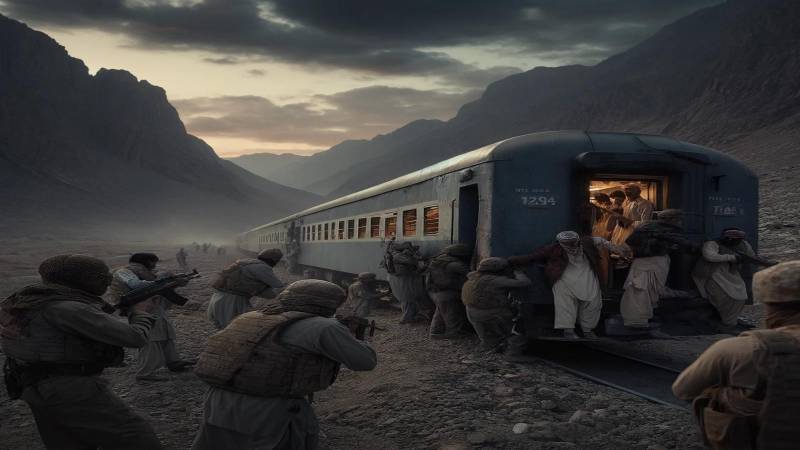
The unthinkable has happened in Balochistan - even by the province's standards, as far as law and order are concerned, the hijacking of an entire train with around 450 people on board, has to be an extreme cause for concern. Also, it should send a decisive signal to the government and the establishment that whatever is being done in Balochistan in an attempt to 'fix' the problem there isn't working at all.
The fact of the matter is that this has been going on for a long time now - the simmering resentment among many Baloch that while their province's extensive minerals, energy, and natural resources are utilised and exploited for the use of the country as a whole, the province itself does not get much in return. And that is why for many years we would hear of stories of no gas connections to residents of Sui, where the country's largest natural gas field is located. Balochistan also lags behind all other provinces in education and health indicators, such as the literacy rate, women's literacy rate, primary school enrolment rate, infant mortality rate, maternal mortality rate, and so on.
Incidentally, the area where the insurgency and violence is greatest is also among the most literate of the province such as the Makran coast and Turbat. And that would make sense, since higher literacy and education levels among a specific segment of the population usually bring with them greater awareness.
One could start by asking what led to a situation where we have an entire train being hijacked by insurgents which ended in the deaths of over 20 hostages and close to a dozen security forces personnel.
Reports indicated that the train which was going from Quetta to Peshawar carried many securities personnel and their families – and if this is indeed the case then it could be argued with some basis that the attackers would have good intelligence and reconnaissance to be aware of this. And this is usually possible only when the attackers have support from the local population.
There is no military solution to the unrest in Balochistan. The unrest comes from a feeling of alienation and resentment, and of not being able to control their destiny or their state of affairs
Of course, it also goes without saying that such attacks and chinks in the armour are also readily and easily exploited by countries hostile to Pakistan (and there’s no medal for guessing which country, in particular, tends to do this, especially in the case of Balochistan). However, that still doesn’t mean that blaming an adversary absolves Pakistan of blame in failing to stop such brazen attacks.
And while there is bound to be a strong knee-jerk reaction to this sordid hijacking saga, it would be far better if the strategy was not reactive but a proactive one. And that means that the federal government allows Balochistan to be run like any of the other provinces – where the elected representatives of Punjab, Sindh, or Khyber Pakhtunkhwa run their affairs and have considerable leeway. That, unfortunately, cannot at all be said for Balochistan where just about everyone and their aunt seems to have a say in how it should be – except of course those who live there, especially in the southern/coastal and central districts of the province.
There is no military solution to the unrest in Balochistan. The unrest comes from a feeling of alienation and resentment, and of not being able to control their destiny or their state of affairs. And then there’s the vexing issue of enforced disappearances and of dissenters still being picked up from time to time.
All that has to stop and those who were picked up should be returned. And there should be no more enforced disappearances. And in instances when returning those who were picked up is not possible then a formal apology should be issued by the state along with adequate compensation to their families. These are all prerequisites to a process whose primary aim should be to empower the people of Balochistan in the real sense, and that will only come when they can make the decisions that affect them and their province.