

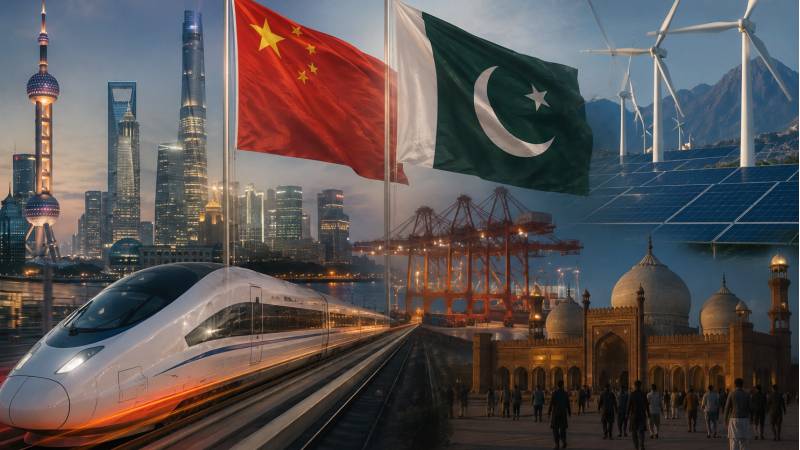
My recent visit to China as a part of media delegation from Balochistan, organised by the Centre for Democracy and Climate Studies in collaboration with the Chinese Embassy was not confined to merely passports, boarding passes, flights, trains, visuals rather it was essentially a well-organized informative and educational exposure visit. Through this, we learned how China is showcasing remarkable progress in the arenas of history, culture, tourism, infrastructure expansion, industrial development, modern transportation system and artificial intelligence advancement. What was astounding and fascinating for me that China knows well how to recognize and preserve its past, organize and govern its present and shape and envision its future.
The trip took place across six days and four cities including Beijing, Datong, Taiyuan and Yangquan, each city had a unique and special chapter thus collectively making the journey truly beautiful and thoroughly memorable.
The Pace of Progress
Once we arrived in the capital city of China, we commenced our journey from Beijing to Daton via high-speed train. In under two hours, we covered a vast distance that would generally take an entire day in my home country. That was an unforgettable moment as I was my first exposure with something so exceptional and extraordinary. The train travelled with peaceful ease, brilliant comfort and outstanding smoothness by shrinking extensive distances within spans of seconds. China's high-speed rail system is not just an infrastructure or development project; it is an emblem of national vision, intent, purpose and ambition. China's 901.5 billion yuan investment in railway construction in 2025 alone is a glaring example of its national statement regarding modern and sophisticated railway networks.

Datong: A City of Timeless History
Datong greeted and welcomed us through the lens of its ancient charm and dignity. The Yungang Grottoes, a UNESCO-recognized World Heritage Site since 2001, serve as a powerful example of China's ability to preserve its heritage roots while continue to leap forward at a breakneck speed towards the future. The site consists of 252 caves and over 51,000 statues which were carved between the 5th and 6th centuries which are considered as the finest works of Buddhist cave art in Asia.
Walking through those caves while being briefed by tourist guides, I profoundly felt touched by artistry with a touch of ancient grace. For me, it was not only an tourist attraction but I realised I was entering in a conversation from one century to another century. I experienced the real soul of ancient China. It witnessed the world's rich heritage reflecting the historical records of classical Chinese civilization. I have always been captivated by skyrapers but this time, I was more spellbound by these statues. It was an epic scenic experience which enriched my knowledge regarding China's rich history, artistic ingenuity and perennial spirituality.

The Industrial Powerhouse
From exploring Daylily Industrial Park to Datong Locomotive Factory and Taiyuan Heavy Machinery Co. Ltd to Jineng Holding Group's photovoltaic technology, our these industrial visits in Datong and Taiyuan demonstrated another side of China's exceptional transformation. We found out that China's development model is not limited to a single sector rather agriculture, transportation, heavy machinery, clean energy and innovative technology are collectively fuelling and driving China's innovation-driven economic growth and national development. The secret of collective sectoral participation lies in China's clear and effective policy direction and strong and consistent institutional continuity.
Pakistan should follow China's suit by valuing past and present equally in order to achieve sustainable development with historical preservation and economic advancement.
Yangquan: A City Breathing National Consciousness
Our final full day in Yangquan, Shanxi, offered us a unique perspective in terms of national consciousness. The city is more defined by the historical memory rather than infrastructure. After visiting the Hundred Regiments Offensive Memorial Hall, an unprecedented and large-scale sabotage operation spearheaded by Eighth Route Army against Japanese aggressors in order to dismantle supply lines by demolishing railways and bridges. It was launched on the 20th of August, 1940, containing 105 regiments of the Eighth Route Army, which went on for more than five days. The Hundred Regiments Offensive Memorial stands as a vivid instance and a powerful reminder that the foundations of nations are not built only through infrastructure, technology, industrialization, or artificial intelligence but also through preserving and honoring the national memory and patriotic sacrifice.

Transportation: Autonomous AI-Driven
One of the most fascinating sites and remarkable experiences of our educational trip was the Apollo Autonomous Driving Center, which left a deep impression on all of us in terms of the exceptional role of artificial intelligence regarding autonomous driving technology. It operates under Baidu's Apollo project, which is designed to shape the future of safe, smart, and AI-driven transportation. The Apollo Autonomous Driving Center is not only developing smart self-driving vehicles but also it is contributing to safer, cleaner, and advanced transportation. What was inspiring was that it was not just a future idea rather, autonomous driving was already being tested and operated in China. This visit gave us an opportunity to witness how China is using research, innovation, and technology to transform and influence the future of transportation. China has already left the world behind in the field of artificial intelligence by integrating AI into practical life.

Lessons for Pakistan
There are three significant takeaways from China's development journey that Pakistan should adopt.
First, modern development and cultural heritage can move hand in hand and complement each other. Both the Yungang Grottoes and the high-speed rail network manifest this Chinese civilization. China has successfully managed to preserve its historical legacy while simultaneously, it is progressing rapidly in terms of economic growth, infrastructure development, advanced technology, and practical adoption of artificial intelligence. Therefore, Pakistan should view its rich heritage, such as Indus Valley Civilisation, Gandhara and Buddhist Heritage, Islamic and Mughal Heritage as a national asset rather than a burden as the country is home to one of the world's oldest civilizations. Pakistan should follow China's suit by valuing past and present equally in order to achieve sustainable development with historical preservation and economic advancement.
Second, successful and effective industrial policy requires long-term vision and consistent commitment. China's remarkable development doesn't take palce overnight rather it is the outcome of policy continuity and consistent planning. Taiyuan Heavy Machinery, which was incepted in 1950, is a major manufacturing enterprise. The high-speed rail network was developed through over two decades of continuous effort. The transition of Shanxi from coal to solar was not a single event but a gradual process. In contrast, Pakistan's path was quite different. Industrial policies have repeatedly altered whenever a new government took power, resulting in inconsistency and uncertainty, thus undermining long-term initiatives. If Pakistan is committed towards meaningful industrialisation and economic transformation, then it must develop a unified national consensus on its long-term economic goals.
Third, what Pakistan can learn from China is that technology transfer and homegrown innovation must move together. No country in the world ends up becoming a global technological leader by exclusively importing foreign inventions. Sustainable progress happens when imported knowledge is identified, absorbed and adapted through research and development. China's rise showcases that the transfer of technology might be a mere outset but self-reliant innovation is the top priority. For Pakistan, this experience is highly significant as the China-Pakistan Economic Corridor moves into its second phase as CPEC Phase II revolves around SEZs, industrial collaboration, agricultural modernisation and technological innovation. This offers a valuable opportunity for Pakistan not only to amplify investment but also to obtain technical proficiency, consolidate industrial efficiency and develop a more competitive manufacturing sector independently.
The Final Takeaway
As our media delegation lifted off from Beijing for Islamabad, I returned not just with notes, videos or photographs but also with enriching experience of witnessing both versions of China; one is ancient and the other is modern China. That is how both faces of China are significantly contributing to the economic, historical, infrastructural and technological transformation of the country and the driving force behind its success lies in patient investment, policy continuity and long-term planning.
What inspired me most about China was not its wealth but its spirit, vision and discipline. A spirit that honours and preserves its historical roots while embracing and shaping tomorrow. A spirit that converts coal-producing cities into the hubs of solar innovation. A spirit that turns historical monuments into tourist destinations. A spirit that truly believes in past, present and future. Above all, that is, perhaps, the most crucial takeaway that Pakistan should remember.