

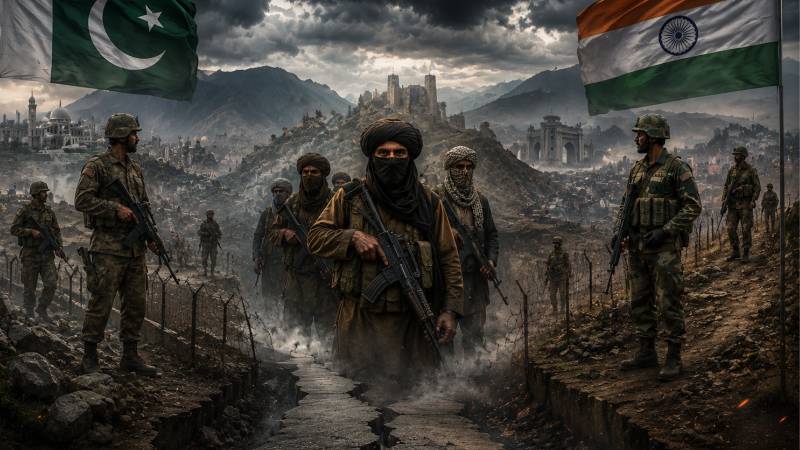
Defence Minister Khawaja Asif recently rebuked Maulana Fazlur Rehman for suggesting soldiers fight for salaries, calling it an insult to the country’s martyrs. No one lays down their life for a paycheque, he argued, but out of duty. Political disagreement is one thing; questioning sacrifice, he implied, crosses a moral line.
Fazlur Rehman’s phrasing was clumsy and insensitive. Pakistan lost 664 security personnel last year, most in Khyber Pakhtunkhwa and Balochistan. That sacrifice is not reducible to wages. But the intensity of the backlash revealed something more telling: the same voices that react instantly to perceived disrespect are far quieter when the state fails to provide security or when it uses its power as a blunt instrument.
Politicians were quick to defend the military’s honour. They have been far slower to confront the worsening realities on the ground — rising violence in KP and Balochistan, or persistent allegations of enforced disappearances and rights abuses. The imbalance is stark: rhetoric is policed more aggressively than results.
This double standard runs through Pakistan’s security debate. Attacks that kill Punjabis in Balochistan trigger national outrage and political unity. Comparable or worse violence within Balochistan and KP draws far less attention. State abuses draw even less. Suffering is not treated equally; it is filtered through political convenience.
Mohsin Naqvi’s tenure as Interior Minister captures this drift in priorities. His remark dismissing the Balochistan crisis as “just an SHO’s job” was not just tone-deaf; it signalled a deeper lack of seriousness. At the same time, he continues to hold multiple high-profile roles, raising obvious questions about focus. The interior ministry sits at the core of Pakistan’s internal security architecture. It is not a part-time assignment, particularly amid escalating militancy.
The pattern is now familiar. Policy failure is met with appeals to sacrifice. Scrutiny is framed as disrespect. The reflex once directed outward — blame Kabul, blame New Delhi — is now applied domestically: invoke sacrifice, assign blame, avoid accountability. Pakistan’s public debate gives the impression that many are in denial or too afraid to speak up honestly.
Pakistan’s security challenges cannot be reduced to ultra-nationalist rhetoric. The conflict in Balochistan is rooted in history—from the 1948 Kalat accession dispute to repeated cycles of insurgency, repression, and failed reconciliation. Ignoring that past all but guarantees misdiagnosis. The same applies to Afghanistan. The Durand Line remains unresolved in Afghan political consciousness, shaping decades of mistrust and strategic behaviour on both sides. Today’s tensions are layered on top of that history, not separate from it.
The evidence suggests something narrower: it was disrupted, displaced and forced to adapt. It has since evolved — geographically, organisationally and technologically. Policy has not.
Militancy in Pakistan is neither purely external nor purely domestic. External sanctuaries exist; UN reporting confirms this. But local grievances, governance failures and political exclusion create the conditions in which militant groups survive and regenerate. One without the other does not explain the scale or persistence of the threat.
The harder questions are internal. How did figures like Nek Muhammad and Baitullah Mehsud emerge? What policy choices enabled the rise of the TTP? What does the continued influence of the Haqqani network within Afghanistan’s Taliban government say about the limits of Pakistan’s past strategy?
History offers a consistent warning: tactical success is not strategic victory. Groups can be weakened, displaced or fragmented. If the underlying conditions remain, they return — often more adaptive than before.
The numbers now reflect that reality. The Pakistan Institute for Conflict and Security Studies reports roughly 3,300 conflict-related fatalities in 2025, up more than 70 percent from around 1,950 in 2024, across over 1,000 attacks — the highest level in a decade. CRSS data shows a similar surge. More than 95 percent of fatalities occurred in KP and Balochistan, with KP alone bearing the majority. These are not peripheral regions. They are the centre of Pakistan’s internal security challenge — and among its most heavily militarised. Rising violence alongside maximum deployment is not just a statistic; it is a contradiction that demands explanation.
Meanwhile, the threat itself is evolving faster than the state’s narrative. The once-clear divide between Baloch ethno-nationalist groups and the TTP’s religious militancy has blurred. Since 2022, Baloch factions and the TTP have moved toward operational alignment — shared training spaces, facilitation networks, and coordinated attacks. Some assessments point to a TTP “wilayat” spanning parts of Kalat and Makran.
The impact is visible. The BLA’s Operation Herof-2 in January 2026 struck dozens of sites across multiple districts in a single day — one of the most coordinated assaults in Balochistan’s history. By mid-2026, TTP activity had expanded into Balochistan’s Pashtun belt at a tempo previously associated with KP.
Technology is also shifting the battlefield. Weaponised commercial drones are now embedded in militant tactics. Hundreds of attempted drone attacks were recorded in southern KP in 2025, with hundreds more in early 2026. The state response has been largely defensive — jamming and restrictions — rather than targeting the supply chains and logistics enabling these attacks.
Faced with this, Islamabad has leaned more heavily on external responses. In early 2026, Pakistan conducted airstrikes on alleged militant targets inside Afghanistan, triggering retaliatory fire and continued cross-border tensions. The external dimension is real. But it is not sufficient. Attacks deep inside Pakistan — far from the Afghan border — cannot be explained by sanctuaries alone. They require local facilitation, intelligence gaps and governance failures.
Yet the official response remains predictable: announce casualties, announce operations, assign blame — often before investigations conclude. External actors are identified quickly and with certainty. Internal failures are rarely examined with the same clarity. This is not about denying foreign involvement or diminishing the sacrifices of Pakistan’s security forces. Their role in dismantling militant strongholds in the 2010s was decisive. But tactical gains were mistaken for strategic resolution. The ecosystems that sustain militancy — selective enforcement, permissive networks, and uneven application of the law — were never fully dismantled.
The National Action Plan outlined what was required: regulate seminaries, cut terror financing, and eliminate banned organisations without exception. More than a decade later, implementation remains uneven, stopping where political cost begins. Pakistan’s grievances against India and the Afghan Taliban are real. External engagement is necessary. But externalising causality cannot replace internal correction. The data from KP and Balochistan is not just a record of violence; it is a test of whether the state can translate battlefield success into lasting stability.
For years, Pakistan has claimed that militancy has been defeated. The evidence suggests something narrower: it was disrupted, displaced and forced to adapt. It has since evolved — geographically, organisationally and technologically. Policy has not. Blaming India or the Taliban is politically convenient, but it is not a strategy. It does not explain why militancy persists, why violence spreads, or why the same patterns keep repeating. External actors may exploit the problem, but they do not account for how long-standing challenges have metastasised over the past five years. Until Pakistan stops confusing attribution with accountability, it will continue to recycle failure and call it policy.