

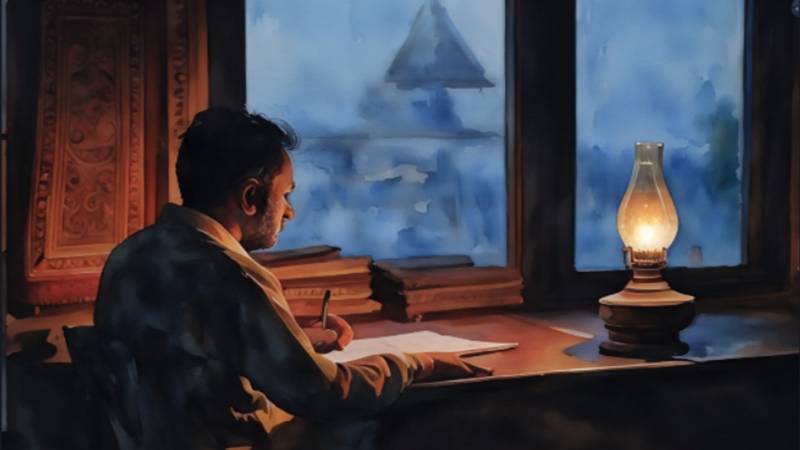
“Literature adds to reality; it does not simply describe it. It enriches the necessary competencies that daily life requires and provides; and in this respect, it irrigates the deserts that our lives have already become”—C.S. Lewis.
More than anything, literature is perhaps most effective in transforming people into better human beings, striking connections with strangers and thus emphasising the significance of oneness among the human race. Literature indicates that no matter how diverse our attitudes towards life and ways of living, human emotions are the same, commonly reflected in stories penned by poets, novelists, and short story writers. They provide deep insights into various aspects of the culture and heritage of different regions, which are fundamental to understanding them, while presenting varying perspectives and simultaneously inculcating feelings of empathy for fellow human beings. Literature is not only a source of entertainment, but also crucial in preserving culture and history.
Universally acclaimed sensibilities of love, hate, joy, sorrow, vengeance, conflict, war, and peace, besides interpersonal relationships, human character, and behaviour, can easily be discerned by exploring the wealth of available literature. Literature is a means to appreciate commonality despite the marked differences in appearance among various human beings. It even goes a step further to include members of the animal kingdom and how they carry somewhat similar emotions to those of humans, invoking the concept of coexistence.
Until time travel becomes a reality, literature is a vital means of travelling through the ages, providing glimpses of the past and, for those who do not have the capacity to travel around the globe, bringing the world to their doorsteps.
There is no denying that social media has shrunk the world, bringing people into closer proximity; however, this can also lead to misunderstandings without proper understanding of their backgrounds. Literature can address this by expanding horizons through knowledge, developing critical thinking skills, interpreting symbolism, identifying and analysing themes, and evaluating characters in the forefront of their actions.
Kamlani is now seen as an addict, roaming the streets of Thatta and Sujawal, begging for money and sleeping on the roadside
Language is the principal channel of communication for humans, and what better medium than literature to promote this ability? Whether fiction, non-fiction, or academic, this genre of language goes a long way in improving vocabulary, grammar, research, and writing skills, which in turn help to raise awareness. Those who contribute to this art deserve applause and respect, not rejection or humiliation. Regrettably, the apathy of Pakistanis towards literati has reached a point where they are no longer perceived as worthy of our reverence.
Earlier, a person of letters was looked upon with awe, making people rise in respect and do their best to resolve their problems. In the past, frequent literary gatherings provided opportunities for potential fans to discover new authors and poets; nowadays, the literature-starved few eagerly look forward to the occasional meetings that can satiate their thirst for inspiring poetry and stories. With fewer gatherings, literary circles are fast diminishing, and consequently, scholars are losing their worth.
The most recent example is that of Mushtaq Kamlani, a Sindhi illuminatus, proficient in Urdu and Persian, and author of many novels and short stories. These include Visaryan na visran (Cannot Ever Forget) and Iha khabar der sa payee (Knowledge Gathered Too Late). His write-ups Jiyan luk lage tyen ruk thian (Where Hot Winds Blow, Toxic Flowers Will Bloom), Ghutti faza (Suffocating Environment), Gungi Barish (Mute Rainfall) were highly influential in forming opinions in the feudal-dominated Sindh in the 1970s and during the dictatorial rule of General Muhammad Zia-ul-Haq. His other stories, which earned him name and fame, include Laash (Dead Body), Zameer khatir (For Conscience’s Sake), Tuhnje naale jivan (Life with You), among many others.
Kamlani did not only have a literary persona; he was also associated with a nationalist party and politically active. However, misfortune befell him when he desperately tried to reclaim his house and a plot of land on the outskirts of Sujawal, located in north-west Sindh, which had been illegally occupied by land grabbers. All his efforts met with failure, while the only force, the Sindh Adabi Sangat (claiming to support Sindhi intellectuals), that could have offered assistance, deviated from its mandate due to internal conflicts. Instead of receiving justice, Kamlani was detained by plainclothes law enforcers for several months without charge, resulting in his mental breakdown.
Kamlani is now seen as an addict, roaming the streets of Thatta and Sujawal, begging for money and sleeping on the roadside. According to his relatives, he not only experienced trauma during his detention but also faced personal issues that left him entirely deranged. He now presents a typical figure of a demented person, oblivious of his once-glorious stature, reduced to a helpless wanderer in tattered clothes. This is how respectable and sensitive literary personalities end up in a society that bows before the ignorant yet powerful and merciless.
After learning about Kamlani’s ordeal, the Sindh Government approached his relatives offering financial assistance and medical treatment—but even this came after he had likely suffered irreparable mental damage. For a person who, as a student at Sindh University, emphasised the importance and multi-dimensional aspects of Sindhi literature, maltreatment and uncalled-for detention can be profoundly devastating. One can only wonder when we will learn to honour our intelligentsia, and pray that sanity prevails in a society that has itself become a victim of false illusions and lost aspirations.