


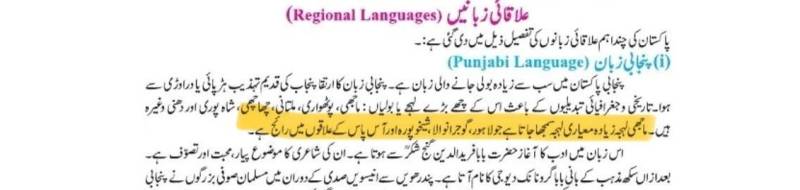
I first encountered the idea of a "standard" Punjabi in tenth grade, in the Pakistan Studies textbook. There was a section on languages in a chapter, and it stated that Majhi is the standard, most authentic dialect of Punjabi. I remember sitting with that sentence for a long moment. I had spent the early years of my life in Khanewal.
I had grown up hearing one language called Jatki, though often, I would hear it reduced and distorted into a slur: jaangli. In my village, nobody spoke Majhi. Nobody’s grandmother told stories in Majhi. Nobody’s wedding songs were in Majhi. And yet here was a textbook, printed and distributed and taught across the country, informing an entire generation of children that what they had grown up hearing, what they had grown up being, was a deviation from the authentic, rather than an expression of it. Years later, I returned to that page, checking if memory had played tricks on me. It hadn’t.
What made this stranger still was the irony that seemed invisible to the curriculum's authors. Virtually all of Punjab's beloved folklore—Heer Ranjha, Mirza Sahiban—the oral traditions that define what it means to call yourself Punjabi, emerge not from Lahore but from Jhang, from the very belt where Jatki is spoken. The language in the textbook, called peripheral, is the language in which Punjab dreamed.
Punjab is often imagined as a unified cultural bloc, a land of shared language, shared harvest festivals, shared grief and shared pride. Politically and administratively, it is presented as singular. But spend a little time moving across it, from the Majhi heartland around Lahore and Gujranwala to the Thal desert of Khushab, from the cotton fields of Khanewal to the riverine belt of Jhang and Chiniot, and a completely different picture emerges. Punjab is not one. It is a hierarchy disguised as a homeland.
At the top of this hierarchy sits Lahore, and with it the Majhi dialect, the Punjabi of the cultural and administrative centre. It is, by an unspoken consensus, the correct Punjabi. Everything else is a deviation from it. The Pothohari speaker, the Saraiki speaker, and the Jatki speaker are all measured against this standard and found, in varying degrees, wanting.
But what is less discussed, and what deserves to be said plainly, is that this hierarchy did not simply emerge organically from cultural merit. It was carried into these regions. The Majhi-speaking class that settled across central Punjab after Partition brought with it not only its dialect but its contempt.
In a culture as layered as Punjab's cannot be the property of one dialect, one city, one class of people who arrived somewhere and decided the locals were beneath them
The locals, whose families have worked this soil for generations, whose language carries the memory of this land in its very grammar, are looked upon with a particular kind of disdain by those who arrived speaking what the textbooks would later certify as the real thing. The word they reach for, casually and without guilt, is jaangli.
Language, in any society, is never just communication. It is sorting. The accent you carry tells the room where you came from, which tells the room how seriously to take you. In Punjab's internal geography, a "rough" accent signals not just regional origin but presumed class, presumed education, presumed intelligence. The association is automatic and largely unconscious, which makes it more insidious than deliberate snobbery.
And yet, Jatki, the Punjabi spoken across the greater Jhang belt, across stretches of Chiniot, Khanewal, and the districts that colonial administrators once called the "Bar," is not a broken thing. It is not Majhi with the polish worn off. It is a complete, living linguistic system, carrying its own grammar, its own music, its own dense archive of centuries of human experience, and it has one of the most formidable oral traditions in the subcontinent. Whole stories sung into the dholas.
Stories with characters, with longing, with moral weight, with humour sharp enough to draw blood, delivered entirely through voice, passed from one generation to the next without a single printed page. All of this constitutes a living literature. It simply has not been recognised as one, because recognition requires the centre to look outward, and centres rarely do that willingly.
Jaangli, literally, means of the jungle, wild, uncultivated, from the uninhabited beyond. In practice, it means you are from somewhere that does not count. Consider what this land has actually produced. Pakistan has given the world two Nobel laureates. Both of them were, by the definition this society casually deploys, jaangli. Abdus Salam was from Jhang. Har Gobind Khorana, whom we cannot fully claim because his family crossed the border at Partition, was from Khanewal.
The most decorated scientific minds this soil has ever grown came from the belt whose dialect a national textbook would classify as non-standard. Salam, who rewrote the laws of physics, grew up hearing the same dholas, the same language that educated Lahoris would have smiled at in a seminar room.
And what exactly is the standard against which Jaangli is measured? The standard was made by proximity to colonial administration, by access to printing presses, universities, and broadcast towers. What gets called jaangli is not inherently wild. It is simply what has not been standardised, urbanised, or approved by the cultural centre. The wilderness is in the eye of the one doing the naming.
Punjab's richness has never lived in Lahore alone. It lives in every tongue that carries a landscape inside it. The textbook I read in tenth grade was wrong. Not just factually, though it was that too, but in the deeper sense of what it taught an entire generation to value and what it instructed them to discard.
Authenticity in a culture as layered as Punjab's cannot be the property of one dialect, one city, one class of people who arrived somewhere and decided the locals were beneath them. The most authentic Punjab is the one that has been here longest, singing its stories into drums long before anyone thought to write them down.
That Punjab is still here. It is still singing. It deserves to be heard.