


Sir John Marshall writes in the Annual Report of the Archaeological Survey of India 1925-26 that: “By the beginning of December (1925), when I arrived at Mohenjo-Daro, the following officers, with their staffs, were already assembled in camp;-Mr H Hargaves (Superintendent, Frontier Circle), Mr MS Vats (Officiating Superintendent, Northern Circle), Mr KN Dikshit, (Superintendent, Western Circle), Mr BL Dhama (Assistant Superintendent, Rajputana and Central Circle) and Mr Sana Ullah (Archaeological Chemist). In addition to those gazetted officers there were also present Mr A.D. Siddiqui, Mr NG Majumdar (Curator of Rajshahi Museum) and Messrs; QM Moneer, JK Roy and KN Puri, all of whom did valuable service in the matter of supervising labour. From Taxila Mr Siddiqui also brought with him several of my own trained overseers besides a quantity of excavation material, tools and camp equipment.” (Page 73)
In 1925–27, Sir John Marshall and his team excavated Mohenjo-Daro. A force of 1200 labourers started digging the ancient site that was hidden in the jungle for thousands of years. A total number of 26 Human Skeletons and Skulls were discovered during this massive excavation. Remains of 39 species of animals including domestic, semi-domestic and wild beasts were excavated from Mohenjo-Daro by Sir John Marshall. Afterwards, Mr EJH Mackay unearthed 15 more Human Skeletons from DK G Area. While 5 other Human Skeletons were found by US Archaeologist Dr GF Dales from a Lane of HR Area in 1964. In this way, the total number of Human Skeletons excavated from Mohenjo-Daro is 46. It is said that a population of 50,000 to 100,000 once lived there.
The city was abandoned in the last period, and only a few people were living there. Dr Michael Jansen calculated that the city may have had over 700 wells with an advanced hydraulic engineering system. The Indus People perhaps spoke a Proto-Dravidian Language and followed a polytheistic religion. Around 3,781 Indus Valley Civilization Sites have been discovered so far from Pakistan and India. Among the people, complete burial, fractional burial, and cremation were common. Climate Change, Floods of the River Indus, and Invasions are the main causes of the decline of this ancient city. The evidences show that there were social, cultural, economic, political, and religious linkages between Mohenjo-Daro, Harappa, and the Indus Valley Civilization with modern-day Iran, Afghanistan, China, Turkmenistan, Oman, UAE, Qatar, Bahrain, Kuwait, Saudi Arabia, Iraq, Syria, Yemen, Egypt, Cyprus, and Crete.

How should the casual visitor or the amateur enthusiast explore the architectural marvels in Mohenjo-Daro today? Which are the key buildings to visit in this place? Which important antiquities and objects were unearthed from the excavations in the past 100 years?
We have tried to provide all these details in an informative summary in this article and the one to follow.
Mohenjo-Daro (2600-1900 BC) was divided into two main parts, which are called the Citadel Mound and the Lower City. The details of the monumental structures and antiquities found from Mohenjo-Daro are given below. These details are taken from the original Reports of the Archaeological Survey of India 1925–26, 1926–27, 1927–28, 1929–30, and 1931–34. Information is also carefully used from the works of Sir John Marshall (1931), Mr EJH Mackay (1938), Sir Mortimer Wheeler (1962), and Dr GF Dales (1965). Recently, the City Wall (5 metres wide) has been excavated by Dr Jonathan Mark Kenoyer in May 2025 in the west of the Great Bath and Granary. It is built of sun-dried bricks and mud plaster.
SD Area (Upper City)
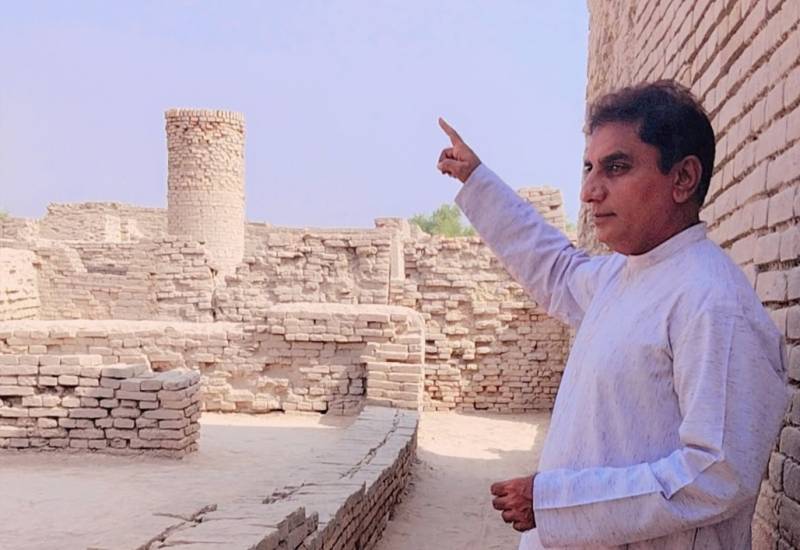
A 72-foot-high Buddhist Stupa stands on the top of Mohenjo-Daro today. This 2nd Century Stupa of the Kushan Period was first excavated by Mr RD Banerji in December 1922. According to Mr Mackay there must have been a Temple of the Indus Period beneath the Buddhist Stupa of Mohenjo-Daro. He believed that this temple was similar to the Great Court at Ur (Mesopotamia), between the Quays and the House of Nannar. Payments in kind were collected by staff for the temple revenues there. Mr Mackay excavated 5 Votive Stupas (11 feet 3 inches in diameter) on a high mound in the north of the Great Bath in Block 8. A gateway of a fortified wall (in the north of RDB Site No.3) was discovered in November 1931. The SD Area is named after Khan Sahib Ahmed Din Siddiqi who supervised the excavation work in this part of Mohenjo-Daro under the guidelines of Sir John Marshall in 1925–27.
15 skeletons belonging to the Late Period were discovered. These victims - men, women, and children - were found with elephant tusks and jewellery, suggesting they were slaughtered by invaders while trying to flee
Mohenjo-Daro’s SD Area has the best architecture, buildings, and structures to see. This mound is 400 m north-south and 200 m east-west. A large number of Houses, Rooms, Courtyards, Corridors, Kitchens, Wells, Bathrooms, Drains, Pavements, and Staircases have been excavated from this area. The Divinity Street (7 to 10 feet wide) with a well-constructed drain and tributaries, Main Street, Dustbin Street, and Lanes are the main passages. A Seal (SD 3192), White Stone Marble, an Alabaster Pedestal, and a Clay Pot full of Kushan Period Coins were unearthed from the Divinity Street area. There was a Block of Paving or Brick Platform (Traffic Control Block) with 10 shallow pits on a direct route to the Columned Hall in L Area. Mackay calls it an Octroi Post for a Great Market Place commonly known as the Assembly. The revenue of this Octroi Post was probably spent on the temple hidden under the Buddhist Stupa of Mohenjo-Daro. Close to it is the Elliptical/Oval well with a platform.

The College Building lies in Block 1 of SD Area in Mohenjo-Daro. It was excavated during 1927 to 1931 by Mr Mackay. According to Mackay this important building was the residence of a very high official, possibly the high priest himself, or perhaps a College of Priests. This building design was copied from the Great Bath which stands in the west in the same area. Probably it stood 2 or 3 storeys high with a fenestrated court. A possible students’ entrance was from Divinity Street, which was in the east of this building. Antechambers for an awaiting audience were also attached to this remarkable building. There was a spacious entrance hall in Room 55 with the apartments of the Head of the establishment. The College Building was entered from Divinity Street by doors that were possibly students’ entrances to this great establishment. Some Grain Bins, Square Bins, cooking places, and washing floors were built by people who reoccupied this dignified building after the floods in the Late Period in the Collegiate Building. A large earthenware jar with Sambhur (Deer) bones was discovered by archaeologists during excavations. Mackay dated this building as a Late Period Structure which had been occupied by some people after a heavy River Indus flood. A Seal (SD 3058), an amuletic clay bulla from Rooms 18 and 19 was found. An unfinished Limestone Torso (SD 2781) was found from the fenestrated Court 61. This statue was in process when a flood hit the city in the Late III Period.
There was a suite of apartments with a shrine (Room 44), a private chapel, and the pavement for the ablutions of the worshippers before they entered the precincts of the shrine. A room for water jars that were filled by skin carriers from the Great Bath wells was also identified. Sleeping quarters, domestic offices, water chutes, vertical chases, exploratory shafts, a bath with a small staircase and drain were also excavated during the clearance.
The Great Bath Building was probably connected with the city’s religion. This holy pool was fed by a Double Ring Well located in Chamber 15. There were possibly foundations of a Hypocaust or Hot-Air Bath. A thick layer of Bitumen was given under the floor for waterproofing the sacred tank. There are many Halls, Chambers, and extra retaining walls. Burnt clay plaster, and evidence of a burnt mass of copper and charcoal indicated that this building was set on fire during an invasion. Following objects were found from the Great Bath during Marshall’s excavation: 2 Phallic Emblems in Alabaster and Faience, A Miniature pot of Blue Faience, a Copper Spear head, a Copper Chisel, Several Rectangular Pieces of Metal with animals and pictographic legends, one bearing a horned figure (Gilgamesh?) clad in leaves and carrying a bow, and two square seals of a bull and a rhinoceros with pictographs. The other features of the Great Bath Complex are the 3 Entrances to the building from east, north, and south, Platforms round the Great Bath supported on mud-filled masonry cells, Watertight backing, Wooden treads, A manhole, a corbelled arch, and fenestrations. Fragments of Gypsum or cement were also found.
Sir Mortimer Wheeler excavated the State Granary building at Mohenjo-Daro in 1950. He interpreted this structure as a Civic Granary. Dr FA Khan calls it a Public Treasury Building. Others believe that it was a dockyard. The officials of the City State of Mohenjo-Daro supplied grains to the inhabitants of the city during famine and floods of the River Indus. This structure stands in the west of the Great Bath. It measures 27X50 metres with 27 brick blocks. There are horizontal and vertical passages for the crossing of air. It had loading platforms and the site of a stair. The building had a timber rooftop or ceiling. The Great Bath Drain crosses close to this granary from the east. Other important Structures are the Remains of a loading dock where loading and unloading were done with bullock carts, the collapsed drain at the northern end of the main street, the division wall at the northern end of Main Street, depredations of brick robbers during the Buddhist era, a Passage between Bathrooms in Block 6, a curved drain, a covered drain with stone blocks, a complex of Buildings in the South, ringtones, bricks with human and animal footprints, and wedge-shaped and specially trimmed bricks were also found. A camel skeleton was excavated by Sir Mortimer Wheeler in the 1950s. Other objects found in this area are: Steatite Seals, Sealings, Copper Tablets, and fragments of inscribed objects.
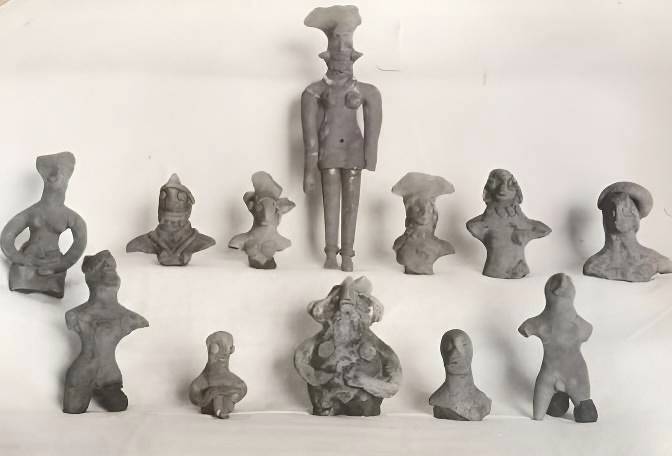
The pottery of the SD Area Mohenjo-Daro exhibits many types, shapes, and sizes. Some specimens include the Ritual Offering Stands, Pottery Cages, Vases, Jar Stands, Pottery Heaters, Jar Covers, Bowls, Cones, Rims, and Potsherds, etc. Among the human figures, the fragment of statue (SD 694) is worth mentioning. It was discovered from the southeast corner of Block 1 and belongs to the Intermediate Period. Animal and bird figurines or toys found at this area are: a black steatite head, models of bulls, monkeys, a stone figure of a ram, a dove with outstretched wings, a bronze figure of a buffalo, a toy frog carved out of shell, and a large limestone bull (5 inches) with sockets for eyes, ears, and horns was found from Room 56. Perhaps it was part of an image that adorned the large building.
The commonest jewellery and personal ornaments found at this site are the: steatite spacer, a heart-shaped piece of faience inlay, a shell rosette, a large faience disc-shaped bead, a large bead of variegated limestone, ivory objects, a broken bracelet, an imitation carnelian bead, a long barrel cylinder bead of pottery, a glazed steatite bead, an unfinished stone bead, a decorated carnelian bead, a white limestone bead, spindle whorls made of faience, an amuletic clay bulla, and a piece of glazed inlay. Various kinds of Weapons, Tools, and Implements were also found in houses and buildings at Mohenjo-Daro. These are the badly corroded copper chisel that was found from the Great Bath during excavation. A fragment of faience of tubular construction, a broken copper lance head, white stone marble, an extremely interesting pottery prism, a copper awl, and a fine limestone mace head. A fine bronze spear head and a copper rod were also found. Other Antiquities and Art include: weights, a large conical stone, a faience gamesman, a faience ball, a black stone ball, a door stop, a jamb, a sill, a yellow limestone gamesman, a gamesman of chalcedony, a shell rosette, a slate palette of dark grey colour, a lapis lazuli jar, a knife, a fine limestone mace head, a faience ball, a gamesman, faience vessels, alabaster dishes, and shell inlay. No human remains or skulls were reported during the excavations from this area.
L Area (Upper City)
Sir John Marshall writes in his book Mohenjo-Daro and the Indus Valley Civilization (1931) that, “The Buddhist monuments on the summit of this mound were mainly excavated by Mr RD Banerji in 1922–23; the deeper digging in the prehistoric strata beneath them was started by Mr Banerji, but chiefly done by Mr BL Dhama under my own direction in 1925**–26**.” (Page 113). He further writes that, “I began the excavation of L Mound at its southern end in January, 1927, and thence worked northwards.” (Page 151). According to Mr Mackay’s L Area Excavation Report published in the Annual Report of the Archaeological Survey of India 1926–27, this mound is designated by the letter L. Sir Mortimer Wheeler excavated a Group of Towers/ ACC Citadel Gateway during the 1950s.
The Stupa mound is separated by a distance of 92 meters. The L Area was probably a quarry for brick robbers in the past. Another important part of the Citadel Mound, the L Area covers a surface of 7,500 m. A large number of Houses, Rooms, Courtyards, Corridors, doorways, kitchens, wells, bathrooms, drains, pavements, and stairways are found in it. Other important structures are the large court, compartments, small chambers, earthen floors, ablution places, a narrow lane, partition walls, pavings, and entrances.
A very large Pillared Hall or the Assembly Hall, possibly a Market Place, is the most elaborate structure. It had 20 square brick pillars arranged in 4 rows. Close to this building conch shells mixed with pottery, along with carved beads, were unearthed. The piers, a flower bed for beautification of buildings, old foundations, a system of water channels, an aperture, shallow buttresses, fairly flat grounds, paved walks, aisles, brick benches, curious constructions, an annexe, semi-circular walls, Late Period alterations, batter, and a gallery were also common features here.
This area is also famous for the discovery of a reed matting place. A wall no less than 28 feet in thickness was excavated. A ring of bricks, probably jar stands, was found. Around 35 conch shells were unearthed from a Shell-Cutter’s Workshop. A chamber with 5 circular pits to hold large jars filled with egg-shaped pieces of clay was dug during excavation. Chamber 60, having a quantity of carbonized wheat possibly stored in a basket, was brought to light. Other important finds were the 3 limestone rings in a row, a dump for kiln refuse, and a Sandal-Maker's or Leather-Cutter’s Stone. A quantity of charcoal mixed with brick and other rubbish was found. The L Area pottery exhibits many types, shapes, and sizes. Some specimen includes the Storage Jars, Clay Jar Covers, Pottery Vessels, Potsherds, and Pottery Cones, etc. Black stone door sockets, cut bricks, and wedge-shaped bricks were also discovered during diggings.
Among the human figures, the Limestone Head (L 127) and Limestone Head (L 898) are famous. While an alabaster sculpture (L 950) was found lying on the top of a drain belonging to the Late Period. Model animals and pottery figures include a rhinoceros, a dog, a figure of a mastiff (dog), etc. The jewellery and personal ornaments found at L Area are as follows: decorated carnelian beads, a well-made pottery bracelet, a cone made of shell, and pottery rings. Different kinds of Weapons, Tools, and Implements were also found from the houses and buildings at this area. These are a razor, flint flanks, and limestone balls. A large stone 2 feet long possibly used by a sandal-maker or leather-cutter. Other Antiquities and Art include: a carved ivory plaque, weights, and clay balls. No human remains or skulls reported during excavations from this area.
DK Area (Lower City)
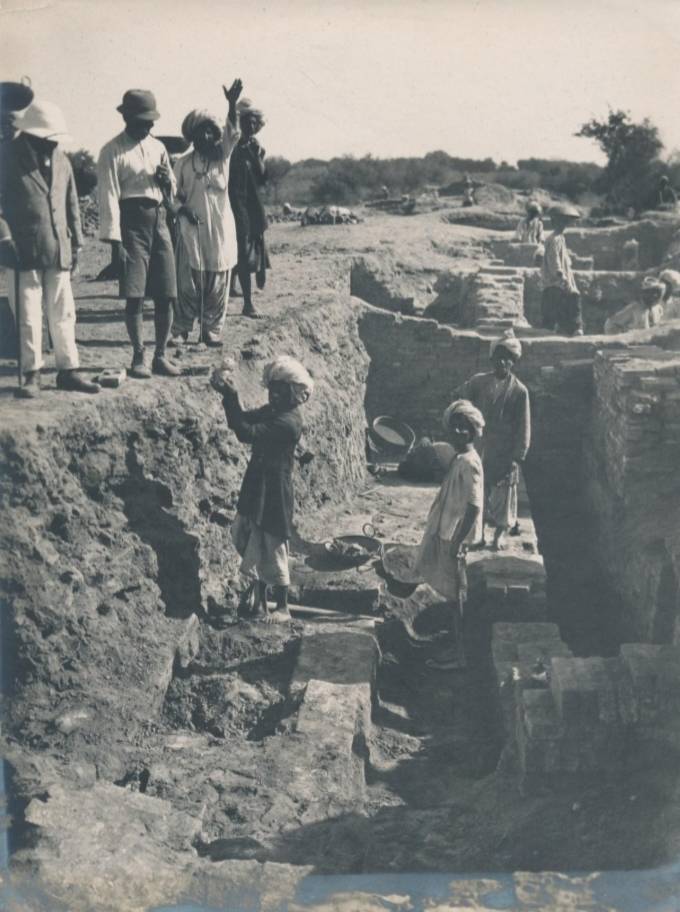
The DK Area is called after Mr KN Dikshit (M.A.) the Superintendent in the Archaeological Survey of India. He started excavation in the mounds designated B, C & E in the lower city under Sir John Marshall’s supervision in December 1925–26. Owing to the absence on leave of Sir John Marshall, Rai Bahadur Daya Ram Sahni was deputed to continue the exploration of the ancient mounds at Mohenjo-Daro during the cold weather of 1926–27. The excavations lasted from the 17th November, 1926, to the 8th March, 1927.
Therefore he remained at the site until the close of May 1927, in order to clear up and complete his notes on the work. Mr Ernest Mackay, who had recently been recruited from Mesopotamia, arrived at Mohenjo-Daro on 26th November 1927, and assisted him for a week at the HR Area site. After that Mr KN Dikshit placed him in charge of the L area south of the Stupa mound. Rai Bahadur Daya Ram Sahni was also assisted by Mr BL Dhama, QM Moneer, H.L. Srivastava, Mr KN Puri, Mr N.G. Majumdar, and Mr Panchanan Mitra. Mr KN Dikshit commenced operation in Trench D of the DK Area in February 1928.
The Excavation in DK G North was commenced from 20th October 1930 and ended on 1st February 1931. Mr Devi Dayal Mathur took Mr H.L. Srivastava’s place up to March 28th, 1931. These excavations were halted due to a cut in the budget on 6th November 1931. A trial excavation was carried out again in April 1932 in the DK Area. QM Moneer (Custodian of the Museum at Mohenjo-Daro) conducted excavation during 1933–34. The DK Area has been divided in different parts i.e. A, B, C, D, E, F, G, H & I. The DK I, came to be known as Moneer Area later. The buildings of the DK Area are divided into three different periods: 1) Early, 2) Intermediate, and 3) Late.
The main buildings at DK Area are the Houses, Rooms, Courtyards, Chambers, Floors, Corridors, Kitchens, Wells, Bathrooms, doorless compartments, pavements, stairways, facades, windows, and gratings. The Drains, cesspits, brick piers, flights of steps, columns, ablution places, niches, buttresses, and well-preserved doorways were common city features. Other Structures are the 10 feet deep Platforms of sun-dried bricks (covered with an iron shade now), a well with square coping, batter of walls, and beam holes. A hammam or bath with a Hypocaust beneath was excavated from the DK B Area. The buildings had apartments, windscoops, and cupboards. The Chief House is the Complex of Buildings which is supposed to have been the Governor's Palace in the Lower City. It consists of spacious courtyards, a row of rooms, a shelf for a lamp, wells, a main entrance, a side door, and an oven. Other main structures of DK Area are an annexe, a double staircase, washing floors, sunken recesses for storage jars, and a public well in Block 6. The traces of wood ashes and burnt mud plaster were found during excavations. A well with the marks of ropes, a cooking platform, a pottery pipe in Block 8 A, the Secular Building, badly built houses, and soak jars (3 feet high) are also other findings. The High wells with 3 occupation levels from Intermediate I to Late III Period are visible from the distance. The Main Road/First Street was 36 feet wide. It was used for pedestrian and animal traffic. Long Lane, Central Street, West Street, and Low Lane were main passages in this part of Mohenjo-Daro.
Encroachments were also discovered in Block 6 where lock-up shops or stalls set up by market people. In Block 7, House VI and VII was originally a Storehouse or Servants' Quarters with over 55 chambers. There were many entrances to the Street. There were Bazaar benches, a possible temple or shrine of a deity/site of a sacred object, and a series of soak pits. Remains of a culvert, water chutes, well windlasses, and niches used as ventilators were found. Besides this, Brick kiln debris, traces of plaster, paved baths, and ornamental brickwork were discovered. Other important structures and findings are three houses, deep walls with a platform, shops in Block 5, artisan quarters, police barracks, watchmen’s quarters, potters' quarters, shops (Block 9), a discarded well, cooking places (Block 9 A), the business premises of a well-to-do citizen (Block 27), a food hatch (A Window like opening in a Kitchen), a watchtower (Block 12), and a combined privy and bathroom (Block 17). An oval-shaped kiln, columns to support rough shelters, flooring or roof plaster, drain pipes, wedge-shaped bricks, and 2-foot-long very large-sized bricks for drain cover. During digging 2 feet thick pockets of fine grey sand that had been deposited by a flood 33 feet below datum, were also found.
Other important findings of this area are a pottery wheel, a theriomorphic vase (inkstand), large storage jars, ritual offering stands, handled cups, grey ware pottery, vases, bowls, goblets, basins, beakers, a rasp, a polychrome vase (Room 43, House IV Block 6), a pottery toilet jar, a fine painted vessel or lota, reserved slip ware, terracotta potsherds, bangles, broken pottery, ashes, and humus which is a product of decaying vegetable matter. From the Trial Excavations of April 1932 following antiquities were found from DK Area: small pottery cones (35 in all) with chocolate-coloured paint, pottery balls, pottery rattles, a layer of potsherds, traces of charcoal and ashes, small pottery vessels (may have been toys), six terracotta bulls, one terracotta buffalo, a moveable head of a ram figure, two terracotta headless bodies (unidentified), three model chariot wheels of burnt clay were found together with some broken frames of model carts or chariots, lamp stands, a shell jar lid, an ivory vessel, a pottery model of a socketted axe, and pottery coated with a thick cream slip with broad zigzag lines resembling early pottery from Kish and Ur in Mesopotamia.
Seals, Sealings, and Tablets:- Numerous Seals of the Late and Intermediate Periods have been excavated at the DK G Area. Following important seals were found during the excavations: the Pipal Tree Deity Procession Seal with 7 figures (DK 6846), a faience tablet of a throned figure with attendant Nagas, a paste sealing, and a seal of a female figure wearing the horns of a Ram or Goat, etc.
A statue commonly known as the King-Priest (DK B 1909) was excavated from the DK B Area in 1927. Other important finds are the limestone statue (DK B 1057), a limestone statue of a monkey/human being (DK I- 419), a limestone sculpture (DK 4647), and a bearded man with long hair coiled up at the back, the bronze Dancing Girl statue (5.2 inches) was found from DK Block 9, House X Room 81, a sandstone pyramid (DK 2074), and a small faience double-faced bearded head (DK 845), was also found. Following animal and bird figurines as votive offerings were found during excavations: tiger, bull, antelope, ram, dog, turtle, oxen, horse, elephant, pig, rhinoceros, hare, sheep, goat, buffalo, monkey, doves, fowls, peacocks, duck, turtle, and goose. Other miscellaneous items were toys like rattles, a brick gaming board, a pottery die, whistles, a bird chariot, lapis lazuli gamesmen, and an agate gamesman, etc.
A gold cone, gold bangles, a gold necklace with jadeite, and silver earrings were discovered from a hoard. Other finds were, a silver vase (8 inches) with its conical lid, agate and jasper beads, an ivory tusk, the bezel of a ring, an inscribed ivory stick, a conch shell, a shell ball, a shell jar stopper, a bronze mirror, copper bangles, copper rings, a faience vessel, a hoard of over 500 lozenge-shaped flat faience beads, jade beads, bronze hairpin pendants, an ivory hairpin, amulets, and a yellow steatite medallion, etc. Copper, ivory, and faience jewellery was also found besides a faience plaque, a faience gamesman, a faience sealing, and a faience spindle whorl. Following copper weapons, tools, and objects were found from DK Area: sword, sickle, needle, ore, utensils, pan, bowl, bronze dish, bowl, adze-axe, cover of a box, spearhead, copper melt, copper knife, razors, a copper saw (16 inches long), spoon, axes, dagger, arrowheads, hooks for fish, flint share, mace heads, a flint core, a chert burnisher, and saddle querns.
The other objects were excavated as under: grating for windows, alabaster dishes, bone tools, a lead plumb bob, a feeding cup, a horn peg, a cover brick, a pottery candlestick, a pottery tablet, a silver vase which contained cotton textile, a hoard of copper and bronze tools and implements, and broken weapons and tools of brick robbers in Block 4 and Block 10. A copper dirk resembling one from Egypt from the King Ramses II Period, 18 inches long, was found from Room 53, House VIII, Block 9. Mr Mackay writes that perhaps this dirk came from Cyprus or Syria. A portion of a measuring rod or scale made from fine shell (2.62 inches long) was also discovered. Pottery scale pans, cube-shaped stone weights, and barrel weights were discovered from the area.
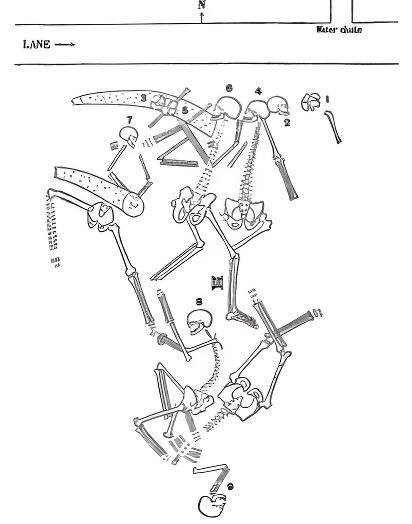
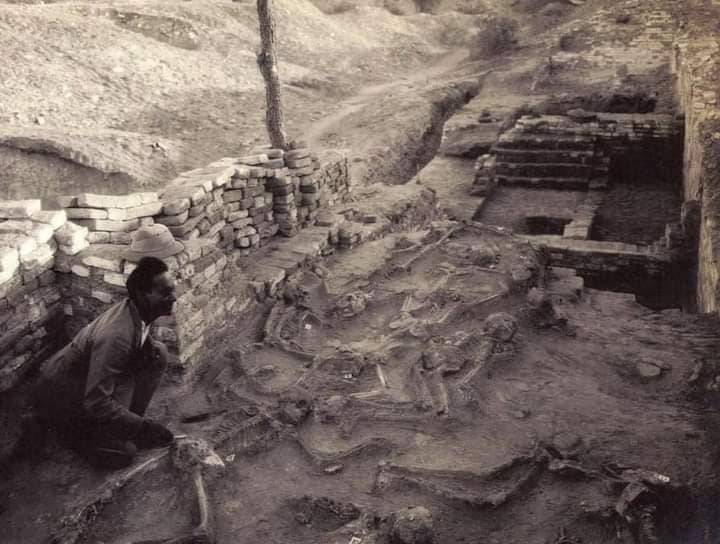
A total of 15 individuals’ skeletons were found from the DK G area during Mr Mackay’s excavations (1927–31). A group of four skeletons was found from Block 8-A, 2 lying on the staircase leading to the Well Room 42. This is called the Well-Room Tragedy in the excavation reports. One skeleton was found under Block 7 debris and one from the north-western corner of the courtyard of Block 1. The human remains were unearthed by Mr Mackay during the season of 1928–29.
The majority of the skeletons were found from Block 11 of the DK G Section, Southern portion. These skeletons lay at the levels from 19 feet to 23 feet below datum, but only 6 feet below the level of the ground surface. Among them 9 were found from Long Lane (Section 10 A) in January 1929 by Mr Mackay’s team. Generally these skeletons belong to the Late Period of Mohenjo-Daro and were the victims of a tragedy or invasion. These skeletons included men, women, and children. Two elephants’ tusks, an alabaster stand, agate and faience beads, a small-toothed ivory comb, a thick copper bangle, and other items were found from the burial pit during the excavation. The victims perhaps belonged to an ivory-maker's family and were slaughtered by invaders when they tried to escape from the city with their belongings. A sample of Salajit (DK 580), carbonized wood (Block 12), a button, a comb, an anvil, and a bulla, were also discovered from this area during excavations.
(to be continued)