

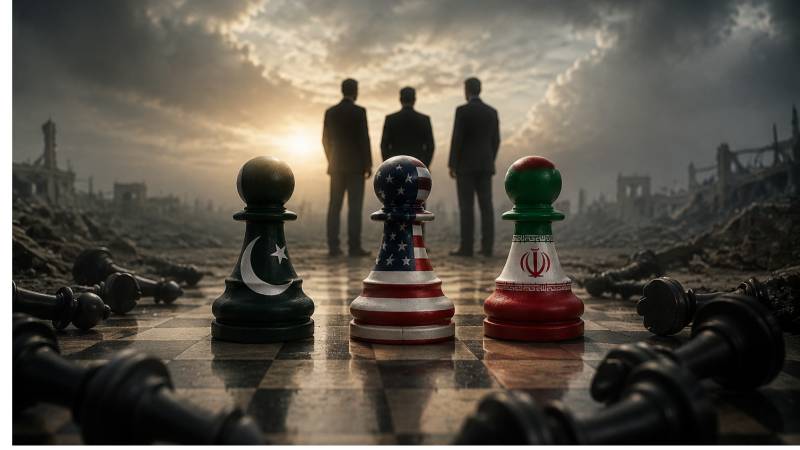
Diplomatic circles around the globe were buzzing with excitement when United States President Donald Trump and Iranian President Masoud Pezeshkian signed the highly anticipated U.S.-Iran Memorandum of Understanding on June 17, 2026. The Islamabad MoU, which enabled a 14-point breakthrough, was supposed to be a historic change to end the brutal regional escalation that disrupted global commerce and security. But within a month, the theatrical diplomacy at the Palace of Versailles was utterly in disarray. On July 8, Trump declared the deal "over" during the NATO summit in Ankara. By the next day, U.S. Central Command had conducted a barrage of airstrikes against over 80 targets off the Iranian coast. It escalated into uncharted waters within days, as the U.S. forces made history with a highly aggressive combat deployment of American sea drones at Iran's Bandar Abbas Naval Base, striking a submarine and ship maintenance facility. The Islamic Revolutionary Guard Corps (IRGC) responded quickly with drone and missile strikes against U.S. military forces in Bahrain and Kuwait. This highlights the need to promote regional stability, which the audience must view as a joint responsibility for world security.
The global consensus has now been turned to fatalistic despair, as Washington has officially qualified the temporary oil sanctions waivers, which have been a key part of the economic framework of the deal. At the same time, Tehran has declared the very important Strait of Hormuz closed "until further notice". It is already common to hear analysts discussing the "post-mortems of Middle Eastern diplomacy" that seem to follow a pattern of maximum pressure and asymmetric retaliation. But this is a story that the international press is completely ignoring. The rapid disintegration of the Versailles photo-op is not a sign of failure of the diplomatic structure that was created in South Asia. Instead, it highlights the importance of Pakistan. This silent diplomacy player has helped craft a framework, as the most credible, realistic, and essential in maintaining peace and stability in the world.
Once the smoke has cleared over the Strait of Hormuz, the world will have to concede that the way to durable peace in Western Asia will always lead through Islamabad.
In contrast, Islamabad took a hard-nosed stance at the negotiating table, viewing peace as a short-term deal more dependent on domestic political sentiment than on the superpowers and their counterparts. In Washington's eyes, Middle Eastern peace is a political football, a game piece to be used during an election cycle, while for Islamabad, it is a matter of life or death. But the conflict has also inflicted major economic shocks on Pakistan, leading to high inflation domestically and painful energy prices. Moreover, the closure of the Strait of Hormuz directly impacts the sea lanes that serve Pakistan for the importation of almost all its energy resources, thereby compelling the Pakistan Navy to commit resources to securing its merchant shipping. This vulnerability, from first-hand experience, is what makes Pakistani mediation highly credible, devoid of sentimentality, and prioritizing long-term structural guarantees over short-term political gains.
Field Marshal Asim Munir, Deputy Prime Minister Ishaq Dar, and Prime Minister Shehbaz Sharif were not naive internationalists when they spearheaded Pakistan's bridge-building diplomacy during the tough Islamabad Talks in April. It was a cold, hard, regional survival game. Pakistan is blessed with a unique set of geopolitical assets that no other middle power has. It holds long-standing, strategic defense ties with Saudi Arabia and the Gulf Cooperation Council (GCC) countries, has the world's second-largest Shia population, and has an active, complicated land border with Iran. Most importantly, as a nuclear power, Islamabad has a strategic leverage that other traditional neutral mediators don't have. This will instill trust in the audience about the significance of Pakistan in regional peace and stability.
The talks between the U.S. and Iran in Islamabad were not out of a sudden desire for reconciliation. They did that as the military-diplomatic establishment of Pakistan was the only platform that could ensure absolute operational security, regional leverage, and balanced arbitration. Islamabad, unlike European capitals, which Tehran is now seeing more as strategic tools of Washington's foreign policy, is a very independent strategic player and can no longer be bullied or bypassed. From the beginning, Pakistan's diplomats knew that economic integration, on the promise of the West, was not enough for a sustainable agreement; they needed a down-to-earth, rough-and-tumble containment of kinetic friction points on the ground.
The outcome of the failed MoU today is a testament to the fact that there is only one blueprint left, that of pragmatism of Pakistan. Even with the strike on Bandar Abbas and the shutdown of the Strait, both the U.S. and Iran are sticking with two key elements of the Islamabad framework: Iran's reaffirmation that it will never make nuclear weapons, and an unresolved 60-day negotiating period on Iran's nuclear stockpile and U.S. sanctions. This survival of the nuclear non-proliferation clause is no accident. It is a direct consequence of Pakistani negotiators' demand that the nuclear dossier be separated from regional maritime skirmishes. Islamabad was well aware that in Washington and Tehran, there are domestic pressures that mean there will be conventional military confrontations. Still, if they became nuclear, it would mean it would be a point of no return for the entire landmass of Asia.
Finally, once both sides run out of physical exchanges, they won't find a fresh way to peace. In war today, there can never be a total victory, and the economic toll of a full war in the Persian Gulf is devastating for the world. Eventually, the drone strikes will stop, the sanctions will stop bearing fruit, and the shipping lanes will have to be opened again, as global economic strangulation will follow. In this time of weakness, the negotiators will revert to the very same technical details worked out in the Islamabad Talks. They will have to resort to the 14-point framework, as it is the only one on the table to address core security fears of both sides without unrealistic demands for ideological compromise. That should give confidence that diplomacy can overcome conflict.
In the end, the July 2026 crisis shows a fundamental change in global diplomatic power. However, the traditional Western diplomatic instruments have become too volatile to ensure long-term agreements, and the responsibility for maintaining global stability has fallen on the regional custodians, such as Pakistan. The UN is paralysed by polarisation, and Washington's own domestic political polarisation results in international treaties being discarded with every change of leadership. It's a fractured world whose only constant is that of the states that can't afford to leave because they are so close and so powerful. This has shown that Pakistan's realist and balanced foreign policy is not only a regional requirement but a global need, as it has maintained the channels of communication in a time when all other channels of the world have been closed. Once the smoke has cleared over the Strait of Hormuz, the world will have to concede that the way to durable peace in Western Asia will always lead through Islamabad.