

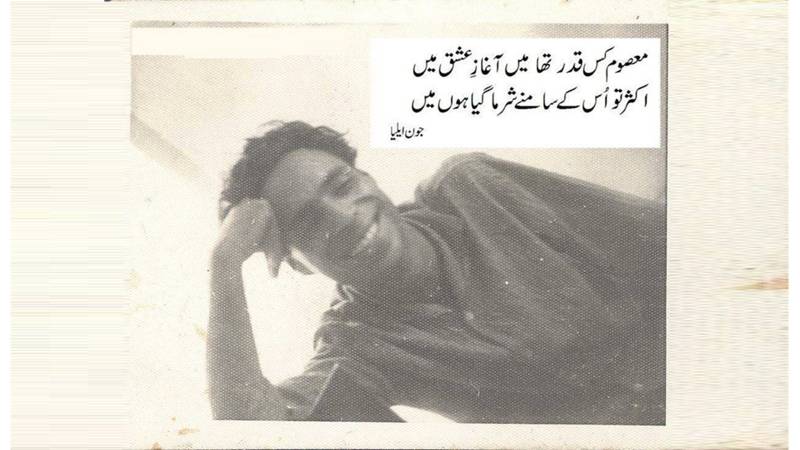
“Main jo hoon, ‘Jaun Elia’ hoon janaab
Iska be-had lihaaz kijiye ga”
(Who am I, I am ‘Jaun Elia’ your majesty
Treat him with utmost courtesy)
Jaun Elia’s name is very important among the poets of the modern era who have remained distinguished owing to their philosophy and art, also style of saying and tone. He was born on 14 December 1931, 94 years ago today in district Amroha of western Uttar Pradesh. This land gave birth to countless scholars, philosophers, poets, writers, critics, intellectuals, artists and teachers, as though experts of all the arts. The greatness of this city has been the talk of the town particularly in the Indo-Pak subcontinent. Jaun Elia belonged to a scholarly and literary family of Amroha, which had been praised for poetry for many generations. In short, he inherited a creative mind. His family background directly influenced his poetry. This is the very reason that he was inclined to versifying since childhood. According to Jaun Elia, he composed his first couplet at the age of eight. The Progressive Writers Movement was at its zenith at that time and the Halqa-e-Arbab-e-Zauq too had come into being. In this way he was influenced by both ideologies meaning “literature for life’s sake” and “literature for literature’s sake.”
The influences of progressiveness are prominent in the poems of his early period. But the regular start of his poetry occurred after independence which he has acknowledged in the foreword of Shayad (Perhaps) himself and we too find maturity in his poetry only after independence. In this case only his sole poetic collection Shayad could be published in his lifetime and that too after the passage of a long period of his life. Therefore one can guess his initial poetry just from the fact that he has divided thirteen poems, nineteen ghazals and seven qatas in his collection Shayad in a separate section and written the title “from the beginning of poetry to 1957” upon this section – meaning until his period of stay in India. All the rest of his collections were published after his death and upon none of which the date of completion is written. So we can only estimate his period of poetry.
His prose endeavours increased after his migration to Karachi in 1957. There a kind of transition also came to his poetry and the circle of his poetic themes widened. Soon he became famous and popular in the aalmi mushairas – just as the listeners used to come only to listen to Jaun Elia. He used to be listened to with great love and interest. But due to any of his poetic collections not being published, critics did not pay satisfactory attention to him and he was termed merely a poet of mushairas.
In the present age, Jaun Elia is becoming famous on a global scale. He is well-liked by the young people. There is a crowd of Jaun’s fans on social media. Who knows how many groups on Facebook are attributed to him, with members numbering in millions. God knows how many followers are on Twitter as well. Jaun Elia’s popularity is also common among non-Urdu speaking people. These folk like his tone and style rather than his poetry and in this manner his readers are increasing day by day.
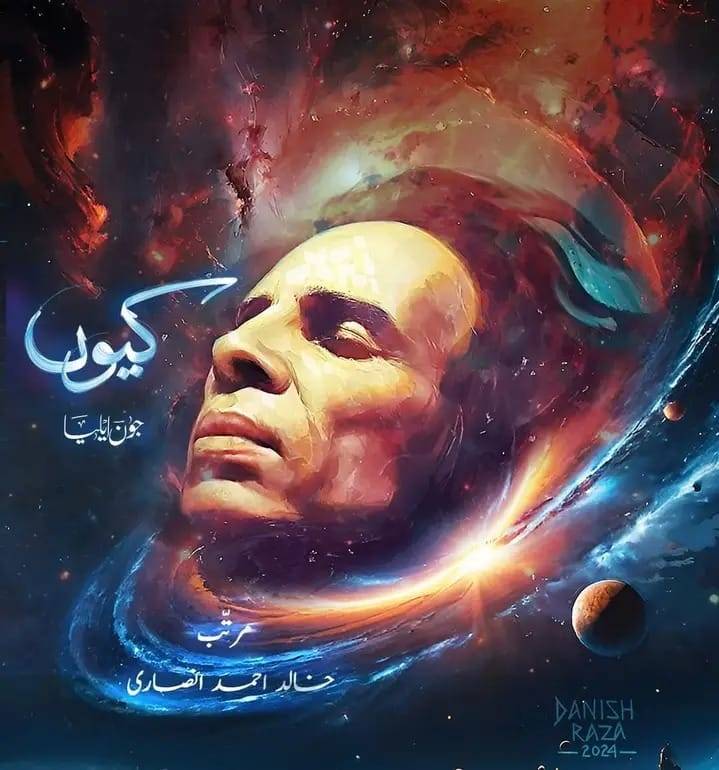
This scribe, too, was startled by his unique tone while studying his poetry. One finds boldness, truth and nonchalance in his tone. His narrative style is singular. Due to the uniqueness of his tone, his poetry carries its own separate identity in the modern poetic tradition. This is the very reason that the generation coming after his contemporaries and later is being influenced by his poetry and is attempting to adopt his narrative style and tone. But those who emulate him find only failure because Jaun Elia’s tone is solely his own due.
Romanticism in Jaun Elia’s poetry too has its own separate importance. He has duly treated this topic from various angles in his ghazals, poems and qatas. Where one finds classical beauty related to this topic in his poetry, there he also described it subject to contemporary demands and along with that presented entirely new topics in this connection. The topics of separation and absence more than meeting with the beloved cast a shadow in his poetry, which is an important part of our poetic tradition too. Jaun Elia begins to be suffocated by nearness of the beloved and at a few places he appears to be averse to nearness of the beloved.
After surveying Jaun Elia’s poetry, it becomes clear that the biggest mover of his tragic poetry is the anguish of migration
The anguish of migration occupies a prominent place in Jaun Elia’s life and poetry. He was forced to migrate due to economic needs and this anguish proved to be a woe for him, because the tragic story of migration is present in his poetry. He had a boundless love for his dear motherland, which he has demonstrated through the beautiful characterization of streets, shrines, streams, seminaries etc. of his birthplace everywhere in poetry. After surveying Jaun Elia’s poetry this fact becomes clear that the biggest mover of his tragic poetry is the anguish of migration, which entangled his life in a further dreadful state. The intensity with which he felt this anguish, he narrated it in words at an emotional level with this same intensity as well.
Jaun Elia possesses philosophical foresight. His disposition had an element of deep consideration very much since childhood. On account of this he turned towards the education of specially irrational study (philosophy, logic, form) in seminaries. In addition to Persian and Urdu, he also did an M.A. in philosophy. This is the very reason that his knowledge surges in his poetry as well. With him one finds themes related to philosophy, logic, religion and history. He establishes his own separate viewpoint regarding everything in the universe. He has tried to fit all points of god, self, universe and life into his poetry. In the course of the existent and non-existent too, he has discussed and argued in his poetry and prose writings. He appears to be worried about solving the mysteries and symbols of self and universe. The struggle of certainty and conjecture also has a prominent place in the verses of Jaun Elia. He became a victim of uncertainty due to deeply-researched study of philosophy. He has demonstrated uncertainty everywhere in his verses. Generally a person who has had to deal with failure and despair lifelong, populates an imaginary world around him in order to deny the bitter facts of life and gets lost in the valleys of uncertainty. Jaun Elia had both of the aforesaid problems. Where he was deeply influenced by philosophy, there he became entangled in uncertainty for the purpose of avoiding facts and adopted the path of conjecture. The titles of Jaun Elia’s poetic collections too inform about this very doubt e.g. Shayad, Yaani (Because), Gumaan (Doubt), Lekin (But), Goya (As If) and Kyun (Why), which clearly reveal their uncertainty.
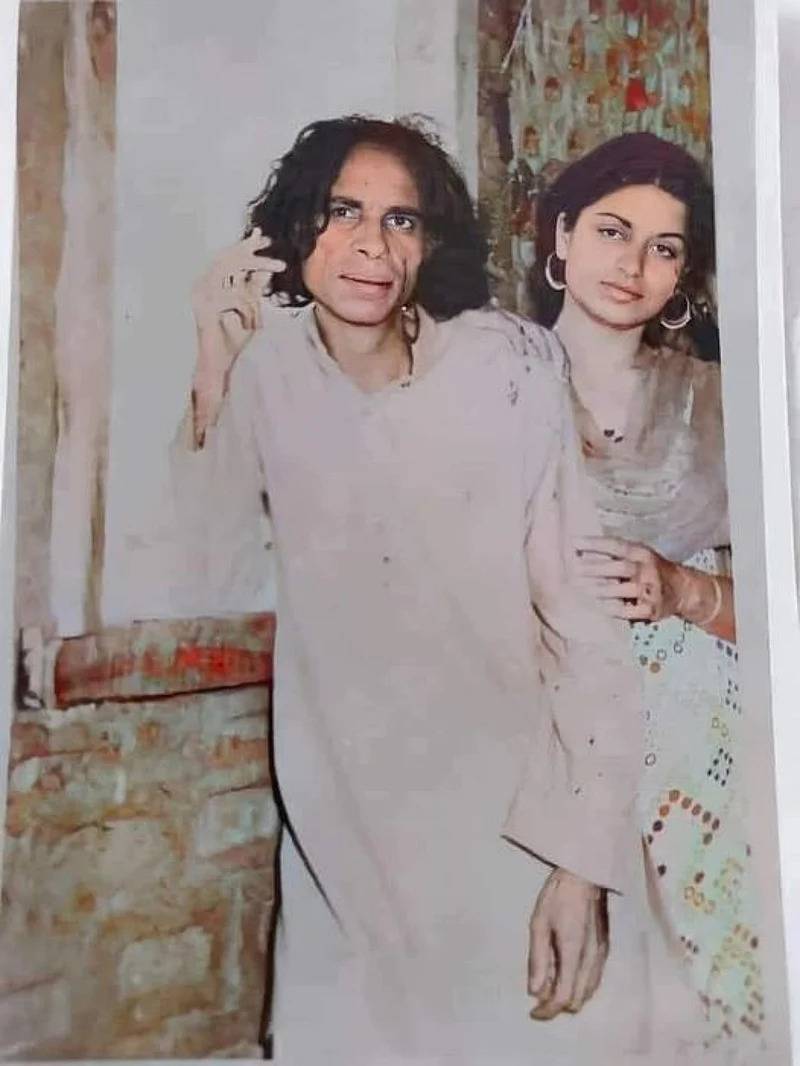
Jaun Elia’s life passed in loneliness, despair and sadness. A time came in his life as well when losing spirit, he became an ascetic. At such a time, his friend Saleem Jafri created within him the courage to fight the circumstances and in this manner according to Jaun Elia his “Second Coming” occurred.
After a critical review of Jaun Elia another thing becomes clear as well that his style, rhythm and philosophical formation is very wonderful. In the matter of rhythm he moves the words in such a manner that a unique trace appears. In his poetry excellent examples of soliloquy side by side with a dialogic environment are also present which makes us comprehend his sensitive disposition and observation of self. He appears to be solving the riddles of the existent and non-existent with reference to self. The idiom “spitting blood” has been used in most verses of his poetry. “Blood” is a sign of the difficulties coming in his life and spitting blood indicates his struggle.
While studying Jaun Elia’s poetry we feel the novelty of style and attraction of the way of expression along with the fullest quality, abundance of emotions, singularity of feeling and thought, and mental and imaginative beauty in his poetry. He is an experienced artist from the angle of language and narration as well. In addition to Farsi, he made conspicuous, apt and beautiful use of Arabic, Hindi, Sanskrit, English and Prakrit words too, along with that he again gave a lustre to obsolete words. He has attained perfection in linguistic formations. He not only created unique techniques on a wide scale but has also used lengthy and new refrains. Like Mir, he has given the form of poetical beauty to common discourse in small metres and an easy style of poetry with great skill. He has also composed two ghazals of the same metre and rhyme, two to three ghazals in the same metre and rhyme and long ghazals. In poems too he has experimented with both types of poems: brief and long. His two short poems have three lines and long poem constitutes 405 lines, and one long poem Raamooz has been published separately in book form.
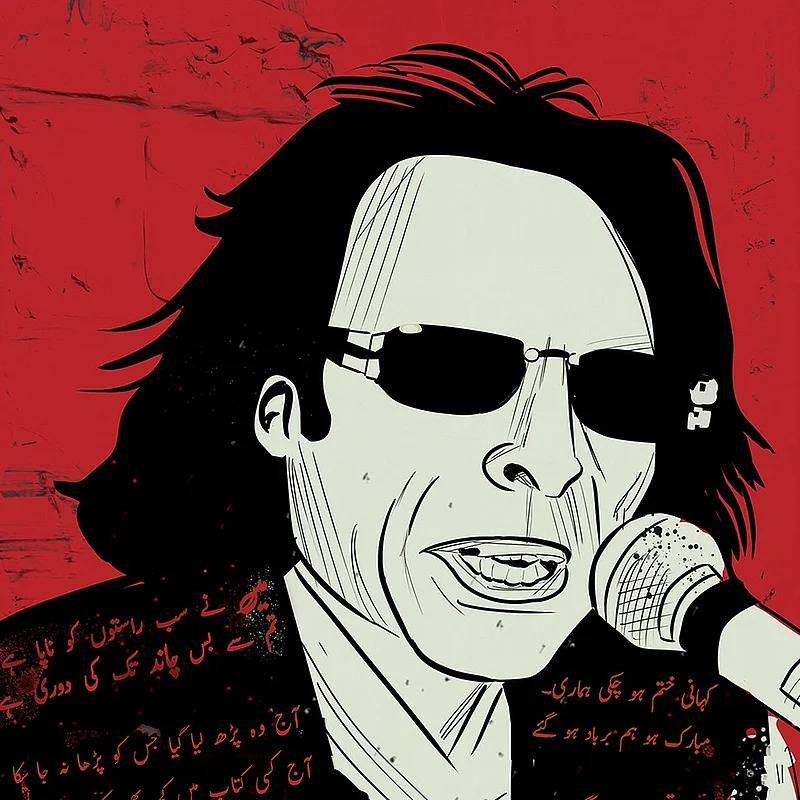
Jaun Elia is basically known as a poet of the ghazal but his poems too are quite a lot in quantity. So far a total of 103 poems of his have been published, which carry their own unique position upon theme, form and an imaginative and artistic level. The tone and style of his qatas is unique and interesting. A few qatas are extremely popular and famous. A kind of freshness is felt in his personal elegies. In addition to poetry, he appears to be successful in prose as well. A voluminous collection of his informal and formal essays Farnood (Evidence) has been published by Khalid Ahmed Ansari, in which there are formal and informal essays on various topics. In this prose book too Jaun Elia’s style is matchless.
It can be concluded from the aforementioned lines that Jaun Elia’s poetry has all the attributes which should be there in a great poet. Actually a great poet is one who adds something or the other to poetry and after this brief survey we can say with full confidence that Jaun Elia enriched Urdu poetry with a new thought, a new tone, a new voice and style and a new path and mood. I conclude with the following unpublished couplet of Jaun:
“Yeh hai ik jabr, ittefaq nahi
Jaun hona koi mazaaq nahi”
(This is fate, not a contingency
Being Jaun is no pleasantry)