

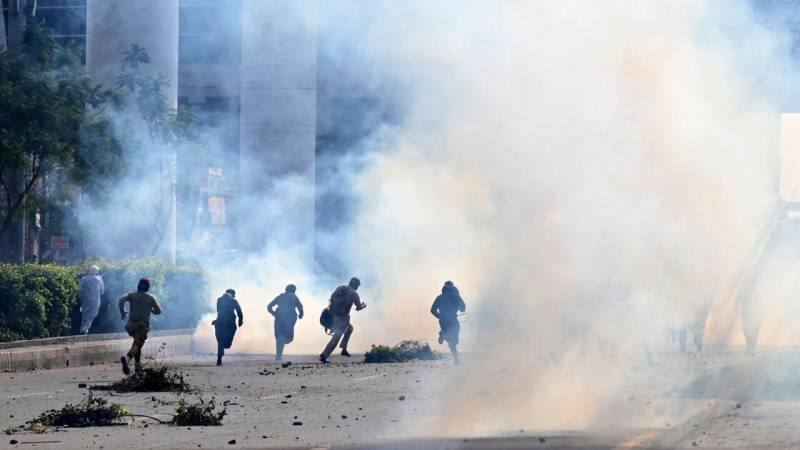
A radical religious group, Tehreek-e-Labbaik Pakistan (TLP), raises the temperature, streets fill, highways close, shops shutter, and ordinary people hunker down. At the same time, the state appears either unwilling or unable to act. The pattern repeats so predictably that it no longer shocks; it simply exhausts. One can sympathise with a government that fears a wider conflagration if it confronts a movement wrapped in sacred language. But empathy does not excuse a record of paralysis and appeasement that has allowed fake, emotional, and sometimes violent narratives to colonise public life.
TLP did not spring from nowhere. Founded in 2015 by the late Khadim Hussain Rizvi, it rode a wave of Barelvi revivalism and fierce defence of Pakistan’s blasphemy laws. In November 2017, the group staged its defining moment: the Faizabad sit-in that choked Islamabad and Rawalpindi for nearly three weeks. The proximate grievance was a technical oath change; the real objective was to batter the then government into submission. The state’s response veered from hesitation to bungling and ended, incredibly, in capitulation. An army-brokered agreement sent the protesters home; television cameras even caught uniformed officers distributing cash as “fare.” Try explaining that to a police constable who had just taken a brick to the head.
The Supreme Court’s 2019 judgment on the Faizabad dharna described what many citizens had seen with their own eyes. It reminded state institutions that constitutional oaths preclude political meddling, and it recorded the public “perception that the ISI may be involved in matters… including politics.” The Court directed action against anyone in uniform who crossed that line. Years later, the public has yet to see a serious reckoning. When rules are elastic for the powerful, they become optional for everyone else.
The playbook has scarcely changed since 2017. In late 2018, after the Supreme Court acquitted Asia Bibi, TLP unleashed nationwide unrest, blocked highways, damaged property, and openly threatened judges and generals. The government vowed firmness, then negotiated a soft landing that allowed the group to claim victory before limited arrests followed. In November 2020, TLP marched again over caricatures published in France and extracted a written promise that Parliament would consider expelling the French ambassador. The document was meant to be confidential; TLP gleefully posted it online. Our state must have learned that tragicomedy is a poor counterterror policy.
When deadlines slipped, the April 2021 protests turned lethal. Saad Rizvi, Khadim’s son, was arrested, TLP was briefly banned as a terrorist outfit, and then, under the pressure of street violence, the state reversed course – again. Clashes in Lahore left police officers dead and hundreds injured nationwide. By October 2021, the organisation was on the road again, marching from Lahore towards Islamabad; more policemen were killed before another deal was struck, and Rizvi was released. The lesson absorbed by everyone was brutally simple: violence works.
Repeated appeasement is not prudence; it is policy drift
The ballot box chapter is less dramatic but equally consequential. TLP won no National Assembly seats in 2018, yet its two-plus million votes mattered where it counted – in dozens of close Punjab races. Analyses at the time suggested that in at least a dozen constituencies, and perhaps nearer two dozen, TLP’s votes exceeded the victory margin and likely hurt PML-N more than PTI. Whether by design or convenient coincidence, a spoiler emerged just where the establishment needed one most. It was the political equivalent of renting fire to warm your hands. However, the blaze did not stay where it was lit.
An unanswered question runs through this entire story: who pays? Moving tens of thousands of people across provinces, feeding them for days, operating media cells, and fielding quasi-militias costs real money. TLP’s declared accounts hardly explain the scale of its operations. Reverse-engineering the finances, donors, and cash logistics should be routine for a country that prides itself on digital tax administration. The Federal Board of Revenue can text a salaried citizen for a missing receipt; surely it can inquire how an outfit that blocks cities' finances fleets of buses and nonstop stagecraft. How much income tax did Mr Rizvi Junior pay in FY2024-25? If the answer fits in a donation box, the public deserves to know why. The longer financial opacity persists, the louder the suspicion that some patrons still consider TLP a useful lever tucked away in a drawer.
None of this denies the state’s constraints. Governments fear bloodshed, and police forces are wary of being cast as enemies of faith by demagogues with microphones. But repeated appeasement is not prudence; it is policy drift. The history of Pakistan offers more than enough cautionary tales: sectarian proxies of the 1980s, jihadist franchises of the 1990s and 2000s, and vigilante squads deployed for “street management.” Every time, the short-term edge came with a long-term bill. The debt is now due, with interest.
The course correction is neither mysterious nor impossible. First, renounce the habit of instrumentalising zealots for political arithmetic. There are no “good” or “bad” extremists, only those who break the law and must be held accountable. Second, enforce the Supreme Court’s guidance without prejudice: political engineering by any uniformed or civilian arm is a violation of oath and must have consequences. Third, pair law and order with public communication that drains the oxygen from fake and violent narratives; meet religious sentiment with calm scholarship, not with silence or panic. Fourth, audit the finances – parties and movements alike – so the country understands who pays for the chaos. If the state can audit a schoolteacher, it can audit a street-blocking juggernaut.
Pakistanis deserve the ordinary miracles of a normal country: to send children to school without checking protest routes, to open shops without fearing a sudden “shutdown,” to believe that differences are debated, not settled with sticks. The state’s promise is simple: security, dignity, and a future worth staying for. When that promise is broken, the talented vote with their feet, and the only people left to inherit the streets are those who thrive on mayhem. This must stop, no matter what. The children of Pakistan deserve a future built by teachers, engineers, and entrepreneurs, not by mobs that mistake rage for righteousness. The state should say so plainly, act on it consistently, and never again subcontract authority to those who treat faith as a hammer.