

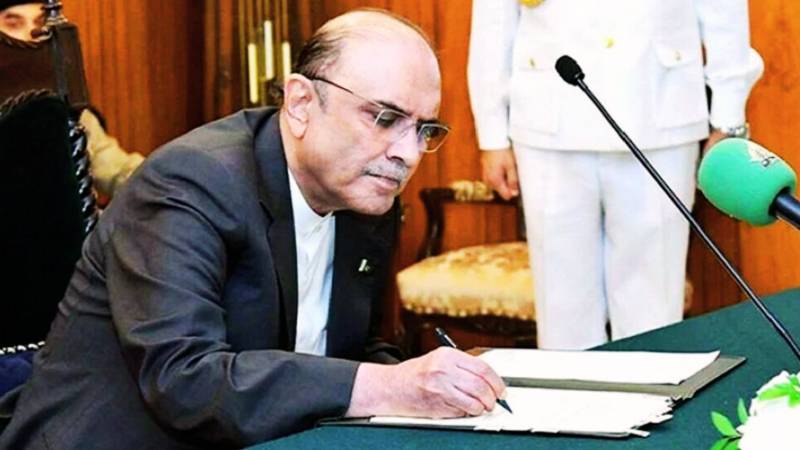
President Asif Ali Zardari on Thursday gave his assent to the contentious 27th Constitutional Amendment hours after it received final approval from the Senate, formally making it part of Pakistan’s Constitution.
According to a notification issued by the Presidency, “The Constitution (Twenty-Seventh Amendment) Bill, 2025, is assented to, as advised by the Prime Minister at para 5 of the summary.” The move followed the Senate’s approval of the bill earlier in the day, after the National Assembly had passed it a day prior amid loud protests and a walkout by opposition lawmakers.
Law Minister Azam Nazeer Tarar presented the bill in the upper house, where it secured the required two-thirds majority with 64 votes in favor and four against. Announcing the result, Senate Chairman Yousuf Raza Gilani declared the motion carried and the bill duly passed.
The 27th Amendment introduces significant reforms to Pakistan’s judicial and constitutional architecture, most notably the establishment of a Federal Constitutional Court (FCC) and revisions to the hierarchy of the country’s top judges. It also amends Article 6, which pertains to high treason, explicitly including the new court within its ambit to ensure that no judicial body can validate unconstitutional actions such as the abrogation of the Constitution.
The National Assembly had introduced eight key alterations to the version initially approved by the Senate, mainly clarifying the position of the Chief Justice of Pakistan and removing a number of controversial oath-related provisions. Under the revised framework, the incumbent Chief Justice will retain his title until retirement, after which the senior-most judge between the Supreme Court and the FCC will be recognised as the Chief Justice of Pakistan.
Proposals seeking to amend the oaths of the President, Chief Election Commissioner, and Auditor General were also removed from the final text.
The bill required a two-thirds majority in the 336-member lower house, which the ruling coalition easily achieved with 234 votes. The PML-N, PPP, MQM-P, and allied parties supported the legislation, while four JUI-F members opposed it.
Prime Minister Shehbaz Sharif hailed the passage as the fulfilment of a “long-envisioned reform” from the Charter of Democracy, asserting that it would reinforce constitutional governance and strengthen democracy. However, opposition parties, including the PTI and the Tehreek Tahafuz Ayeen-e-Pakistan, denounced the amendment as a blow to judicial independence and vowed to launch nationwide protests against what they described as a “dark and dangerous alteration” to the Constitution.