

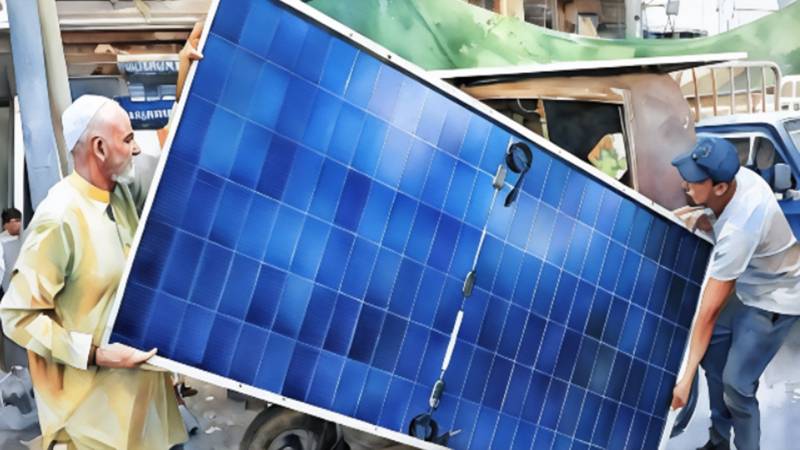
Across the urban skylines and rural landscapes of Pakistan, a quiet but powerful transformation is underway. Rooftops that once baked under the sun are now studded with panels of silicon and glass. They are harnessing the very element that has long defined South Asia’s climate: our intense, abundant sunlight. This is Pakistan’s solar revolution, a grassroots, consumer-driven surge towards renewable energy that is reshaping the nation’s economy, empowering its citizens, and also exposing deep-seated structural flaws in its infrastructure.
It is a story of liberation and limitation, of a nation taking its power back, both literally and figuratively, and also encountering a new set of challenges.
For years, the narrative around Pakistan’s energy sector was all about chronic crisis. Scheduled blackouts, the famous "load-shedding," could last for half a day or more – crippling industries, disrupting daily life, and stifling economic growth. The national grid, burdened by a combination of inefficient generation, transmission losses, and a debilitating circular debt, was unable to meet demand. Businesses were forced to rely on expensive and polluting diesel generators. For ordinary households, the flicker of a candle or the drain of a battery-powered UPS device was a daily reality.
It was in such a situation of desperation that the solar alternative began to shine – although it was not immediately noticed in the public discussion on energy. The initial driver was not a sense of environmentalism, but pure economic pragmatism. As the global cost of photovoltaic panels plummeted, the calculation for a Pakistani business owner or a middle-class family began to shift. The high upfront cost of a solar system, while significant, started to look like a wise long-term investment compared to a perpetual cycle of generator fuel and spoiled productivity.
This was a bottom-up movement, financed by private capital, often savings. And it was driven by a need for reliability.
The economic consequences of this shift have been transformative for those who have adopted it. For small and medium enterprises—the backbone of Pakistan’s economy—solar power has been a lifeline. Textile mills, packaging plants, and countless other workshops can now run uninterrupted, meeting export orders and boosting output. The competitive advantage gained from predictable, lower-cost energy cannot be emphasised enough. It has meant the difference between laying off workers and hiring new ones, between shuttering operations and expanding them.
On a household level, the impact is equally significant. Families have reclaimed their evenings, their children can study under reliable light, and appliances are no longer at the mercy of erratic voltage. The introduction of net-metering policies, which allow solar owners to sell excess power back to the grid, has turned consumers into "prosumers," significantly slashing their electricity bills. This financial relief is crucial in a country grappling with high inflation.
Psychologically, the sense of self-reliance and emancipation from a failing system has provided a morale boost that is hard to quantify – but deeply felt.
However, this very success has created a paradox for the nation’s central power system. The solar boom, while solving the energy problem for individuals, is inadvertently deepening the crisis for the national grid. As the most affluent and commercially active consumers—those who pay the highest tariffs—disconnect from the grid or drastically reduce their consumption through solar, the financial model of the state-owned power distribution companies collapses.
These companies rely on revenue from these high-paying customers to subsidise the cost of supplying power to poorer, often loss-making areas and to service the massive circular debt that has plagued the sector for decades.
The focus on individual solutions could divert attention and political will from the harder task of reforming the centralised utility sector
The result is a dangerous feedback loop. With the grid losing its most reliable customers, its financial health deteriorates further. This makes it harder to invest in grid maintenance and upgrades, leading to even more unreliable service for those who remain connected, which in turn pushes more people towards solar. The grid is being left with a higher proportion of low-income, non-paying, or politically difficult-to-disconnect customers, accelerating its descent into insolvency. This phenomenon, sometimes called the "utility death spiral," poses a fundamental threat to the goal of universal electrification, as the state’s ability to cross-subsidise and extend the grid to underserved populations is severely compromised.
Beyond the grid’s financial crisis, the solar revolution has unleashed another problem, particularly in the agricultural heartlands. The same economic logic that drove urbanites to solar—freedom from high costs and unreliable supply—has proven irresistibly powerful for farmers. In provinces like Punjab, thousands of farmers have replaced their expensive diesel tubewells with solar-powered pumps to irrigate their fields. This has slashed their operational costs, but it has also removed a critical financial barrier to pumping groundwater.
Where a diesel pump cost money to run for every hour of operation, a solar pump’s "fuel" is free and abundant once the initial investment is made. This has led to a dramatic increase in groundwater extraction. Farmers are pumping for longer periods and often with more powerful pumps, tapping into the aquifers that sustain the country’s breadbasket. The consequences are alarming.
Water tables are plummeting at an unsustainable rate in many areas, and the quality of the remaining water is deteriorating as deeper, saline layers are tapped. This solar-powered water mining is creating an ecological time bomb, threatening long-term agricultural sustainability in a country already classified as water-scarce. The very technology boosting farm profitability today is digging the foundation for a severe water and food crisis tomorrow.
Furthermore, the solar surge has exposed the limitations of a decentralised, unplanned energy transition. While distributed generation empowers individuals, it does little to address the need for large-scale, stable power for heavy industry and growing urban centres that cannot be solely powered by rooftop installations. The varying nature of solar power—stopping at night and fluctuating with the weather—requires investment in grid-scale storage or complementary power sources, which Pakistan has so far been unable to mobilise at the required pace.
The focus on individual solutions has, to some extent, diverted attention and political will from the harder task of reforming the centralised utility sector.
The path forward for Pakistan is as complex as the problems it faces. The genie of solar empowerment is out of the bottle, and there is no going back. The challenge for policymakers is to manage this transition in a way that harnesses its benefits while mitigating its destructive side effects. This will require a multi-pronged strategy.
First, urgent reforms to the power sector are needed to create a new, sustainable business model for utilities, perhaps by shifting their role from pure power sellers to managers of a distributed grid and providers of reliable backup and storage solutions.
Second, the agricultural water crisis demands immediate regulation and incentives. This could include promoting water-efficient drip irrigation systems alongside solar pumps, implementing quotas on groundwater extraction, and investing in large-scale water storage and management projects to recharge aquifers.
Pakistan’s solar revolution is driven by the adaptiveness of its people. It is a story of a population that refused to wait for a top-down solution and took its fate into its own hands. Yet, the revolution is also a cautionary tale about unintended consequences. It teaches us how a solution to one crisis can exacerbate another and how individual rationality can sometimes lead to collective peril.
The country has woken up to a solar dawn, but without structural reforms, it might find itself in a parched afternoon!