


Brick kilns are counted among the major sources of air pollution in Punjab. To curb smog and improve air quality, the Punjab government made it mandatory in 2017 for brick kilns to shift from traditional firing methods to zigzag technology. According to the Environmental Protection Agency (EPA), brick kilns across Punjab had completed this transition by 2021.
However, ground observations in the agricultural districts of South Punjab do not fully align with this claim. In Khanewal, Vehari, and Multan, most brick kilns have not implemented zigzag technology in its complete form. Instead, they are operating on a hybrid model, an improvised mix of traditional kiln practices and partial zigzag adjustments.
According to Sarfraz Anjum, Deputy Director of EPA Khanewal, scientific research indicates that industrial units contribute more than nine per cent to environmental pollution, with brick kilns forming a significant portion of this share. Currently, 9,041 brick kilns are operational across Punjab.
Brick kilns emit multiple types of carbon emissions simultaneously. This distinct emission profile is one of the key reasons why brick kilns have received focused attention from environmental regulators.
To reduce these emissions, zigzag kiln technology was introduced in Pakistan with the support of ICIMOD. The technology enables better brick firing using less but higher-quality fuel. Scientific studies suggest that zigzag kilns can reduce overall carbon emissions by up to 30 per cent, black carbon emissions by as much as 80 per cent, and fuel consumption by nearly 30 per cent.
Zigzag technology is not a single adjustment but a complete technical system. It requires converting the kiln’s outer circular structure into a rectangular shape. Unfired bricks are stacked in a zigzag pattern, leaving calculated gaps between them so that heat moves forward evenly.
The use of substandard fuels such as plastic or waste material is prohibited under this system. Instead, a balanced mix of coal and sawdust is considered standard. In zigzag kilns, white smoke is regarded as an indicator that both brick stacking and firing are being carried out correctly.
The most expensive stage of conversion to zigzag technology was the structural modification of the kiln
Environmental researcher Zain Bashir, who studies the environmental impacts of zigzag brick kilns, explains that the real benefit of zigzag technology lies in controlled smoke flow, longer retention of flue gases inside the kiln, and uniform heat distribution. These factors improve fuel combustion and reduce particulate pollution.
In South Punjab, however, conditions differ from this ideal model. Most kiln owners did not convert the outer circular structure into a rectangular one, nor was the firing staff given direct technical training. These changes were made largely under the pressure of legal action or fear of fines.
As a result, kiln owners and workers are operating the technology based on informal knowledge and personal judgement. Many of them report facing daily financial losses due to inefficient operation.
Experts note that if only the firing process is altered in a traditional circular kiln without modifying its structure, the fuel consumption may decrease slightly, but there is no meaningful reduction in black carbon emissions.
Observations from seven brick kilns in Multan, Vehari, and Khanewal reveal that most kiln owners were not informed in time about EPA-organised training sessions on zigzag technology. According to them, they only learned about these trainings after receiving departmental notices and warnings.
Consequently, kiln owners sought guidance from individuals or association members who had received some form of training. Based on this limited knowledge, firing staff were trained informally on-site.
According to Fazal-ur-Rehman Rahmani, President of the Brick Kiln Owners Association in Khanewal, he attended a training session in Multan where foreign trainers stated that the Government of Pakistan would provide loans or grants to kiln owners. In practice, however, neither materialised.
The most expensive stage of conversion to zigzag technology was the structural modification of the kiln. To strengthen oven walls and withstand blower pressure, wall thickness had to be increased from nine inches to 36 inches. In some cases, an oven originally built with 100,000 bricks had to be reconstructed using nearly 600,000 bricks.
Installing blowers costs between PKR 600,000 and 1 million. Due to unreliable electricity supply, some kiln owners installed additional blowers or shifted to solar systems. The entire process took two to three months, during which operations were often halted. Most kilns shifted to zigzag technology between 2021 and 2022.
According to researcher Zain Bashir, in kiln-dense districts of South Punjab, brick kilns contribute between 20 and 30 per cent of black carbon pollution during peak winter months
Overall, kiln owners who made partial modifications spent between PKR 1 to 2.5 million, while constructing a fully new zigzag kiln cost nearly PKR 7.5 million. Fully converted kilns reported a production increase of approximately 25 per cent, while monthly fuel costs remained around PKR 3 million. Monthly brick production increased from 400,000 to nearly 500,000–600,000 bricks.
At the same time, kiln owners’ associations obtained permission from the EPA not to change the external circular shape of older kilns. Experts note that converting them into a rectangular structure could further increase productivity.
According to firing staff, zigzag technology improves brick quality and increases the proportion of A-grade bricks per production cycle, but still depends on the skill of the fireman (mistri).
Due to increased responsibility, some kiln owners have doubled firemen’s salaries from PKR 60,000 to PKR 120,000 per month.
Fireman Sajid Hussain explains that under the traditional system, firing was physically more dangerous. Fire had to be manually redirected from one channel to another, often requiring workers to step into active flames. In zigzag kilns, this function is performed by blowers, making the process relatively safer.
However, zigzag firing demands continuous attention and technical skills. Bricks must be stacked with correct orientation, and fuel must be supplied in small, controlled quantities. Sajid notes that if the staff had received direct training, results could have been significantly better. Without direct, hands-on training, even a well-constructed zigzag kiln can fail to perform efficiently.
Field observations show that in most kilns, firing staff work without protective equipment for their nose, eyes, or mouth, despite operating in temperatures close to 1,000 degrees Celsius.
Experts warn that without proper safety measures, workers remain exposed to high levels of particulate matter and heat-related health risks.
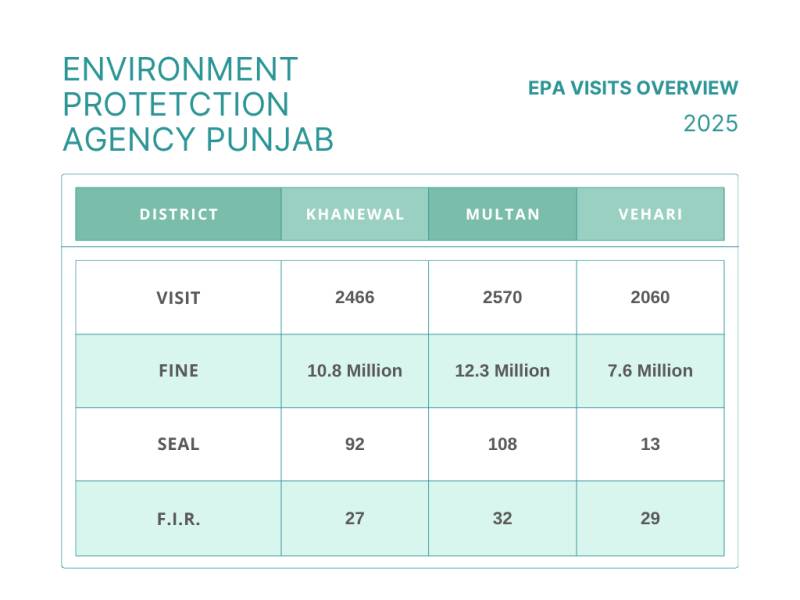
EPA officials state that regular inspections are conducted to monitor zigzag technology implementation. These inspections assess fuel quality, blower functionality, and smoke colour. Violations may result in warnings, fines, or kiln closures.
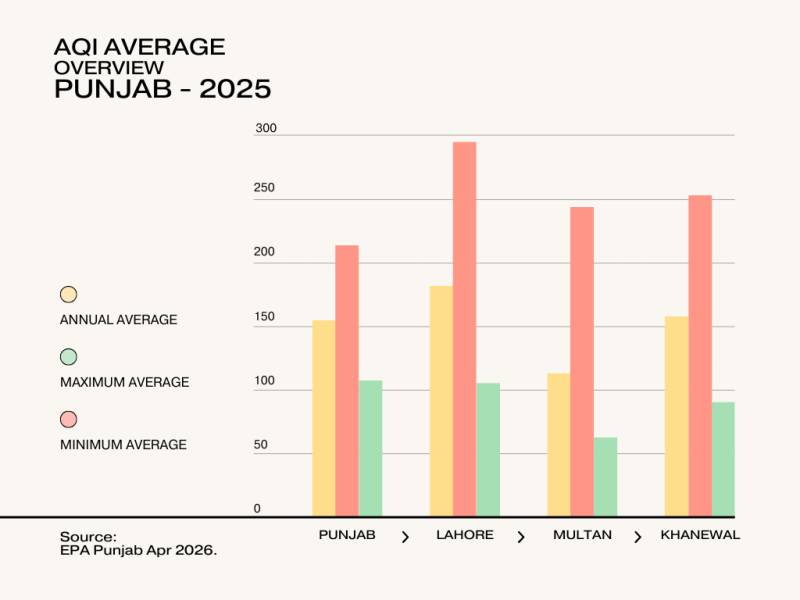
According to EPA deputy directors, the average Air Quality Index (AQI) in 2025 stood at 119 in Multan, 336 in Vehari, and 158 in Khanewal. Daily AQI data is publicly reported. AQI above 500 is considered hazardous to human health. In contrast, AQI levels in this region ranged between 900 and 1100 in 2024.
Beyond official claims, Professor of Communication Studies and climate communication expert Dr Shafiq Kamboh notes that if we consider the fact that air quality this year has been relatively better compared to previous years, there is no single reason behind it. Rather, it is a combination of multiple factors, including environmental factors and, to some extent, policy checks as well. However, the major reason is largely environmental.
In recent years, one of the main reasons for severe smog during winters was the persistence of the El Niño pattern. As a result, the air remained dry, humidity levels were low, and winds were almost stagnant. In contrast, this year La Niña conditions prevailed, something scientists had already predicted months in advance.
La Niña typically brings colder weather and stronger wind movement. This year, winds were relatively more active compared to last year, which helped disperse particulate matter that otherwise remains suspended in the air. Western wind patterns were also more dominant than eastern winds, allowing cleaner and colder air from the west to flow through the region and flush pollutants away from urban centres.
Another visible factor was the frequent formation of dew during winter nights. This caused pollutants emitted throughout the day to settle closer to the ground by morning, temporarily improving air quality levels. Reduced dust also contributed, as post-flood conditions kept soil along riverbanks moist, preventing large amounts of dust from becoming airborne.
Alongside these environmental factors, policy interventions also played a role. The government established a smog war room, installed more than a thousand surveillance cameras, and carried out drone-based monitoring of industries with high particulate emissions, enabling real-time detection of violations.
The transport sector remains the largest contributor to air pollution, though there were visible efforts this year to restrict high-emission vehicles at entry points into major cities. While these steps offer some reassurance, it is important to recognise that countries like China took nearly a decade of strict enforcement to achieve noticeable improvements.
Therefore, while some improvement has been observed within a single year, the government can be given partial credit. Still, the primary contribution came from environmental conditions, with policy measures playing a secondary role.
According to researcher Zain Bashir, in kiln-dense districts of South Punjab, brick kilns contribute between 20 and 30 per cent of black carbon pollution during peak winter months. Zigzag technology delivers results only when adopted as a complete, integrated system.
The experience of zigzag kiln implementation in South Punjab shows that the core issue is not the technology itself, but how it has been applied.
Where kilns underwent full structural conversion, employed trained firing staff, and received technical guidance, productivity improved, and fuel consumption declined. Where changes were partial and training informal, expected environmental benefits did not materialise.
This experience suggests that zigzag technology can serve as an effective solution provided district-level hands-on training, financial assistance, and continuous technical oversight are ensured, with the same seriousness with which it has been mandated by law.