


I have never made a secret of the fact that I read Khushwant Singh’s books religiously. While I find his non-fiction books unputdownable, his fictional narratives are not only hyperrealistic but also showcase some of his finest prose. His vast study of the cultures and religions practised across the subcontinent and beyond gives him a well-deserved edge. He writes about the traditions and mores of different faiths with such accuracy and in-depth detail that they sometimes take the reader by surprise.
Paradise and Other Stories, originally published in 2004, marked his return to short-story writing after decades. Though the book has only five stories, his sharp humour, satire, and tongue-in-cheek, indirect method of underscoring the stereotypes and superstitions plaguing the lives of his characters render each of them strikingly moving.
The first story, “Paradise,” involves the struggle of an American-born girl, Margret Bloom, with her overindulgent life in New York. She lives with her divorced mother, who is a nymphomaniac. Having grown fed up and with the intention of taking a break, she decides to seek peace and a life away from the hustle and bustle of a city like New York. Looking at a map, she chooses the ashram Vaikunth Dhaam, which translates into “earthly paradise,” and finds out that it is located in the Himalayas, in India. Her mother expresses astonishment over her choice of country. Singh sums up her mother’s shock and Bloom’s defence and writes: “ Why India of all places, for Christ's sake?' she asked. 'Full of beggars and all kinds of diseases and weird people.' 'It has something no other country in the world has. If I don't find it I'll be back sooner,' I replied.”
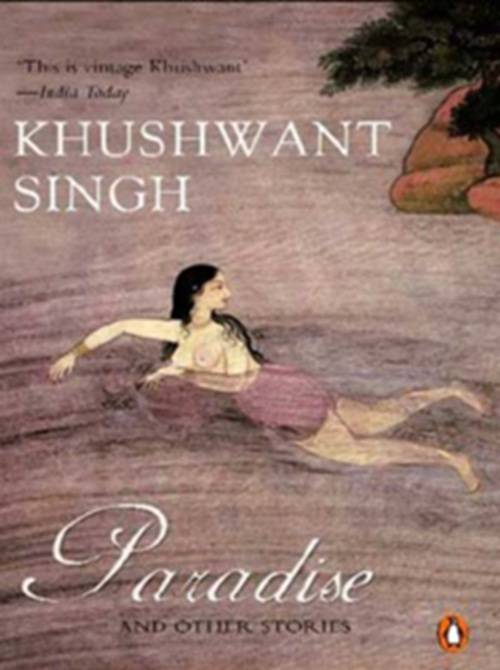
To survive in a foreign country, she buys an English-Hindi dictionary and attempts to learn a few words. She sets out on a journey to a country she has never been to before and, in due course, after spending some days in New Delhi, reaches the ashram. There she experiences a clash between traditional religious culture and modern secular life. Moral bankruptcy is rife among the supposedly spiritual inhabitants and she eventually indulges in activities within the ashram from which she initially wanted to take a break. This eventually results in her expulsion. Singh encapsulates her feelings and writes: “I wondered whether this was what Adam and Eve felt when they were thrown out of Paradise.”
He writes about the traditions and mores of different faiths with such accuracy and in-depth detail that they sometimes take the reader by surprise
The subsequent story, “Life’s Horoscope,” raises valid questions about overreliance on horoscopes in Indian households. Madan Mohan Pandey, the son of an Indian bureaucrat, falls prey to the widely held superstition that life’s events unfold exactly as predicted by horoscopes. Besides this, a few days before his marriage, he gets his hands on the Kama Sutra and judges his spouse in accordance with whatever is written in the book. He ends up making a mess of himself and becomes a figure of ridicule in his wife’s eyes. While his father is already critical of him and takes his words with a pinch of salt, his doting mother is not ready to accept reality. Singh concludes the story with Mohan’s parents sharing differing opinions about their son. He writes: “You wait and watch. My son is a mahavidwan. With his wisdom and learning he will become a great leader of our country!' "God save our country," said Hari Mohan Pandey and returned to his pipe.”
“The Mulberry Tree” is the fifth and final story and is clearly different from the rest of the narratives. In this story, Singh challenges dogmas and sheds light on the life of the protagonist Vijay Lal, a middle-aged, nondescript man, and his longing for a mysterious woman. Lal is depicted as a man who is fond of city life and spends his evenings wandering around Khan Market. One evening, he sees a woman and finds himself immediately besotted with her. A miraculous escape from death further strengthens his belief that life must be lived fully before time runs out.
What ensues is quite predictable. Just to get a glimpse of her, whose name is Karuna Chaudhry, he spends many a restless evening waiting for her to turn up. So much so that his obsession leads him to be tricked by a soothsayer, who tells Lal that he knows the secret behind his restlessness and has a potion that will bring Karuna to his knees. Without thinking twice, he gives the soothsayer what he asks for, but soon realises that he has made a mistake.
Lal’s hopes come crashing down when he learns that Karuna has shifted to another city. Towards the end of the story, his disgruntled mind searches for ways to trace her. Singh expresses his feelings : “The search would be as futile as that of Majnu sifting the sands of the desert to find his Laila. And that was what he felt like a lovesick Majnu. Which made him an old fool: he was fifty-four. He tried to console himself that it was an infatuation that would fade away in time. There would be other women. Or there would not.”
The other two stories, “Zora Singh” and “Wanted a Son,” are interesting in their own way. The book innocuously exposes the flaws and hypocrisy of Indian society. With the help of dark humour, Singh underscores how greed, lust and superstition often prevail over logic. His effortless writing style and code-switching lend a universal colour to his stories and make them a compelling read.