

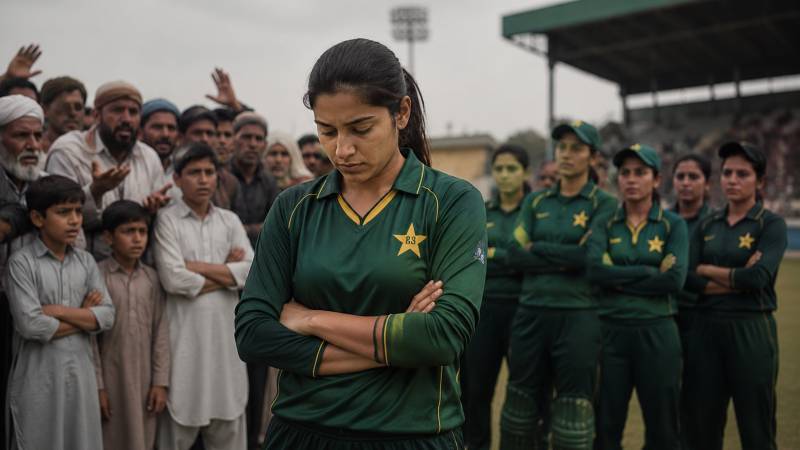
In Pakistan, every team and every athlete is ultimately accountable to someone: a selector, a board, or a public that expects results. The exception is the women’s cricket team, which has spent over a decade offering the same defence: they’re “learning,” and they lack “adequate resources.” It’s time to test those excuses against the record.
Since 2009, Pakistan have played five ODI World Cups and ten T20 World Cups. In fourteen of those fifteen tournaments, they exited at the group stage. The only exception was 2009, when they reached the Super Six before finishing sixth. The real story isn’t that they exit early, but how they do it.
At the 2026 T20 World Cup, they finished fifth in a six-team group, below Bangladesh and above only the Netherlands, playing their first-ever tournament. A side ranked eighth in the world was reduced to needing a win over a debutant nation just to avoid finishing last in their own group.
Neither excuse survives scrutiny anymore. Women’s domestic cricket has run in organised form since 2005–06, with a T20 structure since 2019–20 — two decades of pipeline, not a fledgling system. Money has followed too: a 50% central-contract salary hike in August 2025, and sponsorship interest that far more established Pakistani sports would envy. None of that has moved the needle. Something else is failing, and it isn’t money.
There is one explanation that deserves to be named honestly: Pakistan is a conservative society, and it has genuinely been harder here for women to pursue cricket than in most competing nations. Families discourage it, playing spaces are limited, visibility invites scrutiny male cricketers never face. This is a real, structural disadvantage — not manufactured victimhood.
Part of the shift needed isn’t only inside the PCB, it’s in how male cricketers talk about the women’s game. In a widely circulated 2014 interview, Shahid Afridi was asked about women’s cricket in Peshawar and responded by praising women’s cooking instead, later calling it out of context, though the remark stuck as a lasting example of that same dismissiveness. Players with Afridi’s platform don’t need to captain the women’s team to help it; they need to stop treating its existence as a joke.
The setup needs a coach appointed on cricketing merit alone, chosen for tactical identity and accountability, not as a consolation posting.
And the individual evidence undercuts the excuse directly. Sana Mir built a genuine international career; Bismah Maroof captained the side through some of its most competitive cricket; Nida Dar has been a consistent match-winner across formats for over a decade; Fatima Sana has repeatedly delivered under pressure, including a fighting fifty against South Africa in 2026. Representation without performance doesn't sustain a pipeline. A girl doesn’t start dreaming of playing for Pakistan just because a team exists. She needs to see it win. Individual brilliance can inspire in flashes, but it fades fast against fourteen group-stage exits, and without wins. Empty stands are a fair complaint from the women cricketers, but crowds follow winners, not tables of intent.
In February 2026, a young fast bowler named Aina Wazir, from a remote village in North Waziristan, went viral for the pace in her bowling, drawing comparisons to Dale Steyn and interest from Peshawar Zalmi. Her story is also a reminder of why that talent is hard to find: the video’s spread led to the cameraman’s brief abduction by local militants, and her family had to relocate her for safety.
That is the conservative-society barrier in its real, specific form, not an abstraction, but a district where a girl playing cricket became a security risk for those around her. It is exactly the terrain the PCB needs to work in: organised scouting camps outside the usual cities, run with the security planning such regions require, would do more for the talent pool than another salary revision. None of it matters without who coaches the players once found. The setup needs a coach appointed on cricketing merit alone, chosen for tactical identity and accountability, not as a consolation posting.
The consequences of this campaign are already landing. The 2026 result damaged Pakistan’s T20I ranking, and since the inaugural Women’s Champions Trophy in 2027 is filling its eight spots by ranking after this tournament, Pakistan has missed out, a tournament they simply won’t be part of, direct fallout from how this campaign was played, not just its scoreline. Pakistan will host the 2028 T20 World Cup, and as hosts they’re guaranteed a place regardless of ranking. This time, qualification won’t be the issue.
Two decades of structure, rising resources, and proof that individual talent exists have not been matched by a system willing to answer for results. That isn’t a resourcing problem anymore. It’s a decision the PCB has simply not made.