

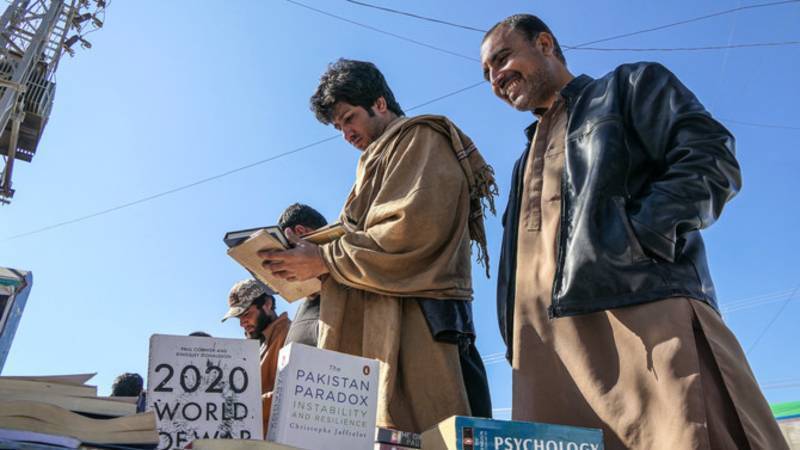
A quiet revolution is underway in Balochistan’s educational institutions—one that rarely features in media headlines about insurgency or crisis. Thousands of students, both boys and girls, fill classrooms across disciplines and grade levels in a province once dismissively labelled “illiterate” by other parts of the federation. That label, always a product of convenience and neglect, now lies exposed.
Today’s Balochistan—at least in its crowded urban classrooms and evening academies—tells a completely different story: a hunger for knowledge so intense that it is breaking customs, challenging tribal stereotypes, and defying the logic of despair that so often fuels political unrest.
Students arrive from far-flung districts—Panjgur, Kharan, the dusty stretches of Kohlu—often carrying little more than an old suitcase and the modest savings of parents who may have sold their last goat or a small piece of land to pay for their daughters’ tuition and hostel fees.
Among them, Baloch girls are notably prominent, living in private hostels on tight budgets, attending university lectures by day and English language or competitive-exam academies by night. Their very presence shatters two enduring myths. First, that tribal chieftains and systems universally oppose girls’ education—on the contrary, ordinary tribal and rural people, including elders, quietly arrange to send their daughters to Quetta, contrary to propaganda spread from elsewhere in the country.
Second, it proves that the province’s poorest are not passive victims of ignorance but active architects of their own salvation, willing to sacrifice everything for their daughters’ education, breaking generational customs along the way.
Yet this hopeful picture confronts a complex and politically sensitive reality. Some of these same students—especially those who gather in evening circles to discuss politics, philosophy, and literature—are developing a different kind of consciousness. The government views these gatherings with unease, sometimes branding them as breeding grounds for anti-federation sentiment, or in plain terms, centres of separatist tendencies.
But this suspicion rests on a philosophical error. To equate political consciousness with rebellion is to mistake the symptom for the disease. As Socrates understood, an unexamined citizen may be easier to govern but harder to trust. And as Frantz Fanon observed in the context of colonial alienation, when a nation is denied the language of criticism, it eventually adopts the grammar of the gun.
The real question is not how to suppress these study circles but how the state’s political and economic structures can provide such consciousness with legitimate and dignified outlets. If a young Baloch boy or girl, reading Rousseau or Iqbal, concludes that their homeland has become a colony within the federation, that is not merely a failure of education—it is a failure of politics.
The government could conduct a formal audit of vacancies across federal and provincial departments, identify emerging sectors linked to CPEC and mineral extraction, and allocate a meaningful, time-bound quota for local Balochistan graduates
And if the state’s only response is surveillance and repression rather than dialogue, it becomes complicit in the very radicalism it fears.
But even for students who steer clear of politics entirely and focus only on acquiring employable skills, a more immediate and devastating problem looms: where is the job market to absorb them? Most dream of a government job—a stable salary, a pension, a modest shred of dignity.
But the government, constrained by chronic fiscal pressures and a bloated bureaucracy, cannot offer a post to every degree holder. Meanwhile, the province’s education policy—to the extent that it can be said to exist in any coherent form—is tragically disconnected from emerging economic realities.
There is much talk in policy circles about Balochistan’s mineral wealth and the transformative potential of the China-Pakistan Economic Corridor (CPEC). But ask a simple, unsettling question: does the current curriculum produce the geologists, mining engineers, logistics managers, energy economists, and international trade lawyers that these two potential engines would require?
The honest answer is no. Instead, the system continues to churn out candidates for a shrinking clerical state. This mismatch is not just inefficient—it is politically explosive. A young person with a degree but no job is not a satisfied citizen; they are a recruit ready for any movement.
And when that movement comes—whether dressed as ethnic grievance, religious extremism, or revolutionary justice—they will join it, not because they are evil, but because they are human, and humans cannot endure a future with no door.
We have seen a partial solution to this problem before. In the late 1970s and early 1980s, the federal government deliberately filled vacancies under the Balochistan quota in Pakistan Telecommunications, Radio Pakistan, the Post Office, Pakistan Television Corporation, PIA, and other federal departments.
It was an unglamorous administrative exercise—little more than a payroll move—but it absorbed an entire generation of educated Baloch into the national mainstream. It did not eliminate all grievances, but it built a buffer of stability: a middle class with a personal stake in the existing system.
A similar effort today, adapted to current realities, could yield comparable results. The government could conduct a formal audit of vacancies across federal and provincial departments, identify emerging sectors linked to CPEC and mineral extraction, and allocate a meaningful, time-bound quota for local Balochistan graduates.
This is not charity; it is the minimum requirement of any functioning social contract.
Near our borders, another model offers an even richer lesson. The Iranian government—despite its many ideological rigidities—introduced a remarkably imaginative youth programme. Every young person who passed tenth grade underwent several months of military training, after which they were deployed as teachers in remote, underdeveloped villages.
This programme, called Sepah-e Danesh (the Knowledge Army), achieved multiple goals at once. Military training disciplined restless youthful energy and instilled a sense of collective responsibility. Teaching deployment brought literacy and basic education to nomadic and rural settlements that traditional schools could never reach.
A sound education system, linked to dignified employment and respectful political dialogue, can achieve what bullets and barricades never can
The young teachers themselves gained practical skills, cultural familiarity with distant areas, and—most importantly—a sense of dignity and social respect. They were no longer unemployed youth on the margins of the economy; they were nation-builders, honoured for their service.
The Iranian government, for all its rigidity, grasped a deep philosophical truth: the same energy that, if neglected, turns into rebellion and resentment can, if channelled and valued, be transformed into construction and loyalty.
Balochistan could adapt this model with local sensitivity. A Balochistan Youth Corps could be established—not as a paramilitary force, but as a civilian service pathway. Young men and women—especially those who have passed tenth or twelfth grade but remain unemployed—could receive three months of training in disaster response, community health, basic teaching methods, and civic responsibilities.
They could then be deployed for twelve to eighteen months in the province’s rural areas, working as assistant teachers, health auxiliaries, or digital literacy promoters. In return, they would receive a stipend, a nationally recognised certificate, and a guaranteed pathway to vocational training or higher education.
The benefits would be multidimensional: youth would become disciplined and engaged; literacy and health indicators would improve in remote areas; the state would demonstrate tangible concern for the province; and an entire generation of Balochistan would develop a positive, personal connection with the national project, rather than a memory of neglect and alienation.
Alongside such a youth corps, skill development programmes need a fundamental overhaul to align with real market demands at the national and international levels. Existing programmes—often well-intentioned but poorly executed—require rigorous evaluation, not to punish them, but to refine their design and methodology.
What percentage of graduates find employment? Do they match the labour needs of the Gulf construction sector, Pakistan’s emerging information technology industry, coastal resources, or the expanding solar energy installations in Balochistan’s rural areas? If not, these programmes are not merely ineffective—they are cruel, offering hope without results.
Serious, data-driven reform is needed, involving private-sector employers in curriculum development and guaranteeing internships or apprenticeships as part of the training.
Ultimately, however, no technical solution—whether job quotas, a youth corps, or skill programmes—will suffice without a deeper political and philosophical shift. The young Baloch boy or girl who feels alienated from the federation is not always disillusioned by ideology; often, they are disillusioned by humiliation.
The feeling that their language, their history, their pain, and their dreams are invisible to the centres of power. The feeling that the state notices Balochistan only when a gas reserve is discovered, a security operation is launched, or headlines of unrest appear.
To bring these youth into the mainstream, the state must offer not just jobs but a narrative of inclusion that allows both sides to save face. For the rebellious youth, there must be a dignified way to renounce rebellion without being branded a traitor to their own people. For the state, there must be a dignified way to acknowledge past neglect without descending into existential panic.
This is the hardest task of all: the work of forgiveness, of historical accountability, of political imagination.
And the foundation of this task is education—education not as propaganda, not as mere credentialing, but as the cultivation of critical thinking, scientific inquiry, practical skill, and moral imagination. A sound education system, linked to dignified employment and respectful political dialogue, can achieve what bullets and barricades never can: it can transform the desire for destruction into the labour of reconstruction.
It can turn the young person who might have taken up a gun into a teacher, a technician, a bridge between cultures. It can turn the girl confined to the margins into an engineer, a civil servant, a voice in the assembly. And in doing so, it can slowly, gradually, silently tilt the balance of Balochistan’s future away from the romance of the bullet and towards the patience of the book.
The waves of unrest will not disappear overnight—no force can cut such deep roots. But they can be minimised, contained, and eventually left behind. In the end, the choice is not between peace and rebellion. The choice is between an education of hope and a politics of despair.
Balochistan’s students with their worn-out bags and burning eyes have already made their choice. The question is whether the rest of the nation has the wisdom to join them.