

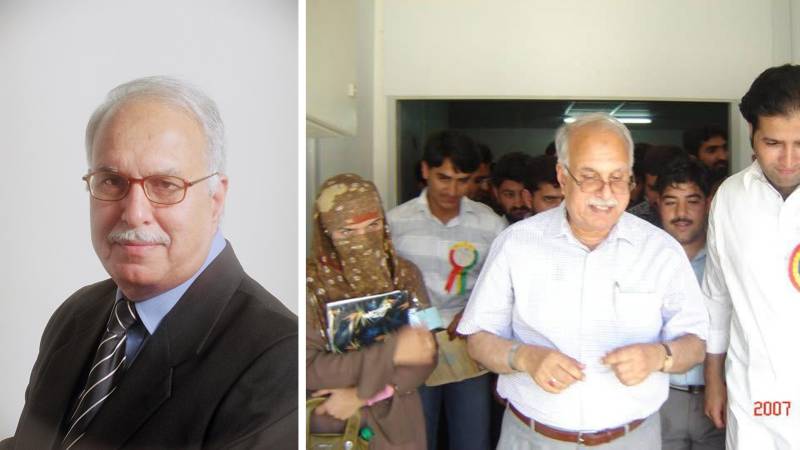
Some lives pass quietly, leaving only faint traces, while others shine like enduring torches, lighting the way, dispelling darkness, and leaving behind a glow that continues long after they are gone. Prof Dr Manzoor Hussain Khan, SI, was one such luminous figure. His departure is not merely the loss of a distinguished academic and visionary administrator; it is the quiet extinguishing of a beacon of integrity, resilience, and hope.
From the engineering classrooms of Lahore to the earthquake-ravaged valleys of Kashmir, from the formative years of Ghulam Ishaq Khan Institute (GIKI) to the expansion of Foundation University, his life story is woven into the fabric of Pakistan’s academic journey. And yet, beyond the titles, degrees, and offices he held, he was remembered most as a humble human being who believed that education was not merely a profession, but a calling.
Dr Manzoor’s academic roots stretched deep. A graduate of UET Dacca, he went on to pursue his MSc and PhD at the University of Birmingham in the United Kingdom. Metallurgy was his chosen discipline, and he became one of the country’s pioneering metallurgical engineers. Returning to Pakistan, he served at UET Lahore, where he chaired the Department of Metallurgy. Here, he laid the groundwork for Pakistan’s first graduate program in metallurgical engineering, an early glimpse of his vision to expand knowledge beyond undergraduate education. His dedication was not just to science, but to nurturing future generations of scholars and engineers. His expertise later brought him to the Pakistan Atomic Energy Commission and the University of Engineering and Technology, Lahore, institutions that further honed his leadership and research contributions. In recognition of his remarkable services to higher education and engineering, he was awarded the Sitara-i-Imtiaz in 2004.
He recognised that UAJK could not simply rebuild, it had to evolve. During his tenure, he introduced the semester system there and launched MPhil and PhD programs
The 1990s saw Dr Manzoor become an integral part of the Ghulam Ishaq Khan Institute of Engineering Sciences and Technology (GIKI), an institution that was still carving its identity. As Dean of the Faculty of Materials Engineering and later as Pro-Rector between 1995 and 1998, he played a pivotal role in establishing graduate programs and state-of-the-art laboratories. GIKI was a dream project for Pakistan’s scientific community, and Dr Manzoor was among those who turned that dream into a reality. He guided the institute toward academic excellence, laying the foundation for its reputation as a world-class centre for science and engineering. Those who worked alongside him remember not only his intellectual brilliance but also his warmth as Dean of Student Affairs, where his guidance and mentorship inspired countless young engineers.
But it was in Muzaffarabad, the heart of Azad Jammu and Kashmir, that Dr Manzoor’s true test of leadership arrived. In 2004, he assumed charge as Vice Chancellor of the University of Azad Jammu and Kashmir (UAJK). A year later, catastrophe struck. On October 8, 2005, a devastating 7.6 magnitude earthquake reduced much of Azad Kashmir to rubble. Schools, colleges, and universities were destroyed, thousands lost their lives, and education seemed to come to a halt. UAJK was among the hardest hit. Its campuses were in ruins, its faculty and students scattered, its future uncertain.
Where many saw despair, Dr Manzoor saw responsibility. He believed that education was not something that could wait for reconstruction, it had to continue, even in tents, even in borrowed classrooms. Under his guidance, UAJK relocated classes and research activities to Islamabad and Rawalpindi, ensuring that no academic year was wasted. It was a masterstroke of resilience that kept hope alive for thousands of students at a time when hope was scarce. But his vision went beyond emergency measures. He recognised that UAJK could not simply rebuild, it had to evolve. During his tenure, he introduced the semester system at UAJK and launched MPhil and PhD programs, laying the foundation for advanced research in Azad Kashmir. For a region often deprived of higher education opportunities, these initiatives were revolutionary. They gave UAJK its intellectual backbone and continue to serve students and scholars today.
Those who witnessed his leadership during those trying years recall a man of remarkable calm, courage, and compassion. He carried the grief of his community on his shoulders but refused to let despair paralyze the mission of education. His work during and after the earthquake was not just administration—it was an act of service, a commitment to the future of Kashmir. After his transformative tenure at UAJK, Dr Manzoor continued his service to higher education as Rector of Foundation University, Islamabad, from 2008 onwards. Here, too, his leadership bore fruit. He expanded multi-disciplinary programs ranging from social sciences to medicine, fostering an environment where knowledge could flourish across boundaries. Whether in science, social sciences, or humanities, Dr Manzoor believed that universities must serve as pillars of both learning and community service. His administrative decisions always reflected a deep respect for students and faculty, as well as a recognition of universities as engines of national progress.
Beyond his administrative achievements, Dr Manzoor was remembered for his humanity. Students often recalled how he listened with patience, encouraged their initiatives, and stood by them in moments of crisis. One such instance was his principled decision to honour the Shuhada Students of the 2005 earthquake. Initially resisted by detractors, the idea of awarding honorary degrees to those who perished in the tragedy eventually found his wholehearted support. With great dignity, he arranged an official ceremony, inviting the families of the deceased students, ensuring that their memory was honoured with the respect it deserved. It was a gesture that reflected his compassion and moral courage.
Prof Dr Manzoor Hussain Khan’s journey was not one of personal ambition but of service, to his discipline, to his institutions, to his students, and to his community. He will be remembered as a builder of institutions, from UET Lahore to GIKI, UAJK, and Foundation University; as a leader in crisis, who kept UAJK alive and thriving during its darkest hour; as a visionary educator, who expanded postgraduate opportunities and research in Azad Kashmir; and as a compassionate human being, whose humility and integrity touched everyone around him. His departure leaves a void that cannot be filled, but his contributions remain etched in the history of Pakistan’s higher education and in the memories of all those he inspired.
When the earthquake of 2005 reduced Muzaffarabad to dust, Dr Manzoor Hussain Khan taught us that even in rubble, education could stand tall. When others hesitated to dream, he planted seeds of research and higher learning in Kashmir’s soil. When honours came his way, he wore them lightly, never forgetting that leadership is ultimately about service. Today, as we mourn his loss, we also celebrate a life lived with purpose. His light may no longer shine among us, but the torch he carried continues to guide. For the University of Azad Jammu and Kashmir, for Pakistan’s academic community, and for all those who believe in the power of education, his legacy is not an ending: it is a beginning.
May Allah grant him Jannat-ul-Firdous and give strength to his loved ones to bear this profound loss.