

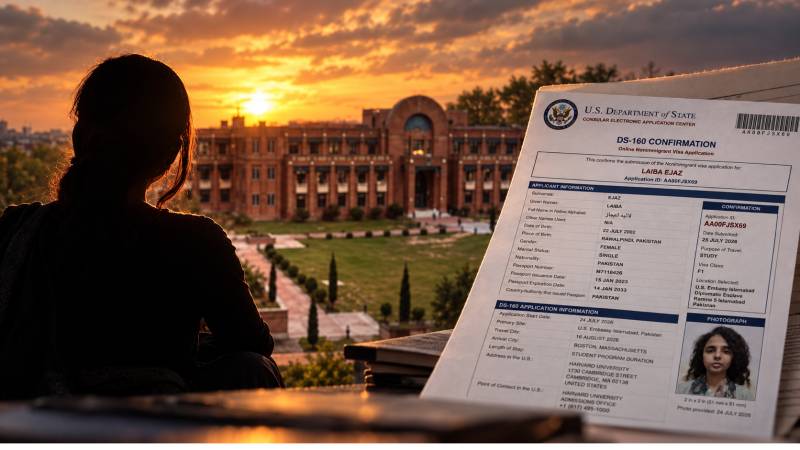
Laiba Ejaz's death raises an urgent question: why must students and their families bear the burden of detecting promises that may never have been genuine? By her relatives' account, Laiba Ejaz's family had little money to spare. Her father earned a living delivering milk by motorcycle; the family lived in a rented flat. Yet when their daughter, reportedly a gold medallist in physics at the International Islamic University Islamabad, hoped to study at Harvard, her father sold a plot of land and her mother pledged her jewellery. They wanted her to have a future they had never been able to afford.
In accounts given by her relatives, an education consultant allegedly promised admission and scholarship support, demanded Rs7 million and supplied documents the family later believed to be false. They say her father handed over Rs2.1 million from the land sale, although published accounts differ over the total paid. On 9 October, Laiba was found dead in Islamabad. Police are investigating, while the Federal Investigation Agency has reportedly contacted her family. Neither the alleged fraud nor the circumstances of her death have been conclusively established.
Her relatives also say she feared what learning of the alleged deception might do to her father. There is particular sorrow in that account. A young woman who may have been deceived was reportedly worried about protecting the father who had sacrificed so much for her. We cannot know everything she was carrying, or reduce her death to a single cause. But when dishonesty is alleged, we should examine the promises made before questioning the judgment of the person who believed them.
Why did she believe the consultant? Why did her parents pay? Why did no one check sooner? These are easy questions after the fact. But they risk turning an allegation of deception into an examination of the complainant. A gold medal does not teach someone to identify forged correspondence. The real questions are what was promised, what was known, and what was taken.
Pakistan was warned about this problem. In a 2023 advisory published by the Higher Education Commission, also reported at the time, HEC cautioned families against consultants promising guaranteed foreign admissions, scholarships and accelerated visas for exorbitant fees. The notice particularly concerned Central Asian destinations, but also urged direct verification with institutions and warned against large, untraceable payments.
Laiba Ejaz’s death raises urgent questions about alleged education fraud, the failure of existing warnings to protect vulnerable families, and the need for a system that verifies foreign university offers, investigates suspected deception and provides students with practical support.
The danger was already visible. A warning cannot authenticate an offer letter for a family. Students need practical help before their families pay. Consider one precise question raised by Laiba's case. Her family says the promised degree was an MS in physics at Harvard. Yet Harvard's Department of Physics states that it admits students to its PhD programme, not directly to a stand alone master's degree. Harvard's School of Engineering and Applied Sciences likewise does not offer direct admission to a standalone master's in Applied Physics, although such degrees may be awarded within other programmes. These rules do not establish what Laiba's documents said, let alone prove forgery. They do make the exact programme and origin of the letter essential questions. A university's name can be printed on a document. That does not mean the university issued it.
Investigators should obtain the actual documents, confirm their origin with the institution, preserve relevant communications and trace the payments. Social-media outrage cannot do that work. Nor should allegations against a consultant be turned into a definitive finding about responsibility for Laiba's death. Both the suspected deception and the circumstances of her death deserve evidence, not assumption.
Even Pakistan's criminal law recognises that cheating can cause more than financial loss. Section 415 of the Pakistan Penal Code covers deception that fraudulently or dishonestly induces delivery of property, or intentionally induces an act or omission causing, or likely to cause, harm to body, mind, reputation or property. Sections 420 and 468 address dishonest inducement to deliver property and forgery intended for cheating, respectively. Whether these offences occurred depends on proof of their legal requirements, including the requisite intent and, for forgery, a forged document. None of these provisions, on its own, establishes responsibility for Laiba's death.
Families reporting suspected fraud should not have to work out which agency can preserve digital evidence, investigate the alleged payments or pursue the money. Those are questions for the authorities to resolve, not additional obstacles for people asking for help. Taking notice of a complaint matters; so does ensuring that it reaches investigators who can act.
HEC could coordinate a low-cost pilot through university career offices, using existing student-support staff and one online request form. With students' consent, advisers could check offers through official university channels and record their status as confirmed, unverified or inconsistent. Consultants should disclose their identities, written fees and any claimed university affiliations; payments should be traceable. Suspected fraud should be referred promptly to investigators. None of this requires treating every consultant as a criminal or every foreign admission as suspicious. Honest advisers also benefit when false claims become easier to detect.
Students also need somewhere to go when a promise collapses. University counselling services should connect a distressed student to confidential emotional support and practical assistance in reporting suspected fraud. Recovering money and recovering confidence are different needs. Students deserve help with both, and reassurance that another person's alleged dishonesty is not their failure. Laiba's family deserves answers grounded in evidence, not a story written around what strangers imagine she felt in her final hours.
Her father sold a plot because he believed in his daughter. Nothing in that sacrifice made her responsible for another person's alleged dishonesty. If someone exploited that trust, the evidence must be followed and the law allowed to take its course. A family should not have to sell its land before discovering that a promised university place may never have existed. Laiba's family deserves answers. The next family deserves protection before it has to ask the same questions.