

An Indian journalist poignantly wrote on Facebook:
“You see a young Muslim boy killed ... You see a Maulana dragged off a train and beaten. … you watched a man in a skull cap being stopped, checked, questioned, then checked again. Not because of anything he did. Just because of what was sitting on his head. …
If you write about it, .... Doors just start closing ... You stop getting certain calls. You learn very quickly how much your livelihood depends on making the people around you comfortable, and how uncomfortable your truth makes them.
If you question the liberal silence, … you lose those people too. You start to understand that their solidarity was always conditional, …
So you learn to edit yourself. Constantly. Before you speak, before you post, before you even finish a thought, there is already another part of your brain measuring … What will this cost me.
You think about 1947. About the people who stayed, … who bet everything on the idea that belonging here was … worth it. You are not saying partition was the answer. … But you do think ... The constant proof of loyalty. …”
Several Indian commenters condescendingly downplayed his truth and revelled in Islamophobic tropes, blaming Muslims for their own predicament and for weaponising victimhood. There was no mention of Hindutva mob lynching and violence, or systemic housing discrimination and economic boycotts. One invoked the ghost of Jinnah:
“It was Mr. Jinnah who wanted to create a South Asian laboratory in the name of Islam ... Islam or Jinnah, choose wisely.”
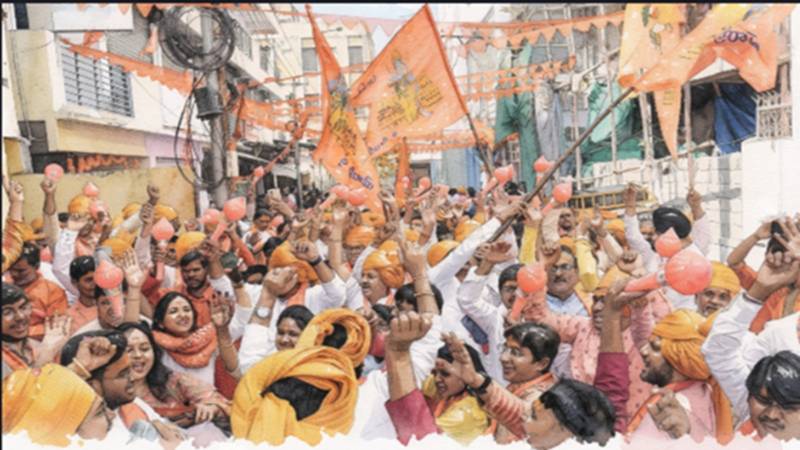
It becomes clear that Hindu nationalism or Hindutva is not specific to Modi and will not go away with him.
What is interesting is that these commenters seemed educated and did not resort to the usual “katmullah, madrassachap, bhikari, porki” name calling. They may not even have been BJP supporters. Although, they were bent on essentialising Muslims into their own caricatured mould. The analogy here would be of white nationalists who harbour racist tropes and blame black Americans for their own poor socio-economic predicament.
This majority with a minority complex has nothing but seething hatred for Muslims, sneering hubris against Pakistan and Bangladesh, and servile sycophancy in Israel
Both Hindu nationalists and white nationalists would be quick to downplay institutionalised casteism or racism by alluding to a Muslim or Black President. They wilfully remain oblivious to everyday discrimination in the housing and job market. Both reflect a stark lack of structural or systemic thinking. The difference is that while MAGA supporters are economically disenfranchised due to hyper-globalisation, Hindu nationalists come from the upward socially mobile class.
Large swathes of young, educated, privileged individuals and ideologues like J Sai Deepak and Anand Ranganathan, amongst others ascribe to this consciousness. To reiterate, Hindu nationalism is not bound to politicians like Modi, Yogi, or Shah.
It is an all-pervading sentiment that cuts across India, for Modi can only tap into what already resonates with the people. The fall of West Bengal to BJP was long overdue, as several Indians noted that Hindutva has finally come home.
Indeed, Bengali intellectuals, Nabagopal Mitra and Rajnarayan Basu wanted “an Aryan state or a Hindu Raj” as far back as 1887, long before the formation of the Muslim League in 1906. Bankimchandra Chattopadhya projected the killing of Muslims and the Hindutva state in his novels, and Aurobindo Ghosh opined “Hindu Rashtra was born along with Sanatana Dharma”.
This majority with a minority complex has nothing but seething hatred for Muslims, sneering hubris against Pakistan and Bangladesh, and servile sycophancy in Israel where they face discrimination despite expressing their unstinted support for the culling of Palestinians. The fact that educated former diplomats like Deepak Vohra and defence analysts can get away with openly promoting killing children or genocide without accountability is telling.
There is an element of Schadenfreude here, as evident from old Uncles who took their hatred with them as they immigrated to the West. Instead of bridging divides and bringing communities together, they end up playing trolls on social media and harass academics. Some have even engaged in obscene gestures justifying collective punishment.
Returning to Jinnah, the way India treats him only reflects how they blame the individual instead of questioning the systemic hierarchy and casteism that siphoned off a committed secularist. The tired tropes of ego and power do not work here.
Muslims of the subcontinent are not a monolith. This is as true today as it was in the age of Empires when Aurangzeb fought the Deccan Muslims or the Nizam opposed Tipu Sultan.
According to Dr. Shamsul Islam, many Muslims of the subcontinent are from regions where Buddhism took a stronghold. As Arundhati Roy states, they were Hindus who had opposed caste hierarchy. Thus, Muslims are not outsiders but made a conscious choice to elect their own path. They do not view land as mother but as a trust from Allah.
Partition was thrust upon Muslims, as the Indian Congress refused to share power with them. Muslim demand was that of a federation or confederation, not a moth-eaten state that was forced to build institutions from scratch. None of Jinnah’s 14 points or the Lahore Resolution hints of partition or an Islamic state. Why then must it be upon Muslims to assuage Hindu nationalists on their “loss of motherland”?
Hindu nationalists hate Muslims but claim what they call “POK”. But “POK” comes with more Muslims whom they would possibly tame by foisting the laws of Manu based on the prescription of their ideologue Golkwalkar:
“stay in the country, wholly subordinated to the Hindu nation, claiming nothing, deserving no privileges, far less any preferential treatment - not even citizen's rights”
Many Muslims reject this criterion, as Hindu nationalists even rail against the Bollywood Khans with their interfaith, secular lifestyles. It seems that the only Muslims they can tolerate are of the obsequious ilk but certainly not the secular Muslims who think for themselves like Jinnah.
To recapitulate, Hindu nationalism has always been simmering in India. Modi has simply removed the façade of secularism and made the covert consistent with the overt. Where Congress had secret ties with Israel, Modi openly embraces a genocidal regime.
What is more concerning is that the educated elite in India dehumanises Muslims and supports the Israeli genocide. Certainly, Hindutva is here to stay and will not leave with Modi. Dissenting voices like those of Ruchika Sharma, Lata Tauro, Rakhi Tripathi, or Kay Rated have a long way to go.