

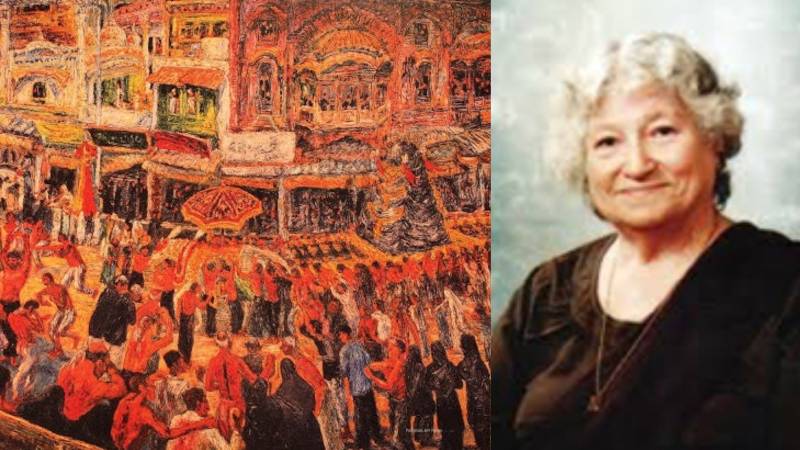
Anna Molka Ahmed’s life and career became inseparable from the cultural story of Lahore. Her arrival in British India at the end of the 1930s was not part of a carefully mapped plan; she later framed it as a sequence of events that felt propelled by forces beyond ordinary intention.
“Did I exercise my choice in coming here?” she asked, reflecting on the “strange fate” that had carried her from Europe into a new world. “I… end up here in the far-off city of Lahore and set up the Department of Fine Arts in the Punjab University. Who is pulling the strings and bringing about these accomplished facts or fait accompli?” That sense of destiny is useful not as a dramatic embellishment but as a key to how she understood her own movement from Europe to South Asia: she did not merely relocate; she was drawn into a city that would become the centre of her professional mission and personal reinvention.
To understand that reinvention, it helps to begin with her beginnings and the changes that preceded migration. Born in London in 1917 to Polish and Russian Jewish parents, she started as an outsider to the subcontinent’s social and cultural world. Yet the foundations of her later identity were laid early: at eighteen, she embraced Islam after a personal search for spiritual fulfilment, and in 1939 she married Sheikh Ahmed, a South Asian student in London.
That same yea,r she travelled with him to the subcontinent, arriving at a moment when global tensions were escalating, and old certainties were collapsing. By early 1940, at only twenty-two, she was living in Lahore, not yet as a cultural insider but already as someone prepared to build a life through work, belief, and commitment rather than through inherited belonging.
Once she arrived, the city’s limited art infrastructure unexpectedly became the opening through which she entered public life. At that time, formal art education in the region was modest, and the University of the Punjab was seeking someone to establish a fine arts programme. She stepped into this need decisively, and in 1940, she was selected to found and chair the Department of Fine Arts, becoming one of the earliest formally trained artists to lead an academic art programme in the region.
What is crucial here is not only the appointment but the conditions under which it began: there was no established syllabus, little staff support, and minimal equipment. Instead of treating this scarcity as a constraint, she treated it as a reason to invent, building a curriculum from scratch and shaping an environment where practical studio work, art history, and theory developed together rather than in isolation.
This educational approach mattered because it produced not only graduates but a new idea of artistic formation in the city. Rather than reproducing a rigid theory-first model, she kept students engaged through parallel learning streams that connected knowledge to practice.
Through seminars, instructional materials, and continuous advocacy, she helped position Lahore as a central node in the development of art education in Pakistan
Over the next thirty-four years, she led the department and trained generations of artists and teachers who later shaped Pakistani art education across institutions. Students such as Khalid Iqbal emerged from this orbit, and her classroom influence travelled far beyond the university. Recognition followed, including the Tamgha-i-Imtiaz in 1963, yet her larger achievement was structural: she helped transform a fragile academic possibility into a durable centre of artistic training that would continue to define the city’s cultural output long after her retirement.
Even so, her relationship with Lahore cannot be reduced to campus leadership, because she consistently treated art as a civic resource rather than a private specialisation. This wider commitment became especially urgent after Partition, when older cultural networks were disrupted and the city’s artistic ecosystem needed rebuilding.
Many artists, patrons, and public supporters connected to pre-1947 cultural life left amid upheaval, leaving institutional gaps and a sense of cultural interruption. In that setting, she helped create public platforms that normalised art as a shared social practice. She organised the first All Punjab Art Exhibitions at the university, opening participation to both professional and amateur artists and establishing habits of display, evaluation, and documentation that made the art scene more visible and more accountable to public life.
From this exhibition culture, her work moved naturally into institution-building across the city. In 1948, she joined other cultural figures to establish the Lahore Arts Council (Alhamra), strengthening a broader base for artistic learning and public participation. Under its auspices, she initiated evening art classes in the city centre, a project shaped by the belief that art education should not remain confined to elite academic spaces.
These classes gained additional cultural energy in a period when Faiz Ahmad Faiz served as the council’s secretary, and they brought together artists such as Naseem Qazi and Colin David in a shared effort to expand art teaching beyond university walls. Just as importantly, her outreach extended to children through regular sessions, reflecting her conviction that creativity should be cultivated early and without intimidation.
Her educational vision also reached schools and communities that rarely entered gallery culture. She introduced modern art lessons at Cathedral School and later at a village school in Hanjarwal on the outskirts, demonstrating that her idea of art was not only aesthetic but also social. One initiative was supported through assistance from teachers in Seattle, showing how she mobilised resources creatively when local support was limited.
Alongside teaching, she contributed to curriculum planning and teacher training by advising education boards and working toward integrating art into primary and middle schooling. Through seminars, instructional materials, and continuous advocacy, she helped position Lahore as a central node in the development of art education in Pakistan, not simply by producing artists but by building the wider educational conditions in which art could survive and grow.
Behind this public work, however, was a personal story shaped by risk and resilience, and it is here that her bond with Lahore becomes most human. Her marriage ended in divorce in 1951, and yet she chose to remain in the city with her two daughters. This decision is revealing because it shows that Lahore had become more than a temporary station linked to marriage or migration; it was now the place where she would make a future on her own terms.
Even after retiring from the university in 1977, she continued working intensively, painting prolifically in her home studio as canvases accumulated around her
She described that period without sentimentality: “Here I was, a foreign woman in a strange land, with no relations, no friends. There was no husband and no son on whose arm I could lean… I had to struggle and slog away against heavy odds.” The statement is not only personal testimony; it also clarifies why teaching, community work, and institution-building mattered so intensely, because they functioned as structures of survival as well as cultural contribution.
Over time, the city’s intellectual circles helped transform isolation into belonging. She found companionship among writers, educators, and journalists such as B.A. Hashmi, Sufi Ghulam Mustafa Tabassum, Rashid Ahmed, and M.D. Taseer, and these relationships anchored her socially while keeping her connected to the political and cultural pulse of the city.
At one point, the family lived in a modest flat above shops near the Mall, on the site where WAPDA House now stands, and the home became a space where visiting thinkers, artists, and writers circulated. In such settings, she was not merely residing in Lahore; she was participating in its living intellectual life, slowly turning the status of outsider into a more complex identity shaped by language, friendships, and everyday commitments.
This growing belonging also shaped how she approached art, though it is better understood through her orientation than through exhaustive discussion of individual paintings. She redirected attention toward lives and spaces that many regarded as ordinary, encouraging students and viewers to see dignity and meaning in the everyday world around them.
She often took students on sketching trips to villages outside the city, using outdoor observation as both technique and philosophy, and in doing so, trained a generation to treat their own surroundings as worthy of serious representation. Her response to the region’s intense light became emblematic of how place altered perception: “When I paint outdoors, it is always in sunshine… I get drunk with the sunshine.” Rather than functioning as a decorative remark, the line captures her sense that the environment itself could energise artistic practice, turning landscape and labour into sources of creative intensity.
At the same time, her work functioned as a witness during moments of collective rupture. In 1947, when Partition brought violence and mass displacement, she made visual records of refugees and their suffering, contributing to early documentation of the human cost of that historical break.
In later decades, when floods, wars, and political tensions shaped public life, she repeatedly returned to the role of observer, recording hardship and resilience as part of the social reality she lived within. As she grew older, her themes expanded toward allegory and existential reflection, addressing violence, hunger, mortality, and social injustice, yet these concerns did not float above experience; they emerged from the anxieties, memories, and pressures of the society around her, and from the city’s own long familiarity with upheaval.
By the time she died in 1994 at the age of seventy-six, Lahore’s art world bore the imprint of her long presence in ways that were institutional, educational, and cultural. Her legacy can be traced first in the transformation of art education, because the department she founded trained generations of artists and educators whose influence continues through schools, curricula, and galleries.
It can be traced second in public cultural life, because exhibitions, councils, classes, and outreach efforts helped normalise art as part of civic culture rather than as a marginal pursuit. It can be traced third in an artistic record shaped by empathy and moral seriousness, one that engaged ordinary lives and historical pain without abandoning the need for creative force.
Even after retiring from the university in 1977, she continued working intensively, painting prolifically in her home studio as canvases accumulated around her. Her creative restlessness never faded, and she captured that quality in her own words when she reflected that she “was born with a restless soul,” always searching for purpose.
In Lahore, that search found direction and form. If fate brought her to the city, it was her discipline and courage that turned arrival into belonging, and belonging into legacy; through decades of teaching, building, and witnessing, she did not only live in Lahore—she helped shape how its cultural memory learned to see itself.