

“Remove all the traffic lights, yellow lines, one-way systems and road markings, and let blissful anarchy prevail. I imagine it would produce a kind of harmony” — Sadie Jones
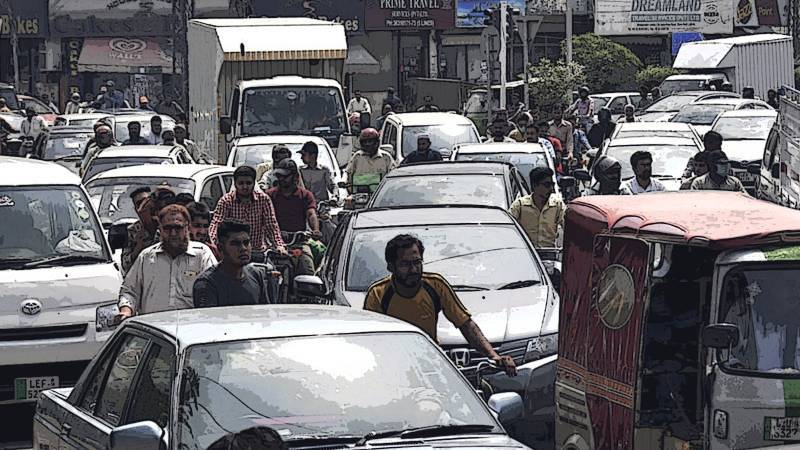
One cannot but commend the Government of Punjab in its attempts to streamline traffic in its beautiful capital, Lahore. Already the city has a vast network of urban multilane motorways, signal-free corridors, traffic signals, overheads, underpasses and of course a voluminous flow of motor vehicles of all kinds — from heavy loaders and buses to motorbikes, bicycles and now the infamous Qingqi that seem to be rapidly growing in number daily. These can be found everywhere on the roads and even without regular number plates or lights, stopping at whichever turn they like and showing no remorse when confronted.
There is a lot of talk about the rule of law, but as far as implementation is concerned, apparently not much is being done, and efforts are mostly directed to nab the weaker segments of society while the powerful ones are conveniently ignored or spared. Some time back, when our present prime minister was Chief Minister of Punjab, he had vowed to punish vehicle owners using non-prescribed number plates. These remained just dares because one can still see all kinds of number plates displayed on both commercial and private vehicles plying on the roads and right under the noses of traffic wardens.
Amazingly, legislators think that by sitting in assemblies and amending laws through different Acts, a revolution in obedience overnight would take place, and everything would become orderly. Laws not only need to be understood by the general public but should also live in their minds and hearts. Sincere implementation should be visible across all segments of society, and people must acknowledge that they alone are not being targeted while those in command get away with exercising their power or by showering their wealth to avoid accountability.
Recently, the existing Punjab traffic laws have undergone changes whereby not only penalties for different violations have been increased significantly, but the concept of First Information Reports (FIRs) has also been introduced to ensure that serious crimes cannot be atoned for by mere payment of money, but the perpetrators actually learn a good lesson. Instances such as underage driving, driving without a license, and offenders found repeatedly committing the same mistakes would be handled with greater severity by imposing heavy fines along with a specified period of imprisonment. Vehicles can also be impounded in certain cases.
Fines introduced are between Rs. 2,000 to Rs. 20,000 for overspeeding, Rs. 2,000 to Rs. 15,000 for violating traffic signals, driving the wrong way or overloading, Rs. 3,000 to Rs. 15,000 for rash driving, plus a 4-point deduction for all these transgressions. Additionally, using pressure horns is likely to attract a penalty of Rs. 2,000 to Rs. 10,000 plus a deduction of 2 points. It may be mentioned here that earlier these fines were in a few hundred which have now gone up to thousands in terms of rupees.
Penalties must commence with the powerful. A few should be made examples that are highlighted at a massive level
Besides pecuniary measures, there are some to-do and not-to-do items on the agenda, such as making it mandatory for marriage halls to arrange sufficient parking space, banning motorcycle rickshaws on specific Lahore roads and taking action against smoke-emitting vehicles. These are indeed wise steps that should have been taken many decades back, but still, better late than never. However, and unfortunately, a lot is lacking when it comes to enforcement and practical implications.
Occasions are very few and can easily be recalled when some die-hard law enforcement personnel can be seen in action on the city roads, including the motorways. The general trend depicts a sordid state of affairs when it comes to ensuring that commuters behave responsibly, ensure safety while driving and take particular care of pedestrians as well as bicycle riders. Using mobiles and texting while driving has become a normal routine.
Although zero tolerance is being claimed, other than a few arteries, one can experience violations of all sorts on the urban streets and roads. In the majority of cases, drivers seem either ignorant or absolutely callous with regard to maintaining lanes and respecting right of way.
Issuing licences without proper tests is, by itself, a crime as it endorses recklessness and encourages accidents. Parents who allow their underage children to drive should also be convicted. A case in point is that of a 14-year-old teenager who caused the death of six members of a family in Lahore, and another involving a high court judge’s son that occurred in Islamabad.
When ordinary folk witness that the powerful escape conviction, a sense of defiance seeps into the minds of the younger lot, especially motorcyclists, rickshaw drivers and untrained drivers of private vehicles. Regrettably, the targeted members of the public are mostly the impoverished being nabbed for not wearing helmets. Labourers who barely make Rs. 1,000 a day find it impossible to pay a fine of Rs. 2,000, while owners of luxury vehicles shamelessly defying all norms of traffic easily get away. Sometimes, even traffic wardens are found in breach of rules, especially when they are not in pursuit.
If there is one hundred percent sincerity in implementation, then a few things need to be kept in mind. Penalties must commence with the powerful. A few should be made examples that are highlighted at a massive level. This would automatically deter the public from flouting laws.
FIRs for defying one-way should include Section 302 of the Pakistan Penal Code, as this is a blatant attempt to put at risk many human lives. Accidents on account of traffic violations captured on CCTV should be displayed throughout the length and breadth of the province.
Intentions may be good, but unless these are reflected in practice, they are meaningless. The Inspector General of Traffic must appear in the media to emphasise the importance of discipline on the roads. Instructions regarding common traffic rules should be given from time to time for which TV channels can be used, specifically during prime time and in between popular programmes.