

The debate over new provinces has resurfaced amid a deepening crisis of credibility in Pakistan’s political system—and it is not unfolding in a political vacuum. Fifteen years after the 18th Amendment transferred major responsibilities for education, health and other public services to the provinces, and the 7th NFC Award substantially increased their share of federal revenues, the state still performs poorly across many basic functions. Against this record, Interior Minister Mohsin Naqvi’s call for new provinces appears to be an intervention in the country’s balance of power: one that could weaken the territorial strongholds of the PML-N and PPP, revive demands for new political units and shift public anger away from the establishment’s own policy failures towards provincial governments and elected politicians.
That political factors do not by themselves invalidate the case for smaller provinces; in some circumstances, they may improve representation and administration. But it does demand greater scrutiny of the proposed cure. Before Pakistan redraws its constitutional map, the more fundamental question is what the existing provinces have delivered with the powers and resources they already possess. Their record since devolution provides a more meaningful test of the country’s political system than political rhetoric, inflated development budgets or the promise of administrative redesign.
The test of devolution should be outcomes, not political or constitutional rhetoric. Fifteen years on, the record is mixed. It is tempting to blame the establishment for the failures of politicians and the political process, but that cannot absolve the two parties that have dominated provincial government for most of this period: the PML-N in Punjab and the PPP in Sindh. As provincial budgets soared, political elites accumulated fortunes while basic public services remained far below what Pakistan's resources should have delivered. One can reasonably argue that Punjab, under successive PML-N governments, has performed better than Sindh under the PPP, particularly on literacy, enrolment and immunisation. But even Punjab's record, viewed on its own rather than against Sindh, leaves much to be desired: in 2024–25, 21% of children aged 5–16 were still out of school, while literacy was only 68%. The gains elsewhere have been even weaker and, in some cases, barely perceptible. There has been genuine progress most notably in immunisation and, in some provinces, literacy and school participation—but not on a scale that can credibly be described as a transformation in provincial state capacity.
The record since devolution provides a more meaningful test of the country's political system than political rhetoric, inflated development budgets or the promise of administrative redesign.
The evidence is encouraging, but not impressive, in education. Between 2011–12 and 2024–25, literacy among people aged 10 and above rose from 60% to 68% in Punjab, from 52% to 58% in KP and from 46% to 49% in Balochistan; in Sindh it fell from 60% to 58%. More strikingly, the primary net enrolment rate for children aged 5–9 did not improve: it fell in Punjab from 64% to 62%, in KP from 53% to 50%, and in Balochistan from 39% to 32%, while Sindh remained at 50%.
The out-of-school measure requires a different baseline because the 2011–12 survey is not cleanly comparable with the later 5–16 series. Using 2013–14 as the baseline, the proportion of children aged 5–16 out of school fell from 27% to 21% in Punjab, 44% to 39% in Sindh, 32% to 28% in KP (excluding merged areas in the earlier observation), and 59% to 45% in Balochistan. This is meaningful progress, particularly in Balochistan, but the levels remain extraordinarily high.
Fiscal devolution has produced a different problem. In FY2024–25, the four provinces budgeted about Rs1.20 trillion in own provincial taxes, against Rs7.24 trillion as their share of federal taxes. Own provincial taxes represented only about 12.6% of total provincial revenues of Rs9.53 trillion. Provincial governments therefore control major expenditure responsibilities while remaining heavily dependent on revenues collected by the federation. That weakens the tax–accountability link that is central to effective fiscal federalism.
The evidence does not prove that the 18th Amendment caused poor outcomes. Nor does it justify reversing devolution. It does, however, challenge the assumption that transferring authority and money to provincial capitals automatically produces better government. The central failure is institutional: Pakistan has decentralized authority without building sufficiently strong provincial and local systems of accountability, revenue mobilisation and service delivery.
Fifteen years on, the record is mixed. It is tempting to blame the establishment for the failures of politicians and the political process, but that cannot absolve the two parties that have dominated provincial government for most of this period.
The scorecard
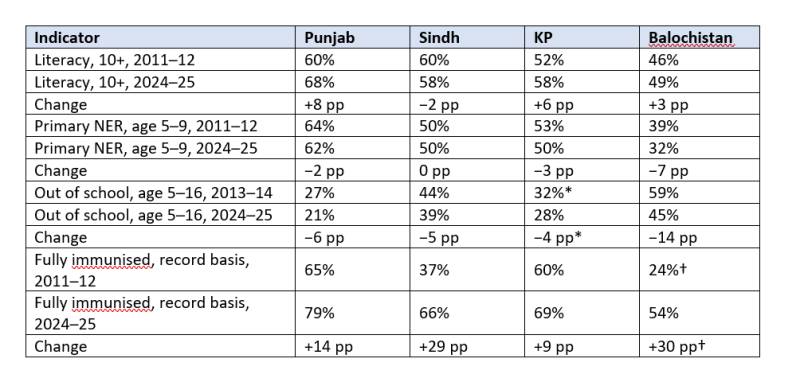
The 2013–14 KP figure covers KP excluding the then-merged areas; the 2024–25 figure covers KP as constituted after merger. The 2011–12 Balochistan estimate is explicitly cautioned by PBS because 57 areas could not be covered for security reasons. Immunisation is also not a perfectly like-for-like time series because the antigen schedule and survey definitions changed.
Literacy: progress, but not transformation
The literacy data are among the cleanest long-run provincial comparisons available from PBS. The national rate rose from 58% in 2011–12 to 63% in 2024–25. At provincial level, Punjab improved by eight percentage points and KP by six. Balochistan gained only three points, while Sindh's rate was two points lower.
The more important point is the level. In 2024–25, literacy was 68% in Punjab, 58% in Sindh, 58% in KP and 49% in Balochistan. Female literacy was only 62%, 47%, 43% and 31%, respectively. The gender and provincial gaps are too large to describe Pakistan's post-devolution education performance as a structural success.
The World Bank reaches a similar conclusion from a broader human-capital perspective: Pakistan's human capital has improved only marginally over the past three decades, with inequalities persisting among provinces, genders and income groups. Its Human Capital Index is 0.41, below the South Asian average of 0.48.
Primary enrolment: the most uncomfortable result
Primary net enrolment is particularly revealing because PBS provides the same 5–9 age definition for 2011–12 and 2024–25. On this measure, the record is not one of steady improvement.
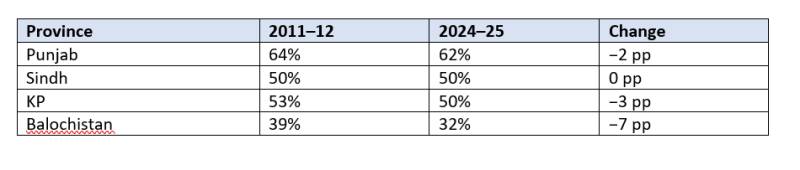
This does not mean fewer children are attending school in absolute numbers. Population growth and changes in the age structure matter. Nor should the indicator be read in isolation from delayed school entry and over-age enrolment. But as a measure of whether children of the official primary age are enrolled at the appropriate level, it is difficult to call the post-2010 record satisfactory.
The result is especially striking in Balochistan: its primary NER was 39% in 2011–12 and 32% in 2024–25. The province remains trapped at a level of basic educational access that is incompatible with rapid human-capital development.
Out-of-school children: progress, but from a very low base
The out-of-school indicator needs methodological care. The cleanest comparable 5–16 series begins in 2013–14, rather than 2011–12. The later PBS series shows genuine progress.
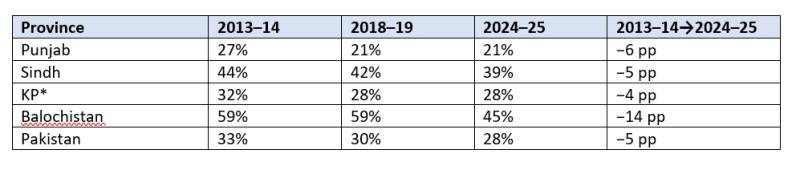
Balochistan's improvement is substantial and should be acknowledged. But 45% of children aged 5–16 still remain out of school there. Sindh remains at 39%, while Punjab, the strongest performer still has 21% outside school. The latest HIES also shows a pronounced gender gap: 52% of girls aged 5–16 are out of school in Balochistan, 37% in KP and 44% in Sindh.
The 2013–14 KP observation excludes the merged areas; the 2024–25 figure includes them. This makes the long-run KP comparison less exact than Punjab, Sindh and Balochistan.
Health: real progress, but not a clean long-run series
Health is harder to evaluate than education because some provincial health indicators have changed definitions or reference periods. Immunisation nevertheless provides useful evidence of administrative progress.
On the PBS record-based measure of full immunisation among children aged 12–23 months, Punjab rose from 65% in 2011–12 to 79% in 2024–25; Sindh from 37% to 66%; KP from 60% to 69%; and Balochistan from 24% to 54%. The gains in Sindh and Balochistan are substantial. These numbers should not be over-interpreted as a perfectly comparable time series: the vaccination schedule and survey definition changed between the two periods, and PBS cautions that the 2011–12 Balochistan sample was incomplete. The right conclusion is therefore modest: provincial health administration has achieved some important gains, but the country remains far from closing its large provincial disparities.
The broader evidence is consistent with this caution. The World Bank estimates that nearly 40% of Pakistani children under five remain stunted, a rate it describes as having remained stagnant for decades. It also places Pakistan's Human Capital Index at only 0.41.
Fiscal devolution: more money, weak own-revenue capacity
But the provinces have developed only limited capacity to finance those responsibilities from their own taxes.
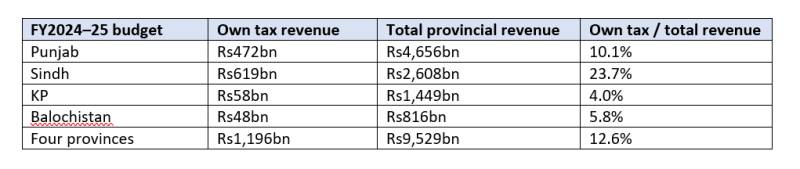
The provinces’ budgeted own taxes of about Rs1.20 trillion were dwarfed by their roughly Rs7.24 trillion share of federal taxes. The dependence is particularly stark in KP and Balochistan, where own taxes amounted to only 4% and 6% respectively of total provincial revenues. This is not simply a problem of the amount of money available; it is a problem of the weak link between taxation, accountability and service delivery.
This is not an argument for forcing poor provinces to become financially self-sufficient. Fiscal equalisation is necessary in any federation. The problem is the absence of a stronger tax–service–accountability relationship. A province that raises very little of the money it spends has weaker incentives to build a broad tax base and stronger incentives to compete for transfers.
What the evidence does and does not prove
It would be wrong to attribute every outcome to the 18th Amendment. Education and health outcomes are affected by poverty, demographics, security conditions, migration, federal programmes, natural disasters and differences in provincial starting points. The 2024–25 HIES also uses a sampling frame updated from the 2023 Census, so minor changes should not be treated as exact causal estimates. Nor is the evidence a case for recentralisation. The provinces have legitimate constitutional responsibilities and local knowledge matters. The better inference is that devolution of functions must be accompanied by devolution of accountability and by stronger institutions. The most serious omission is local government. Education, primary healthcare, sanitation, policing and many other services ultimately depend on institutions below the provincial level. Pakistan has repeatedly devolved power from Islamabad to provincial capitals without creating consistently empowered, elected and fiscally responsible local governments.
Implications for the debate over new provinces
The provincial scorecard should make us cautious about treating the creation of additional provinces as a substitute for institutional reform. New administrative units could improve representation or make administration more manageable in particular circumstances, but they do not automatically create better schools, hospitals, police forces, tax systems or local governments. Pakistan's experience since 2010 suggests that the central problem is not simply the location of political power. It is the quality of the institutions that exercise it. More provinces without stronger accountability could produce more ministers, secretariats and patronage networks without materially changing service delivery.
The strongest conclusion from the data is therefore this: Pakistan has decentralised authority faster than it has built state capacity. The next phase of reform should focus less on drawing new provincial boundaries and more on building capacity, measurable outcomes, provincial revenue mobilisation, professional administration and genuinely empowered local government.