

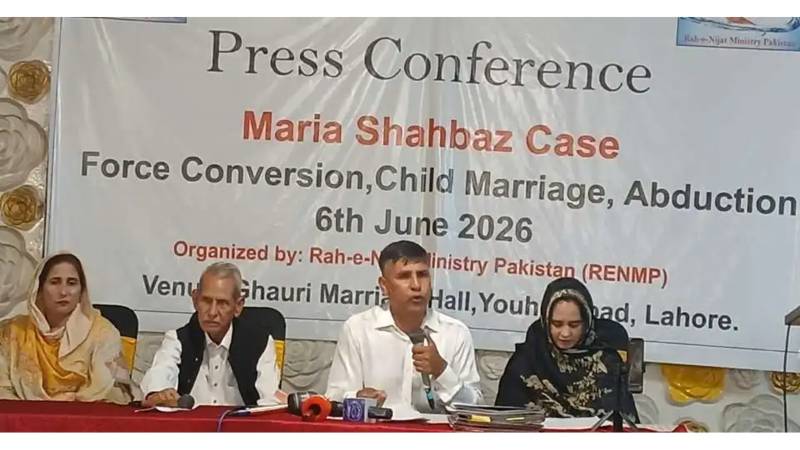
In March 2026, Pakistan's courts upheld the marriage of a thirteen-year-old Christian girl, following her family's allegation that she had been abducted and forcibly converted. The ruling brought Catholic bishops onto the streets, drew condemnation from rights groups across the country, and forced a Provincial Assembly that had spent six years avoiding this exact question to finally move. I wish I could say I was surprised.
In 2020, I led the design of a Punjab government policy called Harmonious, Tolerant and Safe Punjab for Everyone—built, at the direction of the Ministry of Human Rights, Minority Affairs and Interfaith Harmony, through twenty consultation sessions with religious scholars from every faith, legislators from every party, lawyers, journalists, chambers of commerce, and ordinary citizens who rarely find themselves in the same room. It remains one of the most inclusive policy exercises Punjab has attempted.
Its most urgent finding was not complicated. The Human Rights Commission of Pakistan had already documented a pattern we could not ignore: minor girls from Christian and Hindu families, some as young as twelve, being abducted, converted, and married off—with the country's legal system offering them almost no protection, because Pakistan had no law specifically criminalising forced conversion. We recommended, as our first priority, that such a law be passed without delay.
Pakistan has become remarkably skilled at producing the right diagnosis, and remarkably slow at acting on it—a pattern I have now watched repeat across governance sectors
It was not passed. A similar bill had already failed in 2016 and 2019. Ours joined the list in 2020, rejected by the Punjab Assembly's own Standing Committee on Religious Affairs. A federal version was dismissed the following year, after objections from the Council of Islamic Ideology. Between 2021 and 2024, independent monitors recorded 421 further forced conversion cases nationally—seven in ten of them involving minors. In Punjab alone, one rights organisation documented 83 cases involving Christian girls in 2024 alone.
And then, this March, a court in Lahore ruled that a thirteen-year-old's marriage—to a man in his thirties, following her family's allegation of abduction—was legally valid.
I do not write this to claim vindication. A policy that correctly identifies a danger and is then ignored for six years is not a success story. It is, at best, a warning that went unheeded until a child paid the price the warning was meant to prevent. If there is a lesson in this, it is not that I was right. It is that Pakistan has become remarkably skilled at producing the right diagnosis, and remarkably slow at acting on it—a pattern I have now watched repeat across governance sectors far beyond this one.
What finally moved the issue was not our policy, not the earlier bills, not six years of documented cases. It was a single, highly publicised individual tragedy, amplified into a national controversy large enough that avoiding the question became more costly than confronting it. The Punjab Assembly is now advancing a Protection of the Rights of Religious Minorities Bill and a Child Marriage Restraint Bill—raising the marriage age to eighteen for both sexes—that mirror, in substance, recommendations we made in 2020. Even the National Commission for Minorities Rights, passed by Parliament in December, was stripped of its power to investigate cases on its own initiative before it was allowed to pass—a body created to protect minorities, deliberately built without the authority to act.
This is worth sitting with, because it is not really a story about one court case, or even about religious minorities specifically. It is a story about how Pakistan makes and unmakes its own protections. We are, if anything, good at the diagnostic work—gathering the evidence, consulting the right people, writing the policy. What we are not good at is the harder, less glamorous task of building the political will to act on what we already know, before the cost of inaction becomes a headline.
I do not think the twenty consultation sessions we held in 2020 were wasted. They produced a document that, six years later, the Assembly is quietly drawing from. Legitimacy built through genuine consultation does not disappear when a policy is shelved; it waits, and sometimes it is drawn on when the moment finally arrives. But I would be lying if I said that was good enough. A thirteen-year-old should not have to become a national controversy before the protections her country already knew she needed were finally written into law.
If Punjab's new bills pass this time, they will owe something to the case that forced the issue—and to the years of documentation, by human rights monitors and by policy processes like ours, that made clear this crisis was never hidden, only unaddressed. The next test is whether the province can build the institutions to enforce these laws once passed, rather than letting them join the shelf of good intentions that Pakistani governance too often produces. We know, by now, exactly what that shelf looks like. It is past time we stopped adding to it.