

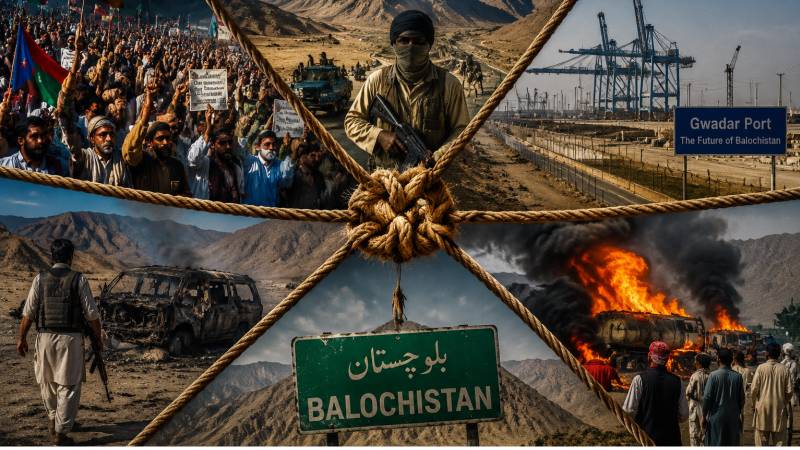
The recent Baloch strife is begotten out of the decades long neglect of the periphery by the core in Pakistan. The aetiology of the present strife features six insurgencies, each one of those emanating out of a set of grievances that were context dependent but had a common thread i.e a sense of alienation from the core. The lack of attention on peripheries and the consequent lack of legitimacy of the core in the eyes of the people of the periphery, lies at the heart of all previous Baloch uprisings.
After each uprising in the past the core treated the issue with placebo solutions and the expedient politics, that were convenient yet unsustainable, especially considering the fact that those solutions failed to integrate the peripheries into the core of Pakistan through an inclusive political process. Like all societies in transition, the Baloch society is also facing the sociological cross currents of that transition, resulting in a class conflict between the old political elite and the educated middle class, having a large politically conscious young demographic cohort. In this conflict between a dying and an emerging order, the role of the state and its institutions is being viewed negatively by political stakeholders in Balochistan.
First, let us have a look at the grievances of the Baloch people. The tribal elite whose interests were being best served by the old system of privileges is unhappy at the erosion of their power. Some of the Sardars have taken recourse to sub nationalism and even separatism (Harbiyar Marri, Brahamdagh Bugti, and Javed Mengal). The old guard of the elite like Ghais Baksh Bizenjo, Attaullah Mengal, Khair Baksh Marri and Akbar Bugti had their own reasons to be disaffected in the past, some of those genuine and some not so genuine.
The common people and the middle class also became estranged due to apathy of the state and the repression of the Sardars. The middle class manifested its disaffection through militant organizations like Majeed Brigade of BLA and Dr Allah Nazar’s BLF. The anger at political marginalization and socio-economic deprivations acted as a catalyst for the separatist tendencies in the Makran belt and the adjoining areas. All of the above was facilitated by the new great game in Balochistan, where the external forces competed for their geopolitical interests, to keep the province destabilized and under developed.
The people of Balochistan have genuine grievances and the state is keen to ameliorate those concerns. The problem is the stultifying hold of the political elite that does not wish to part with its privileges and the benefits accruing from an unequal social order. The political elite that had thrived on an eco system of organized crime and patronage wishes to perpetuate the existing socio-economic inequalities. The state is facing problems in mediating between the two orders while the pitch is being queered by external meddling. The main grievances of the disaffected population stem from bad governance, corruption, and the political disempowerment.
While Balochistan itself constitutes the periphery within the core-periphery matrix of Pakistan, the periphery regions within Balochistan feel politically disempowered and disenfranchised. Despite impressive per capita PSDP spending of Rs 75000 compared to Rs 45000 of Punjab, the past neglect is still weighing hard on the public psyche. The misappropriation of the development funds and doling out of government jobs on political considerations in the past, have completely frustrated the young cohort of the population. The development and connectivity are being promoted by the present government but the distrust engendered due to past mal governance and corruption is failing to subside.
Though on the development front the state has made sincere efforts, there are still functional deficits in the public service delivery and the infrastructure, that are fuelling public anger. While there is no doubt that the number of facilities has gone up significantly in the province but their impact is open to debate. It is worth pondering that why despite the annual training of 10800 IT students through 65 IT hubs, the availability of 1635 health facilities compared to merely 9 in 1947, and 15365 educational institutions compared to just 114 in 1947, the people are still dissatisfied? It is worth questioning as to why the Maulana Hidayat ur Rehman’s Haq Do Tehreek is clamouring for fishing rights in the presence of a Rs 1.4 billion budget of shrimp farming, fish processing and capacity enhancement of local fishermen?
The problem is the stultifying hold of the political elite that does not wish to part with its privileges and the benefits accruing from an unequal social order.
It is also worth determining that what benefits have the 24443 kms of roads brought to the people compared to the 375 kms of road stretch in 1947? One of the stumbling blocks to the public satisfaction is sense of political disempowerment. The first reason for above is the absence of a functioning and empowered local governance system. After 18th amendment the provinces have appropriated all the powers, without devolving those to the district level. The second reason is the perception in the peripheries of Balochistan that the national and provincial assembly elections have not thrown up public representatives that could effectively articulate their concerns at the relevant decision-making fora.
It is because of the above reasons that the government’s sincere efforts at development and local engagement are not eliciting an enthusiastic response from the people. The people are questioning the legitimacy of those who are being allocated the development funds including the civil servants. Despite the transparency and fairness in the spending of the development funds, the people are questioning the legitimacy of those charged with spending those funds. Similar is the case of public engagement. Despite an impressive engagement frequency of 30000 meetings in 2026 alone (144 engagements per day) and the resolution of 51% issues, the people feel that their trusted political representatives should have taken the lead in those engagements.
The public ennui and the frustration therefore stem from a feeling of powerlessness and a perception that they lack agency over their social, political and economic issues in the absence of an effective local government system and trustworthy political representatives. Though the state institutions have rendered a yeoman’s service in tackling the eco system of crime and illegality head on, still several challenges remain. The numerous stakeholders that were benefiting from that eco system of crime have all ganged up to create problems for the government and the LEAs.
So far in 2026, Rs 25 billion worth of smuggling attempts have been foiled by the LEAs while Rs17.4 billion worth of narcotics/ smuggling has been prevented. The fuel smuggling that had peaked in 2023 i(25 million litres/day) has been brought down to 1.1 million in 2026. However, there is a need to create a system of alternative livelihood for the people in order to permanently address the issue of smuggling. The state’s inability to connect to the people was a consequence of a decade long policy of relying on the political elite and Sardars who had perfected the art of milking the state and keeping the people in bondage. The result was a public revulsion against the government while the political elite appropriated all the perks.
Now when the state has adopted a strategy of connecting with the people, the political elite is naturally livid. The main challenge before the state, however, is the legitimacy of the channels for the delivery of public goods and the political power. The best vehicle for delivery of above is the political institutions, especially at local level led by genuine public representatives, in the absence of which the development and governance efforts would lack public ownership.
While the state grapples with the governance and political challenges, the fraught security situation demands a strong kinetic response with full participation of the people. Already in 2026, the terrorists have caused precious loss of 178 civilian lives in addition to 55 abductions, 24 bridge destructions, 60 arson incidents and 47 incidents of property damage. The above situation calls for a vey focused and aggressive kinetic response. While the capacity building of police takes time the FC and army would need to act as early responders to shore up the morale of the police.
The narrative front also has to be properly guarded through an effective rebuttal and fact check mechanism. At present, 300 Indian websites and 1000 social media accounts are proliferating the fake news and propaganda content created by their local proxies in Balochistan. The rights-based movements like BYC need to be monitored and engaged, to wean these away from the external actors. The emotive issue of missing persons should be tackled sensitively while disseminating the correct facts. The exaggerated figures quoted by the social media accounts, mostly operating from India need to be challenged on both epistemic and legal fronts.
The federal Commission of Inquiry on Enforced Disappearances had only 2933 reported cases from Balochistan, out of which 2766 have been disposed off, while only 166 remain pending. Several of the missing persons are frequently found amongst the dead and wounded of the terrorist entities like BLA and BLF, indicating the use of propaganda as a tool in the terror toolkit. The epistemic reach of the propaganda and its cross-border linkages need to be curtailed through an equally effective narrative campaign. But before the above is done, the state has to stitch up the holes in its political engagement, governance, and local ownership strategy. Only an unexploitable inner front, supported by a population solidly behind the state can defeat the machinations of the external actors and their internal allies.