


“Traveling—it leaves you speechless, then turns you into a storyteller.” (Ibn Battuta)
Most of us get exposed to world events by following the news on our phones and on TV and by reading newspapers. Those who have taken classes in geography, politics and history somewhere in high school or college or university will have a deeper understanding of world events.
But all of that is second-hand knowledge. It provides some insight into how the world works. There is no doubt that a well-educated person is going to be in a better position to understand world events than a person who never took the time to educate themselves.
But that second-hand knowledge pales in comparison to the first-hand knowledge one gains by traveling to the places that one has encountered in the classroom or in the news. When you travel, you see firsthand how the world works. It’s a very enriching experience and worth the time and money.
In the early 1960s, we lived in Sukkur. I attended St Mary’s High School and read about the world in several of my classes. But it was all a bit abstract. I learned a lot more when I travelled throughout Sindh and Balochistan with my father. It was part of his job and often he would take me with him when school was off. I got to see forts, temples, gardens, mountains and rivers that I had read about in my books. History came to life. I also saw how much variety there was between Sind and Balochistan and even within the two provinces in terms of language, cuisine and dress.
We lived near the gigantic Sukkur Barrage and even though that was never mentioned in my books, I learned how hydrology worked. The Ayub Bridge was not that far away and I saw first-hand how a suspension bridge differed from a traditional bridge, which was the case with the nearby Lansdowne bridge. On a field trip with my troop of cub scouts, we marched to the Ayub Bridge. When we got to the entrance, we were asked to break up our march and just walk across the bridge to avoid generating unstable vibrations that might damage the bridge.
Be prepared for the unexpected. Sometimes things go awry and the traveller discovers that a particular adventure may not be worth repeating
One day, my father took me to Sadh Belo island in the middle of the Indus River. A Hindu temple was located there. It had an inscription at the entrance which I could not read because it was written in a different script. I asked, “What does it say?” He read it out and I was amazed that I understood every word. I asked, “Did you translate it for me?” He said, no, I just read it as it is written. That’s when I discovered that Hindi and Urdu were (almost) the same language, but the former was written in the Devanagari script and the latter in the Persian script.
In 1974, I came to the US for higher studies. I had been reading TIME, Life and the Readers Digest regularly for years and had seen many American movies. I thought I knew the US. But what I discovered was an America that was quite different. There was a lot of diversity across the 50 states and the district of Columbia. Indeed, there was a lot of diversity even within states and even within cities.
I have had the good fortune of traveling to three dozen countries on six continents, beyond the two in which I have lived for the past seven decades. All these countries account for 44% of the world’s population.
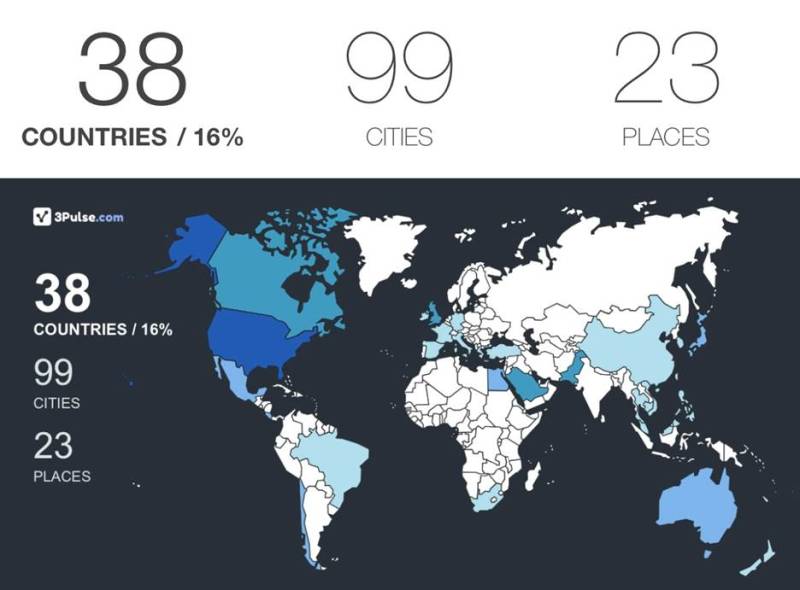
I have learned a lot from my travels. These lessons stand out. First, I learned to respect diversity among humans. I encountered people who spoke English with a different accent and a different vocabulary, people who spoke an entirely different language, people who dressed differently, people who ate differently, people with different political views, and people with different religions. All deserved my respect. There was no reason to denigrate those who differed from me physically or culturally.
Second, I saw first-hand the physical and climatic differences across the continents that I had read about in my geography classes. I saw the canyons, cliffs, mountains and lakes whose pictures I had seen in books. I saw geysers in the High Andes in Chile and the Grand Canyon in Arizona. I saw the Iguazu Falls in Brazil and the Niagara Falls in Canada.
Third, I got to see firsthand the archaeological sites like "Mohenjo Daro" in Pakistan, which has the ruins of the great Indus Valley Civilisation that existed five millennia ago in the Bronze Age. Mohenjo Daro kindled my interest in archaeology. Standing in front of the Pyramids at Giza in Egypt took it to another level.
Fourth, I encountered history as I saw castles and palaces that were built centuries ago and pondered over the good and bad events that had happened there. Touring the gigantic Topkapi Palace in Istanbul was an unforgettable experience, as was touring the Tower of London.
Fifth, I learned how to talk to strangers -- on the streets, in restaurants, in grocery and retail stores, and on the plane. In fact, I learned more by talking to strangers about history and culture than I had ever imagined. For example, discussing Napoleon with a Frenchman while riding a bus in Turkey brought the emperor back to life more vividly than reading history. I ran into celebrities now and then: the Queen of Spain at Grande Bretagne in Athens, a former prime minister of Japan on a flight, General Yahya Khan at the VIP Lounge at the Karachi airport, Prime Minister Zulfiqar Ali Bhutto in the VIP ward of a hospital in Karachi, and Governor Jerry Brown at a wedding in San Francisco. During a taxi ride in Manila, I drove by a military academy and saw President Fidel Ramos speaking to the graduates.
Sixth, I saw how people used energy very differently, how energy prices differed not just across continents but also within countries in the same continent, and how they differed even across states in the US and even within states, how appliances varied in size and how regulations differed from country to country.
And, seventh, traveling is always an adventure, even when it is routine. The traveller has fascinating encounters. But be prepared for the unexpected. Sometimes things go awry and the traveller discovers that a particular adventure may not be worth repeating.
All in all, traveling is a net positive. Mark Twain put it best, “Travel is fatal to prejudice, bigotry, and narrow-mindedness.”
Several of my travels are memorialised here.